Alabama Cannabis Farmers Seek a Fair Shot as State Drafts Medical Marijuana Rules
Independent Alabama cannabis farmers fear big out-of-state operators will dominate licenses as the state drafts cultivation rules for medical marijuana.
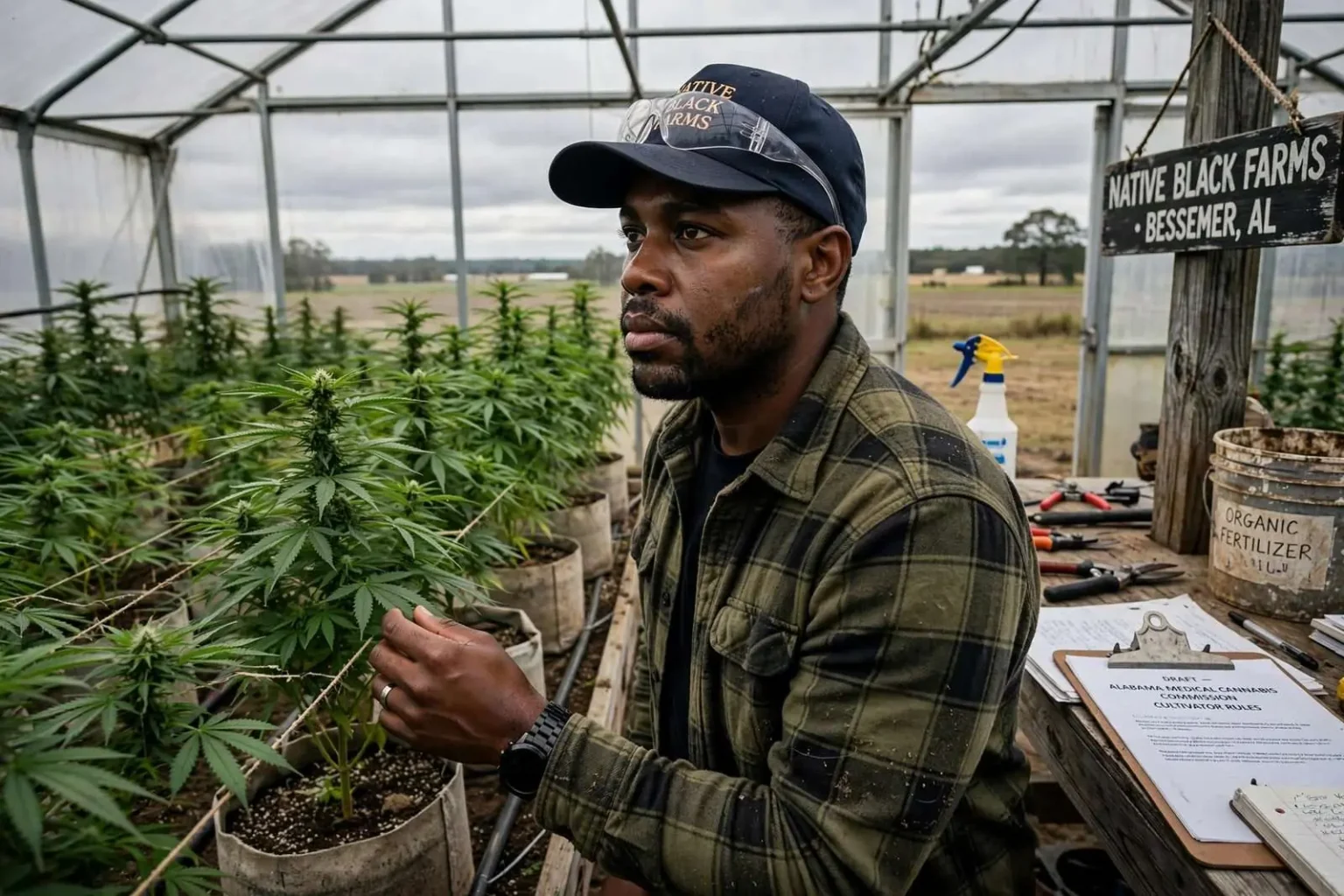
Antoine Mordican already works one demanding job as an electrical engineer. His side pursuit — growing hemp at Native Black Farms in Bessemer — pays him nothing right now. He calls it research: an investment in the skills he expects to matter once Alabama’s medical cannabis program fully opens, which is why he is watching the state’s first draft rules for cultivators closely.
“I’m not in it for a money grab,” Mordican said. “It’s more like research.” But the draft leaves him uneasy, particularly its discretion in licensing. “It leaves a lot of discretion to the [Alabama Medical Cannabis] Commission to pick licensees,” he said. “As a Black farmer, I know I’m underrepresented in those spaces.” One of his goals is to help other Black farmers learn the craft of hemp before the window closes.
Worries about big out-of-state players
Mordican speaks for many independent growers who sank money into legal hemp hoping for a foothold in medical cannabis. Their fear: large out-of-state conglomerates — with an Alabamian placed atop the paperwork and capital for impressive facilities — will sweep up the licenses. Chey Garrigan, executive director of the Alabama Cannabis Industry Association, shares that worry and wants building standards added in future drafts, though she called this first attempt “pretty good.”
“If you’re not going to use hemp farmers, but allow multi-state operators in, that’s dangerous,” she said, arguing that in-state farmers who have already invested deserve first consideration. The concern reflects a pattern seen in other states that legalized medical cannabis after industrial hemp: multistate operators arrive with nationwide balance sheets, professional application teams and ready-made playbooks, and smaller local growers — who bet early on hemp when the market was unproven — find themselves outcompeted for the limited licenses each state hands out.
For Alabama’s hemp farmers, the stakes go beyond one license cycle. Many converted acreage, greenhouses and equipment to hemp after the federal farm bill legalized the crop, absorbing several lean seasons of a volatile young market. Medical cannabis was the horizon that made those investments rational — the assumption that skills and facilities built on hemp would translate into cultivation licenses when the state’s program finally opened.
What the rules would require
Under the draft from the Alabama Medical Cannabis Commission and the Department of Agriculture, cultivators must submit detailed operations plans covering security, growing and disposal. Facilities need perimeter barriers, locks, alarms, 24/7 video surveillance and badge-logged visitors; grow plans must state plant counts and methods, and chain-of-custody documentation is required.
The security requirements read like those governing a pharmaceutical operation rather than a farm, and that is by design. Cannabis remains illegal under federal law, and states that have built regulated medical markets have learned that seed-to-sale tracking and physical security are the price of keeping a program compliant and free of diversion. For applicants, that means the cost of a cultivation operation begins with fences, cameras and logging systems before a single plant is grown.
Transporters and retailers face licensing too, with some operators seeking integrated licenses covering all three roles. Alabama’s framework contemplates a vertically connected industry in which a single company can grow, process, transport and dispense — a structure that favors well-capitalized applicants who can afford multiple licenses, and one reason independent growers worry about who ultimately controls the market.
Cultivators must carry $2 million or more in liability and casualty insurance, stay at least a mile from other licensed growers or hemp farms to avoid cross-pollination, pass criminal background checks, submit to regular inspections, keep signage off their buildings and advertise only appropriately. Violations could bring warnings, fines, suspension or revocation.
The insurance and distance requirements
The $2 million insurance floor and the one-mile separation rule are among the provisions that will shape where Alabama’s cannabis industry physically lands. The distance requirement — meant to prevent cross-pollination between marijuana crops and neighboring hemp fields, which would compromise both — pushes licensed cultivation into rural pockets where nearby acreage is uncontested, and it creates a land rush dynamic in which early site selection determines who can even apply. A grower who has spent years building a hemp operation may discover that a competitor’s license, once granted nearby, forecloses their own path.
The advertising restrictions, meanwhile, will keep the industry nearly invisible from the road. No signage on buildings, and advertising only in appropriately regulated channels, means that even as Alabama’s medical cannabis market opens, the public will encounter it mostly through doctors and dispensaries rather than billboards.
A program built while patients wait
Regulations for dispensaries still await approval, but Garrigan said the state is working toward opening industry applications in September. The sequencing matters: cultivators and support businesses cannot begin operating until the licensing process starts, and patients cannot be served until products are grown, tested and dispensed through the full regulated chain. Every step of the rulemaking process delays the moment Alabama’s registered patients can actually obtain medical cannabis in-state.
Alabama’s medical cannabis law, passed after years of legislative debate, created the commission to stand up a tightly limited program covering a defined list of qualifying conditions. From the beginning, lawmakers wrote the program to be strict — limited forms of product, strict licensing, and heavy oversight — which is reflected in the draft cultivator rules now drawing scrutiny from farmers like Mordican.
For the small in-state growers watching the process, the September application target is the deadline that organizes everything else. The months between the draft rules and the opening of applications are the last window to convert hemp experience into a competitive application: securing a qualifying site, assembling the security infrastructure the rules demand, lining up the $2 million insurance coverage and documenting an operations plan detailed enough to survive commission scrutiny.
Advocates for minority participation in the new industry have pointed to Alabama’s agricultural history as reason to be deliberate about who receives licenses. Black farmers in the state lost land and standing over the twentieth century at rates that outpaced white farmers, and without deliberate attention, critics fear Alabama’s new cannabis economy could replicate the concentration of ownership seen in other legalized states, where a handful of multistate companies came to dominate production within a few years of licensing.
Garrigan’s push to add building standards to future drafts is one piece of that debate — a way of ensuring that facilities meet objective requirements rather than leaving every judgment to the commission’s discretion. Mordican’s complaint cuts in the same direction: the more the rules specify, the harder it becomes for a licensing process to favor insiders or deep-pocketed applicants for reasons that never appear in writing.
Whether the commission adjusts the draft in response remains to be seen. What is clear is that a constituency of Alabama growers — farmers who took a chance on hemp before the medical program existed — is watching closely, and their argument to the state is simple: the skills the program needs are already being developed in Alabama fields, by people who invested in them when there was no guaranteed payoff. The September application opening will show how much of that argument the commission takes into the state’s first cannabis licenses.
The draft rules also illustrate how Alabama’s approach compares with other states that have traveled this road. States that launched medical programs early often wrote looser cultivation rules and spent years tightening them after problems surfaced; Alabama, starting later, has been able to borrow the strictest provisions from elsewhere — the seed-to-sale documentation, the badge-logged facilities, the insurance minimums — and build them in from day one. The result is a rulebook that applicants may find burdensome but that regulators hope will spare the state the corrections other markets required.
For applicants who clear the hurdles, the payoff is entry into a market with limited competition by design. The commission controls how many licenses it awards at each tier of the supply chain, and scarcity in licensing is exactly what makes each license valuable — and exactly why the selection process itself has become the focal point of the debate between independent growers and out-of-state operators.
Behind the regulatory fight sits a practical reality: someone in Alabama will grow the state’s first legal medical cannabis crop, and the rules now being finalized will determine whether that someone is a farmer like Mordican, who spent unpaid seasons learning the craft in Bessemer, or a subsidiary of a company that has operated in a dozen states before this one. The commission’s final rules, expected after public review, will answer that question — and growers across the state are reading every line for the answer.
Native Black Farms, meanwhile, keeps planting. Mordican’s research seasons have built the working knowledge — soil, irrigation, pest pressure and harvest timing — that a competitive cultivation application will demand, and he continues to share what he learns with other Black farmers considering the same path. Whether that preparation converts into one of Alabama’s first cannabis cultivation licenses will depend on the final rules and the commission’s choices, but the intent behind the work has not changed: to enter the industry at its opening, and to bring other farmers with him.