Alabama Coastal Triathlon Returns to Gulf Shores for Its 19th Year on Sept. 12
The 19th annual Brett/Robinson Alabama Coastal Triathlon takes over the Gulf Shores beachfront on Saturday, Sept. 12, with Olympic and sprint races, relays and two-sport divisions starting from The Hangout.
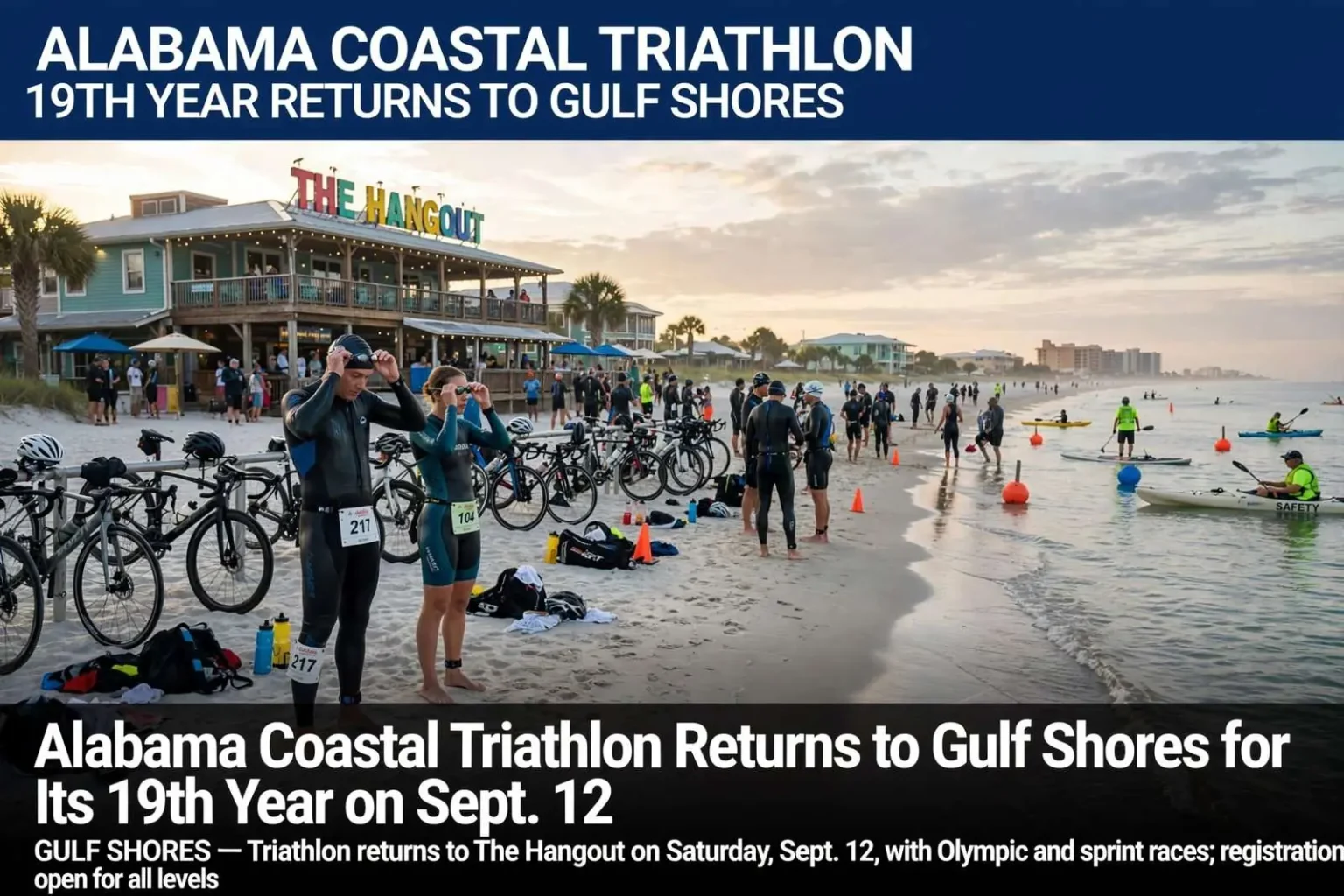
GULF SHORES — The Brett/Robinson Alabama Coastal Triathlon returns to the Gulf Shores beachfront next weekend for its 19th year, with race headquarters at The Hangout and start times set for early Saturday morning.
Registration is open, and organizers are encouraging athletes to sign up early. The field is open to competitors at every experience level, from first-timers to athletes who have raced the course for the better part of two decades.
Race Weekend Schedule
Packet pickup runs from 4 to 6 p.m. Friday, Sept. 11, at The Hangout. Athletes who cannot make Friday can pick up race-day packets and register late on Saturday morning between 5:30 and 6:30 a.m.
The Olympic-distance race starts at 7 a.m. Saturday. The sprint race, branded the “Tri-It-On,” follows at 7:45 a.m.
That staggered start is standard practice at multi-distance events. Sending the longer race off first spreads the field on the course, keeps the swim exit and the transition area from bottlenecking, and gets the fastest athletes moving before the day warms up. It also means the sprint field gets a live preview of the swim conditions before entering the water.
The Race Formats
Competitors can choose from several formats. Alongside the Olympic and sprint triathlons, the event offers swim-bike, bike-run and relay divisions.
Those options do more than pad the entry form. The two-sport divisions give athletes a way to race when an injury, a training gap or simple preference rules out one discipline — a runner recovering from a bike crash can still enter, and a strong swimmer and cyclist who does not run can still finish.
The relay division is the most common on-ramp for people new to the sport. A three-person team splits the race by discipline, so a swimmer, a cyclist and a runner each do the leg they know. For many triathletes, a relay is the first race entry, and a solo attempt is the next year’s goal.
The Course
The race begins with an open-water swim in the Gulf, then moves to a flat course along the beach road.
Organizers describe the Tri-It-On route as a 2-mile out-and-back on East Beach Boulevard heading east of The Hangout. The Olympic-distance route is a 6-mile out-and-back on the same road, passing the Tri-It-On turnaround one mile out. Organizers note specifically that the course measures 6 miles rather than 6.2, a detail that matters to athletes tracking split times against previous races.
Flat is the operative word. East Beach Boulevard runs essentially at sea level along the Gulf front, with none of the climbing that defines triathlons in the Appalachian foothills or the Ozarks. For athletes chasing a personal best, that terrain is the appeal. What replaces the hills is wind and heat: a coastal out-and-back means a headwind in one direction and a tailwind in the other, and a September morning on the Alabama coast delivers humidity that does not break until well after sunrise.
What the Distances Mean
For readers new to the sport, the naming conventions are worth a translation. An Olympic-distance triathlon conventionally covers a 1,500-meter swim, a 40-kilometer bike leg and a 10-kilometer run — the format used at the Summer Olympics since triathlon was added to the program in 2000. A sprint triathlon is roughly half of that, and it is the distance most first-time competitors choose.
Beyond the timed legs, triathlon has a fourth discipline that does not appear in the name: transition. The stretches between the swim and the bike, and between the bike and the run, are timed as part of the race. Athletes lay out gear in a designated transition area before the start and practice moving through it, because minutes lost fumbling with shoes or a helmet strap count exactly the same as minutes lost on the course.
The Open-Water Swim
The Gulf swim is the leg that separates this race from a pool-based event, and it is where inexperienced entrants most often struggle.
Open water offers no lane lines and no black stripe on the bottom to follow, so swimmers must sight — lifting the head every few strokes to spot a buoy and correct course. Swimming in a crowd of other athletes is its own skill; contact at the start is routine. Surf, current and chop add variables that do not exist in a lap pool, and a swimmer who has trained exclusively indoors can be surprised by how different 1,500 meters feels in the Gulf.
Race organizers at events like this one typically station kayakers, paddleboarders and boats along the swim course, and athletes who need to stop and hold onto a support craft can generally do so without being disqualified, as long as they do not advance while holding on. Anyone entering an open-water race for the first time should get into open water at least once during training rather than showing up on race morning having only swum in a pool.
After the Finish
Post-race festivities follow the competition, with food, beverages and the atmosphere the event has built over nearly two decades.
That part is not an afterthought. Triathlon is an individual sport with a heavily communal culture, and the post-race window at a beachfront race — awards, results boards, athletes comparing splits with a plate of food in hand — is a substantial part of why competitors return year after year.
A Signature Fall Event
The triathlon has become one of the anchors of the Gulf Shores fall calendar, drawing athletes from across the region.
Endurance events are valuable to coastal communities for reasons that go beyond race day. Competitors typically arrive with family, book at least one night of lodging, eat several meals out and often extend the trip into a weekend. A September race lands after the summer vacation peak has ended, in the same shoulder-season window that coastal tourism officials work to fill with festivals, tournaments and conventions.
The event carries the name of Brett/Robinson, the Gulf Shores-based vacation rental and development company that serves as title sponsor — the sort of long-running local sponsorship that keeps entry fees manageable and community races on the calendar year after year.
How to Enter
Registration is open now, with late registration available at The Hangout on race morning from 5:30 to 6:30 a.m. Athletes racing Saturday should plan for the Friday packet pickup window from 4 to 6 p.m. if they can, since race-morning check-in leaves only a half-hour cushion before the 7 a.m. Olympic start.