
Alabama Congressman Delivers Craft Brews to South Carolina Colleague After Championship Bet
Rep. Bradley Byrne delivers Alabama craft beers from Gulf Coast breweries to Rep. Joe Cunningham after losing a national championship wager.
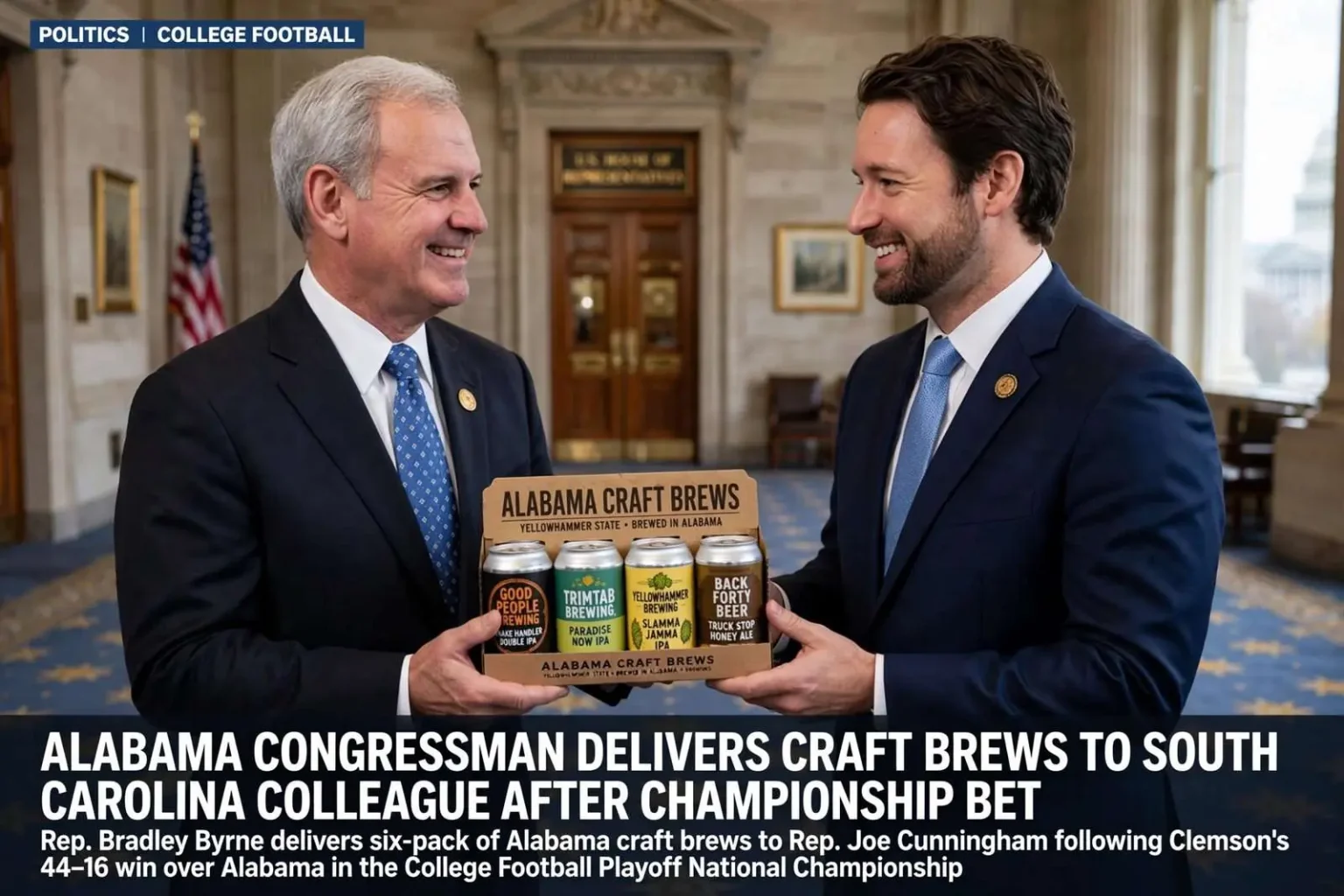
U.S. Representative Bradley Byrne made good on a friendly wager with South Carolina Congressman Joe Cunningham after Alabama fell to Clemson in the College Football Playoff National Championship, shipping a selection of the Yellowhammer State’s finest craft brews to his Palmetto State colleague. The losing side of a friendly bet between two members of Congress rarely attracts much attention, but this one doubled as a showcase for a Gulf Coast industry that has been quietly building a national reputation.
Byrne, who represents Mobile and much of southwest Alabama in the U.S. House, shipped a six-pack of Alabama’s finest craft brews to Cunningham after Clemson defeated the Crimson Tide 44-16 to capture the national title. The championship game was a rematch between the two college football powers, programs that had split the previous national championships and built one of the sport’s fiercest modern rivalries. Alabama’s loss meant Byrne owed his counterpart across the table, and the congressman paid his debt in the most Alabama way available: with beer made in the state he represents.
The two congressmen had wagered a six-pack of their respective states’ best beers ahead of the matchup, a bet that followed a tradition of lawmakers putting local pride on the line over sporting events. Congressional wagers over big games are a long-standing custom on Capitol Hill, typically settled with hometown food, drink or flags and usually celebrated with a public photo of the losing member making delivery. The stakes are symbolic, but the goods are real, and Cunningham received a survey of Alabama brewing in a single package.
Several Gulf Coast breweries were featured in the delivery, including Haint Blue Brewing and Serda Brewing from Mobile, and Fairhope Brewing Company from Baldwin County. The inclusion of three coastal Alabama breweries in a six-pack bound for South Carolina said as much about the region’s beer scene as it did about the bet — a decade ago, a package like that would not have been possible, but Mobile and Baldwin counties now support a cluster of established production breweries and taprooms.
The Breweries in the Box
Haint Blue Brewing has built its identity around Deep South folklore and a lineup of beers with names drawn from regional ghost stories, operating from its Mobile brewery and taproom. Serda Brewing, founded by the Serda family, whose name has been part of downtown Mobile’s commercial fabric for generations, has become a fixture of the city’s brewing scene with a broad range of styles poured at its downtown taproom. Fairhope Brewing Company, on the Eastern Shore, has been pouring beer in Baldwin County since the early years of the state’s craft boom and takes much of its branding from the distinctive character of Fairhope itself.
Other Alabama craft beers in the package included offerings from Back Forty Beer Company, Good People Brewing and Avondale Brewing. Back Forty, which traces its origins to Gadsden and expanded with a Birmingham presence, is one of the state’s better-known craft producers. Good People Brewing, based in Birmingham, holds the distinction of being among the state’s pioneering modern craft breweries, having opened its doors when Alabama’s beer laws still constrained what brewers could produce. Avondale Brewing, also of Birmingham, grew out of the revitalization of the Avondale neighborhood and became a cornerstone of the city’s craft beer community.
Byrne shared a photo of the handoff on social media, highlighting the growing reputation of Alabama’s craft brewing scene. The post drew the kind of attention that congressional beer bets usually do — lighthearted banter from colleagues and constituents — but it also functioned as free publicity for the breweries named in the delivery, whose products reached an audience far beyond their taprooms’ regular crowds.
The bet itself fit the personalities of the two men. Cunningham, an upstate South Carolina Democrat known for his casual style and his love of craft beer, had famously home-brewed beer in his Capitol Hill office as a hobby, making him a fitting opponent for a beer wager. Byrne, a Republican and a Mobile native with deep roots in the city’s business and legal community, understood better than most what the state’s breweries had built over the previous decade.
Alabama’s Craft Beer Boom
The Gulf Coast has seen a surge in brewery openings in recent years, with establishments in both Mobile and Baldwin counties drawing regional attention for their quality and variety. The growth mirrors a statewide trend: Alabama’s craft brewing industry expanded dramatically through the 2010s, aided by legislative changes that steadily loosened restrictions on brewpubs, bottle sales and beer strength that had long made the state one of the most difficult in the nation for craft brewers to operate in.
Those legal changes transformed the landscape. Before the reforms, Alabama brewers operated under limitations on alcohol content that dated to the era of prohibition-era statutes, and brewpubs were effectively barred from the state. The gradual lifting of those restrictions — caps raised on alcohol by volume, brewpubs legalized, taproom sales permitted — allowed a generation of Alabama brewers to open facilities, and the number of breweries in the state climbed from a handful to dozens within a few years.
Mobile’s brewing scene has benefited from the city’s broader downtown revitalization, with taprooms joining the restaurants, music venues and entertainment businesses that have brought foot traffic back to the city center. Brewery events, beer festivals and collaborations among the coastal breweries have built a community of enthusiasts, and each new opening has added to the momentum. Baldwin County’s growth has carried its own demand, with the Eastern Shore’s population boom supporting businesses like Fairhope Brewing.
While the final score may not have gone Alabama’s way, the bet served as a showcase for the state’s thriving craft beer industry. Cunningham received six cans and bottles representing three of Alabama’s metropolitan areas, and everyone who saw the photo of the handoff received a reminder that the state now produces beer worth wagering over. In the odd economics of congressional wagers, losing a championship game has rarely looked so much like winning.
The Rivalry Behind the Bet
The wager’s origin lies in one of college football’s most one-sided recent chapters. Alabama and Clemson had met in the College Football Playoff in three consecutive seasons, trading national championships and producing some of the highest-rated television audiences in the sport’s history. The Tide’s victory over the Tigers in the previous season’s title game set up the rematch, and Clemson’s decisive 44-16 win settled the score in emphatic fashion, handing Alabama its most lopsided defeat of the Saban era and sending Tigers fans home with another national championship.
For representatives of the two states, the result meant a ceremonial payment was due. Congressional wagers have a long pedigree — members have bet crab cakes, cheese steaks, barbecue and beer on everything from the Super Bowl to conference championships — and they serve as a ritual of regional pride that softens the partisanship of Capitol Hill. A six-pack wager between an Alabamian and a South Carolinian over the national championship fit squarely in that tradition.
The bet also highlighted how far beer had come as a point of state pride in Alabama. A generation earlier, the state’s beer culture was defined by a handful of mass-market lagers and some of the strictest alcohol laws in the country. The idea that a congressman could send a colleague a curated six-pack of distinctive Alabama-made beers — and that the harder part would be choosing which breweries to include — reflects the scale of the transformation that the state’s brewing industry underwent in the 2010s.
What Craft Brewing Means for the Gulf Coast Economy
Breweries have become a meaningful piece of the Gulf Coast’s small-business economy. A production brewery and taproom brings manufacturing jobs, tourism spending and regular events to its neighborhood, and the multiplier effects extend to local suppliers, food trucks and nearby businesses that benefit from taproom traffic. Industry studies nationwide have found that craft brewing contributes billions of dollars to state economies annually, and Alabama’s share of that growth has grown steadily with each new brewery opening.
The tourism angle is particularly relevant for Mobile and Baldwin counties, which draw visitors for beaches, history and festivals. Brewery tourism — visiting multiple taprooms over a weekend, sampling local-only releases, taking tours — has become a recognized travel segment, and the concentration of breweries within a short drive across the two counties makes the region a natural stop for travelers interested in Alabama beer. Local hotel and restaurant operators have watched the trend and increasingly partner with breweries on events and promotions.
The state’s brewers have also organized to advocate for their industry, working through trade associations to further modernize Alabama’s alcohol laws and to promote the “Made in Alabama” brand. Each legislative session brings new proposals to simplify licensing and expand sales channels, and the industry’s growth has given it a stronger voice in Montgomery. The congressional beer wager was, in its small way, part of that same project of normalization — evidence that Alabama beer now belongs in the same conversation as any state’s.
For the six breweries whose products made the trip to South Carolina, the exposure came at no cost and with a congressman’s endorsement attached. Haint Blue, Serda and Fairhope represented the Gulf Coast; Back Forty, Good People and Avondale represented Birmingham and north Alabama. Together they made the case that Alabama’s craft scene has both depth and geographic spread, from the Tennessee Valley to Mobile Bay.
Byrne’s losing bet will not be the last wager settled in Alabama beer. As long as the state’s teams keep reaching championship games and its breweries keep producing beer worth shipping across state lines, members of Congress from Alabama will keep finding themselves in the pleasant position of paying tribute to their state’s beer while honoring a debt. For the Gulf Coast breweries that made this delivery, the best outcome was simple: a photo on a congressman’s social media feed, and six Alabama beers opened a thousand miles from home.


