Alabama EMA Director Jeff Smitherman updates major FEMA funding changes
Alabama EMA Director Jeff Smitherman told county leaders at a statewide conference how the agency is adapting to fast-changing FEMA funding rules.
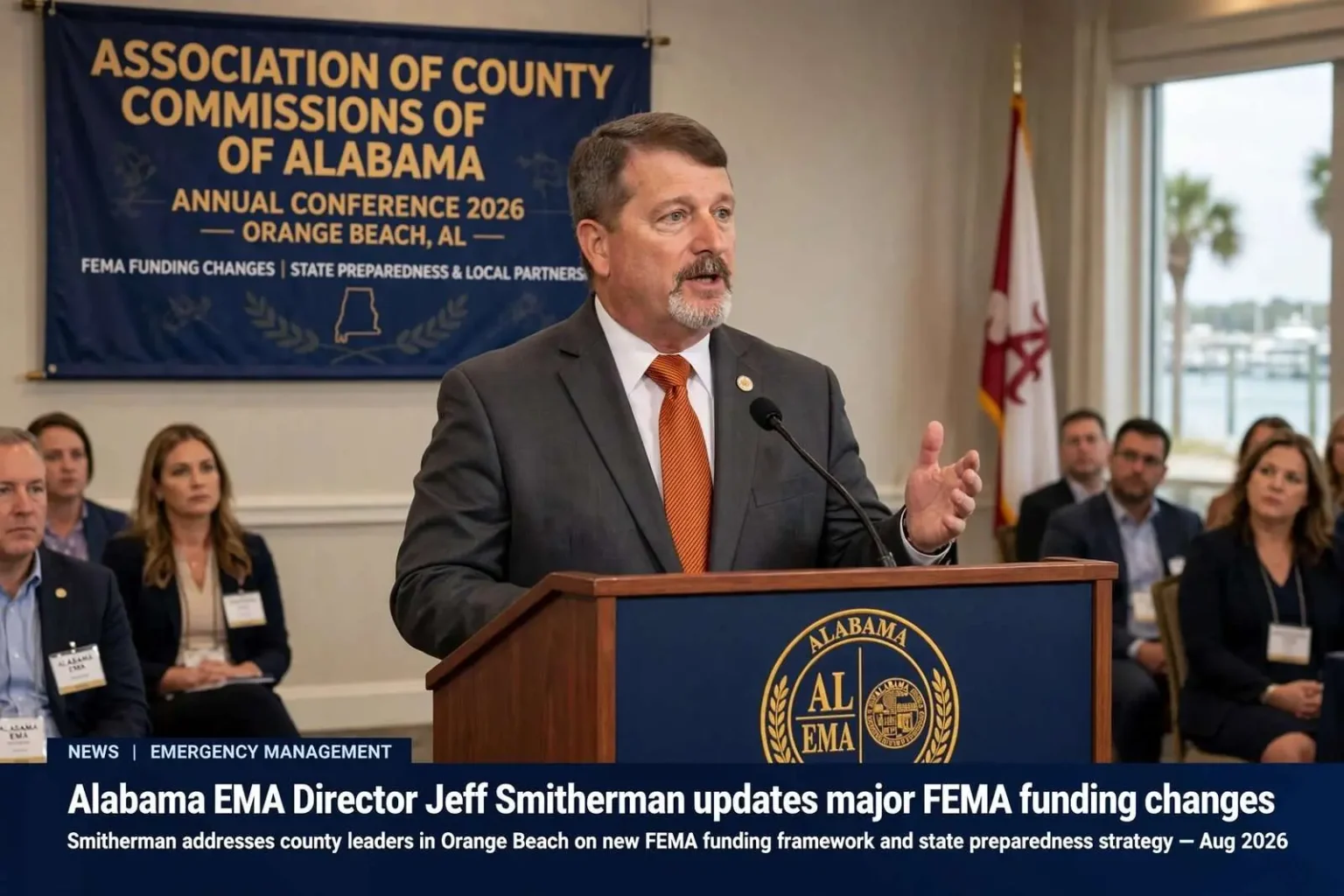
The way the Federal Emergency Management Agency (FEMA) distributes money to help with disasters is changing fast – and the Alabama EMA is already doing the work to be sure Alabama gets its fair share of this important federal funding. That was the message that Alabama EMA Director Jeff Smitherman shared with county leaders at the Association of County Commissions of Alabama’s annual conference in Orange Beach.
The annual gathering of over 1,000 county leaders is an important venue for the state to communicate changes to local and county leaders – who are almost always the first to respond to disasters in our state. The FEMA Review Council’s report, released in May 2026, points to major changes in FEMA’s operating structure – putting more responsibility on the states to help their citizens prepare for and manage disasters.
The Plan Calls for Major Changes in Funding Processes
The plan calls for major changes in FEMA’s funding processes – and Director Smitherman says the states that do the work now will reap the rewards for their citizens: “The money’s coming – we need to be postured and prepared to handle it. If we aren’t doing that work now, then when that money does come then we, collectively as a state, are going to be left behind and other states are going to get that funding.”
Alabama EMA leadership will continue strategically adjusting to changes in federal funding processes to ensure Alabama remains well-funded during times of disaster.
Why the Shift Matters for Alabama
Alabama is no stranger to disaster. Hurricanes along the Gulf Coast, tornadoes across the interior, and flooding in between have made emergency management a permanent priority for the state. When federal dollars flow after a catastrophe, they help communities rebuild homes, restore utilities and repair public infrastructure. Any change in how that money is allocated therefore has direct consequences for cities and counties from Mobile to Huntsville.
What the FEMA Review Council’s Report Recommends
The FEMA Review Council’s May 2026 report signals a move away from a model in which the federal government shoulders much of the upfront disaster planning burden. Instead, the council’s recommendations envision a system in which states take the lead on preparedness, mitigation and recovery coordination, with FEMA playing a supporting role and providing funding once certain planning benchmarks have been met. The goal is to direct federal dollars to states that have already done the work to use them well.
For Alabama, that approach aligns with longstanding practices in the state’s emergency management community. The Alabama EMA, headquartered in Clanton, has historically worked closely with county emergency managers, municipal first responders and federal partners to coordinate disaster response. Strengthening that network, and the documentation and training that go with it, will be a central part of how the state prepares for the new federal framework.
What County Leaders Heard in Orange Beach
Smitherman’s address to the Association of County Commissions of Alabama’s annual conference was framed as both a warning and an opportunity. The warning was that states slow to adapt could find themselves at the back of the line for federal disaster funding. The opportunity was that states which invest in preparedness now will be better positioned to capture the dollars that flow once the new system is fully in place.
For the more than 1,000 county officials gathered in Orange Beach, the message carried practical weight. Counties are the level of government closest to residents when disaster strikes, and the quality of their planning often determines how quickly federal assistance can be deployed. Smitherman’s remarks reinforced the idea that county leaders have an essential role to play in positioning Alabama for the next major federal funding cycle.
Hurricane Season on the Gulf Coast
For Alabama’s coastal counties, hurricane season is a perennial reminder of how much is at stake when federal funding decisions are made. Mobile and Baldwin counties have absorbed multiple major hurricane strikes in recent decades, and the recovery process has typically relied on a combination of state, federal and local resources. Any change in how FEMA dollars flow can therefore have an outsized impact on the speed and scale of coastal recovery efforts.
Inland counties face their own patterns of risk. Tornadoes, severe thunderstorms and river flooding all require rapid coordination between state and county agencies, and the documentation and reimbursement processes that follow a disaster are notoriously complex. County leaders who attended the Orange Beach conference said they left with a clear sense of how much work is ahead to make sure Alabama stays ahead of the changes coming from Washington.
How the Alabama EMA Is Preparing
Within the Alabama EMA, leadership has begun a series of internal reviews and external meetings to align agency procedures with the new federal expectations. Those reviews cover grant documentation, project worksheet preparation, debris monitoring and the kind of damage assessment work that has to be done in the days immediately following a disaster. The agency is also working with FEMA Region IV in Atlanta and other federal partners to clarify what the new federal benchmarks will look like in practice.
Smitherman has emphasized that the Alabama EMA’s work is not a one-time project but a continuing effort to position the state for the next round of federal funding decisions. As the FEMA Review Council’s recommendations move from report to implementation, the agency intends to keep county leaders, municipal partners and the public informed about what is changing and how those changes will affect Alabama.
What Comes Next
For now, Alabama’s emergency management community is taking the FEMA Review Council’s May 2026 report as both a roadmap and a deadline. The roadmap outlines how the federal government intends to distribute disaster funding in the years ahead, and the deadline is the implicit clock that runs while the state prepares to compete for those dollars. Smitherman’s appearance in Orange Beach was a clear signal that Alabama intends to be ready, and that the work of preparing is happening now rather than after the next major storm.
The Association of County Commissions of Alabama
The Association of County Commissions of Alabama, or ACCA, is the statewide association that represents county governments across Alabama. Its annual conference brings together county commissioners, administrators and staff from every corner of the state to discuss policy, training and the operational realities of running county government. Hosting the gathering in Orange Beach reflects the importance of coastal issues to the state’s overall emergency management conversation, and it gives coastal and inland county leaders a chance to share perspectives in person.
Documentation and the Reimbursement Process
One of the most practical concerns county leaders raised at the conference was the documentation work that follows a federally declared disaster. Project worksheets, damage assessments, procurement records and labor documentation are all required for FEMA reimbursement, and any weakness in those records can result in reduced funding or denied claims. Counties that already maintain strong documentation practices are likely to have an easier transition to the new federal framework, while counties with thinner records may need additional training and support.
The Alabama EMA has signaled that it intends to help counties close those gaps in the months ahead. Agency staff have begun meeting with county emergency managers across the state to review current procedures and identify areas for improvement. Those meetings are part of a broader effort to make sure that when the next major federal funding cycle begins, Alabama counties will be ready to capture their share of the available dollars.
Why Preparation Matters More Than Ever
The FEMA Review Council’s May 2026 report makes clear that the federal government is shifting more responsibility onto states, and that shift will play out in the documentation and planning work that happens long before a disaster ever strikes. Alabama EMA Director Jeff Smitherman’s message in Orange Beach was that preparation is no longer optional for states that want to remain competitive for federal dollars. For Alabama, that means investing in the people, systems and partnerships that turn preparedness into the kind of advantage the new federal framework is designed to reward.
Closing the Loop with Federal Partners
Beyond the work happening at the state and county levels, the Alabama EMA is also coordinating with FEMA Region IV and other federal partners to clarify how the new expectations will be implemented. Those conversations are expected to continue as the federal rule-making process advances, and they will shape how counties across Alabama approach their own preparation. Staying engaged with those federal partners, Smitherman told the Orange Beach gathering, is part of the work Alabama must do now to remain competitive for the federal dollars that are coming.
What Residents Should Watch For
For Alabama residents, the practical implications of the FEMA Review Council’s report will play out largely behind the scenes. County emergency management offices will update plans, the Alabama EMA will refine its procedures and federal partners will issue new guidance. But the visible result will be that when the next major hurricane, tornado or flood strikes, the state will be better positioned to capture federal assistance and to deliver recovery resources quickly. That, more than any individual policy change, is what Smitherman’s Orange Beach remarks were designed to drive home.