Gulf Fishermen in Line for $28 Million to Rebuild Oyster Beds and Shrimp Grounds
Federal officials moved in June 2006 to release $28 million for Alabama, aimed at reseeding hurricane-wrecked oyster beds and clearing debris from shrimp grounds off the Gulf Coast.
Alabama’s fishing industry stood to receive roughly $28 million in federal aid to rebuild oyster beds and clear wrecked shrimp grounds, U.S. Sen. Richard Shelby announced in late June 2006, nearly a year after the hurricane season that battered the Gulf Coast.
Shelby, then chairman of the Senate Appropriations Subcommittee on Commerce, Justice and Science, said the National Oceanic and Atmospheric Administration was working with Alabama and other Gulf states to release fisheries money that Congress had already provided in the fiscal year 2006 Emergency Supplemental Appropriations Act.
The announcement, made nearly a year after the storms, reflected the slow-motion nature of fisheries recovery. Houses could be rebuilt in months; a smothered oyster reef or a shrimp ground littered with hidden debris could keep a fleet tied up or losing gear for years. For Shelby, whose subcommittee controlled the spending stream the money flowed through, the task in June 2006 was to push the already-appropriated dollars out of federal accounts and onto the water.
What the storms left behind
The damage the money was meant to address was not the kind visible from a highway. Hurricanes had scoured the bottom of the bays and the near-shore Gulf, smothering oyster reefs in sediment and scattering debris across grounds that shrimpers had worked for generations.
“Shrimp and oysters are the most valuable seafood products of the Gulf Coast region,” Shelby said. He noted that the previous season’s hurricanes had filled shrimp grounds with debris and devastated oyster beds along the coast, causing both immediate and long-term harm to the industry.
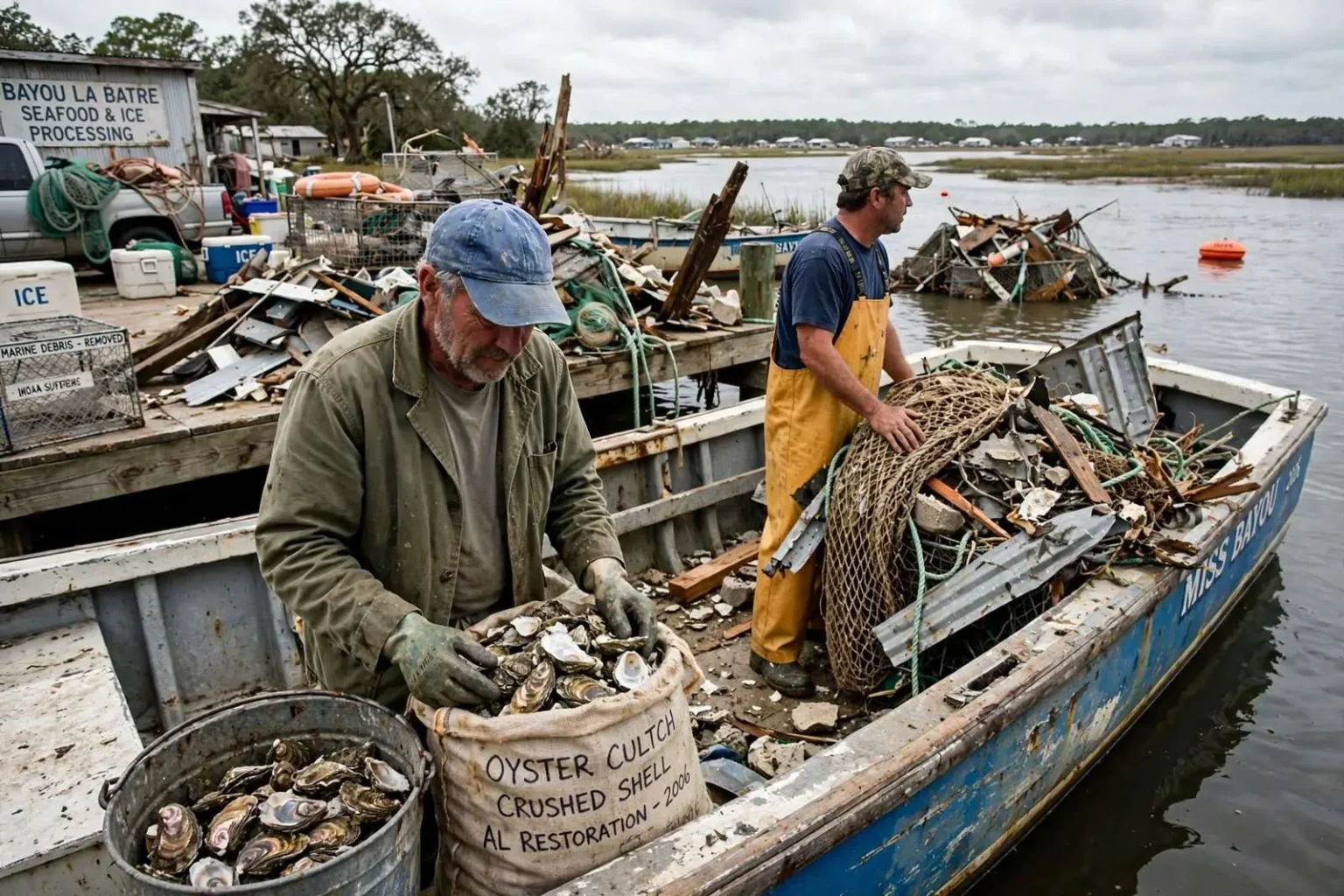
For communities such as Bayou La Batre, Coden and Irvington, that was not an abstraction. Seafood was the economy. A shrimp boat that snagged a submerged refrigerator or a sheet of roofing tin could lose a net worth thousands of dollars, and a fouled oyster reef could take years to come back into production even with help.
Bayou La Batre — the small coastal city whose shrimp fleet was famously rebuilt in the film “Forrest Gump” — had taken a direct hit, with boats damaged on shore and processing houses knocked out of operation. Coden and Irvington, the unincorporated communities along the bay’s western shore, depend on the same industry and the same water, and the 2005 season had struck all three at the height of their working year.
The physical harm ran deeper than the shoreline pictures suggested. Hurricane storm surge pushed sediment across the bottom of Mobile Bay and Mississippi Sound, burying the live oyster bottoms under silt where the shellfish suffocate. The same surge carried decades of ordinary debris into the water — construction material from destroyed buildings, sunken vessels, household goods — and left it scattered across the very grounds where trawls and tonging crews worked.
Reseeding and rehabilitation
Shelby said the $28 million provided to Alabama would go a long way toward restoring productive oyster beds and shrimp grounds in the areas most severely affected. The work fell into two broad categories: reseeding and rehabilitating oyster reefs, and cleaning up and monitoring shrimping grounds.
Oyster reef restoration is painstaking work. Because oyster larvae need hard surfaces on which to settle, restoration crews typically spread cultch material such as crushed shell or limestone across damaged bottom, then wait for a natural set or plant hatchery-reared seed oysters. The results are measured in seasons, not weeks.
The biology dictates the calendar. A reef planted with cultch in the fall may not yield a harvestable crop for two or three years, and every season of delay compounds the economic damage as boats idle and processing plants run short of supply. Alabama’s oyster industry has historically concentrated its harvest on the public reefs of the bay’s western edge, near the communities the money was meant to serve, so the location of the restoration work mattered as much as the amount.
Shrimp grounds recover differently. Trawling bottoms do not need rebuilding so much as clearing — the debris has to be found and lifted out before nets can work safely — and monitoring has to confirm the grounds are free of hazards and ecologically sound enough to fish. The state’s marine resources agencies planned to coordinate that work with NOAA and with the fishermen themselves, who knew the grounds best and whose gear would pay the price for any hazard left behind.
Mapping the hazards
The second piece of the effort was arguably just as important to fishermen: finding out what was down there. NOAA planned to continue locating and mapping hazardous marine debris within prime fishing grounds off the Alabama coast. The agency had begun re-mapping navigable channels throughout the Gulf, including Mobile, immediately after the storms.
“These additional funds will allow NOAA to concentrate mapping efforts in well-traveled fishing grounds to ensure the safety of our fishermen,” Shelby said. He explained that the surveys would keep boats from colliding with hazardous material that storms may have created or moved, and would lower the risk of a fisherman snagging debris and destroying nets and gear instead of catching fish.
Hydrographic surveying is the unglamorous foundation of every other recovery step. Sonar sweeps and diver verification produce the charts that tell captains where a net can safely pass and where it cannot, and the post-hurricane re-mapping of Gulf channels was one of the largest such efforts in the agency’s history. Extending the surveys into the fishing grounds themselves — beyond the shipping lanes — was the fishermen’s priority, since a wrecked net or a holed hull could erase a season’s earnings in a single tow.
Part of a larger Gulf package
Alabama’s share came out of a broader emergency appropriation for the region. The FY 2006 Emergency Supplemental Appropriations Act included:
- $128 million for oyster bed and shrimp ground reseeding, rehabilitation and restoration across the Gulf states
- $20 million for surveying and mapping tied to marine debris removal
The supplemental bill was Congress’s mechanism for funding hurricane recovery beyond the regular budget cycle, and fisheries aid competed for space in it against housing, infrastructure and levee rebuilding. Alabama’s roughly $28 million slice, carved from the Gulf-wide fisheries total, reflected the scale of the damage to the state’s shellfish and shrimp grounds relative to its neighbors — Mississippi and Louisiana, closer to the strongest storms, took larger shares of the regional package.
Shelby framed debris removal as the linchpin of the whole effort. “These efforts must be successful if our fishermen are to maintain their businesses, so that tourists and citizens alike can continue to enjoy Gulf seafood,” he said.
An industry under pressure
The aid arrived at a difficult moment for the Alabama seafood industry, which was contending with more than storm damage. Cheap imported shrimp had been driving down dock prices for years, fuel costs were climbing, and the labor and insurance burdens of operating a boat on the Gulf Coast were rising steadily. Federal restoration money could repair the bottom of Mobile Bay; it could not repair the balance sheet of a shrimping family.
The import squeeze had already reshaped the industry before the hurricanes arrived. Gulf dockside prices for shrimp had fallen far enough over the preceding years that domestic fleets had sought federal trade relief, and the boats that remained were running on thinner margins each season. Rising diesel costs compounded the arithmetic — a trawler burns fuel by the hour, and every dollar added at the pump came straight out of the same margin. Insurance premiums on Gulf vessels, rising even before the record 2005 season, climbed further after it.
That context shaped how the restoration money was understood on the docks. It was not a rescue package; it was infrastructure for the industry’s physical foundation — the reefs, the grounds, the charts — delivered at the moment when the industry’s economic foundation was weakest. Fishermen took it as confirmation that Washington recognized the fishery was worth saving, which in a year of bad news counted for something.
What the money meant for south Mobile County
Still, for the coastal communities of south Mobile County, the announcement counted as good news in a year that had produced little of it. The reefs that fed the region’s processing houses and restaurants had a chance to be rebuilt, and the grounds where the boats worked stood to be charted and cleared.
The seafood economy of Bayou La Batre, Coden and Irvington is an integrated chain: the boats, the docks, the ice houses, the processing plants and the wholesale houses that ship Gulf product across the country. Damage to any link — a reef that produces no oysters, a ground too hazardous to trawl — ripples through all of it, costing work at the plants and in the shops that supply the fleet. Restoration spending aimed at the resource was, in effect, spending on the whole chain.
The timing also mattered for the region’s identity. South Mobile County’s seafood communities are among Alabama’s oldest working waterfronts, their fleets and surnames tracing back generations on the bay, and the 2005 storms had raised the quiet question of whether the industry — and the towns built around it — could survive the combined pressure of disaster and imports. A federal commitment to rebuild the resource, on the record and in the water, was an answer of sorts.
For the fishermen themselves, the work ahead was measured in practical terms: reefs to be recultched, grounds to be swept and mapped, nets to be kept intact another season. The $28 million would not arrive in anyone’s pocket all at once, and much of it would be spent on the surveys, cultch, seed oysters and debris removal that make recovery possible. But the bottom of Mobile Bay was, for the first time since the storms, scheduled for repair — and on the docks of Bayou La Batre and Coden in the summer of 2006, that was news worth the reading.