Alabama GOP Senate Primary Barrels Toward a Runoff as Britt, Brooks and Durant Battle for Shelby’s Seat
A crowded Republican field led by Katie Britt, Mo Brooks and Mike Durant is expected to head to a June runoff in Alabama's U.S. Senate primary to replace retiring Sen. Richard Shelby.
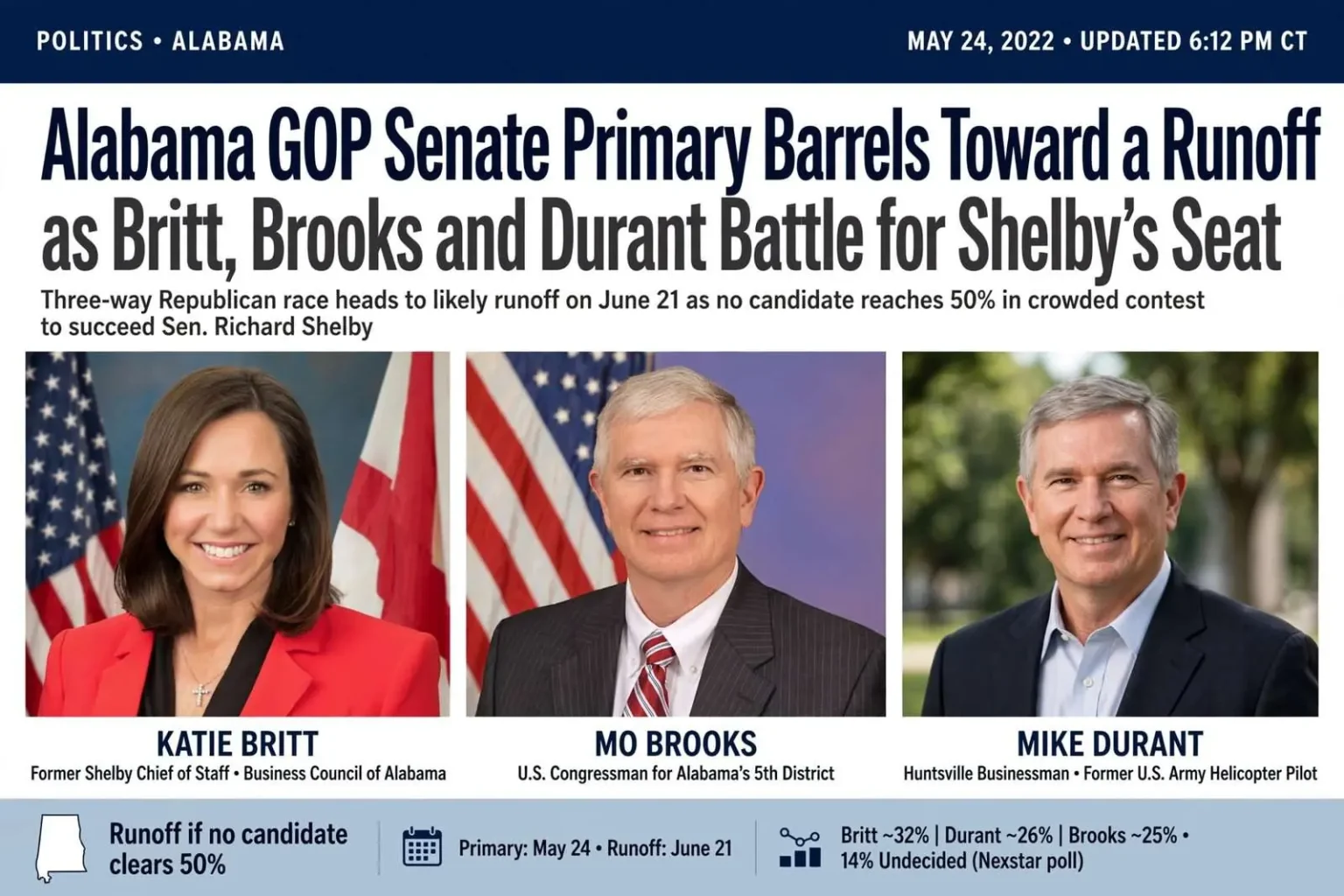
Alabama voters head to the polls Tuesday, May 24, in a U.S. Senate primary widely expected to produce a runoff, as a crowded Republican field fails to coalesce behind a single frontrunner in the race to succeed longtime Sen. Richard Shelby. If no candidate clears 50 percent of the vote next week, the top two finishers will meet again four weeks later, on Tuesday, June 21, to decide the Republican nomination. Multiple polls taken in the campaign’s final stretch show a three-way race that has shifted repeatedly over the past year, with no candidate approaching a majority. Shelby, who announced his retirement in February 2021, has represented Alabama in the Senate for 35 years and has chaired or served as the top Republican on the Senate Appropriations Committee since 2013.
That perch has allowed him to steer significant federal funding toward Alabama projects, including the ongoing deepening and widening of the Port of Mobile, a project local officials have said is critical to the port’s ability to handle larger cargo vessels and remain competitive with other Gulf Coast ports. Whoever wins the general election in November will join Sen. Tommy Tuberville in Washington, marking a dramatic changeover in Alabama’s Senate representation. Shelby and his predecessor colleague Jeff Sessions, who served from 1997 to 2017, combined for 55 years of institutional seniority. Tuberville, in the Senate since January 2021, and Shelby’s successor will together have less than two years of combined experience when the new term begins.
Six Republican candidates are on the primary ballot vying for the nomination: Lillie Boddie, Katie Britt, Mo Brooks, Karla DuPriest, Mike Durant and Jake Schafer. Boddie is reportedly a Florence resident, though little other information about her campaign is publicly available. Britt, an Enterprise native, is the former president and CEO of the Business Council of Alabama and previously served as Shelby’s chief of staff, a background she has used to argue she is best positioned to continue his legacy of delivering federal resources to the state. Brooks, of Madison, currently represents Alabama’s 5th Congressional District in the U.S. House, a seat covering much of the state’s northern border, including Decatur, Florence, Huntsville and Madison.
DuPriest is a Mobile small business owner active with the Mobile Area Chamber of Commerce, the Azalea City Republican Women and the Mobile County Republican Executive Committee, giving her a base of support in Mobile County even as the race has been dominated by the three better-funded frontrunners. Durant is a Huntsville business owner and a former U.S. Army helicopter pilot who was shot down during the 1993 “Black Hawk Down” battle in Mogadishu, Somalia, an experience that became central to his campaign biography. Schafer, a Daphne resident, relocated to Baldwin County from the West Coast in 2020.
Brooks entered the race as an early favorite, buoyed by his name recognition as a North Alabama congressman and his vocal support for former President Donald Trump, who endorsed him in April 2021. An October 2021 poll from the Club for Growth showed Brooks favored by 55 percent of respondents and leading by 43 points. But his support eroded steadily from there — a December 2021 poll put his lead at 31 percent, and it continued to slide into 2022. The turning point came in March, when a statewide poll showed Durant had surged into the lead with 34.6 percent support, ahead of Britt’s 28.4 percent and Brooks’ 16.1 percent.
Trump revoked his endorsement of Brooks shortly afterward and has not endorsed another candidate since, despite reportedly meeting privately with both Britt and Durant. The former president also canceled a rally that had been planned for Birmingham on June 18, just days before the runoff. A second independent poll from The Hill in late March reinforced the shift, showing Durant favored with 32.8 percent, nearly 10 points ahead of Britt, while Brooks had fallen to just 11.7 percent. Notably, 26 percent of respondents in that survey remained undecided, underscoring how unsettled the race still was. The numbers shifted again as the primary neared. A statewide poll conducted May 5-7 showed Britt overtaking Durant, with Britt at 32 percent, Brooks climbing to 22.5 percent and Durant slipping to 21.4 percent.
A separate statewide survey commissioned by the Alabama Forestry Association and conducted May 3-5 showed an even wider Britt lead, at 38.6 percent, with Durant at 27.4 percent and Brooks at 22 percent. A “Sunday Brunch” reader poll of 400 people in early May showed Britt with a commanding 57 percent, well ahead of Durant’s 15.8 percent and Brooks’ 9.3 percent. Money has played an outsized role in the race. Durant has raised nearly $10 million since entering the contest, financed largely by a personal loan of $9.45 million to his own campaign, along with $541,000 in personal contributions. As of May 16, he had roughly $3 million in cash on hand, meaning he had already spent close to $7 million.
Britt’s campaign has worked with $6.83 million, the bulk of it from individual donors. She leads the field in political action committee support, with $368,300 in PAC contributions, and also reported about $3 million in cash on hand as of May 16. Brooks’ pre-primary fundraising report, filed May 12, showed $2.73 million raised from individual contributions and $70,000 from PACs. As of the most recent filing, his campaign had $677,000 remaining. On the Democratic side, the primary field is smaller, with Will Boyd, Brandaun Dean and Lanny Jackson competing for the nomination. Boyd, the presiding bishop of Zion Ministries and pastor of a Florence church, previously ran for lieutenant governor in 2018 and was a candidate in the 2017 special election that filled Sessions’ Senate seat.
He has led Democratic fundraising with roughly $32,900 raised. Dean is the mayor of Brighton, a small municipality near Birmingham, where he has served since 2016 and gained attention as one of the youngest African Americans ever elected mayor in Alabama, winning the office at age 18. Jackson, a Birmingham resident, is a U.S. Army veteran who served from 1972 to 1993. The winners of the Republican and Democratic primaries — or of their respective runoffs, if needed — will face off in the November general election. Two candidates, Rich Bowers and Jarmal Jabbar Sanders, are also registered to run as independents in the general election.
A separate survey conducted for Nexstar Broadcasting in the race’s final week showed Britt with the support of 32 percent of likely Republican primary voters, followed by Durant at 26 percent and Brooks at 25 percent, with 14 percent still undecided. The tight spread reinforced expectations that no candidate was on track to clear a majority, and all three said heading into the weekend that they expected to advance to the June runoff. “An election is like a roller coaster ride,” Brooks said of the race’s swings. “You’re going to be up and down, up and down, every day.” The Nexstar survey showed his support roughly doubling over the previous six weeks, a rebound he credited to his experience in Congress.
“I have experience on my side and I have a track record on my side,” he said. Britt, who has never held elected office, said her rise in the same poll reflected an appetite among Republican voters for a fresh face in Washington. “People are responding to the message of our campaign, which is people want new blood,” she said. “Momentum continues to build. Polls have us surging. That’s because people are responding to our message.” Durant, whose share of the vote in the Nexstar poll fell seven points from a similar survey taken six weeks earlier, attributed the decline to a wave of attack ads that followed his emergence as the front-runner.
“If you look at four weeks ago, when the truth was being told about who I am as a candidate, I had a double-digit lead,” he said. “Once the lies all started, it had an effect.” Mobile-based national political writer Quin Hillyer said Durant’s slide also tracked with a lighter in-person campaign schedule compared with his rivals. “Mike Durant has shown no signs of grassroots organizing, no attempt to get around the state — it’s all paid media,” Hillyer said. Jon Gray, a political consultant with Mobile-based Strategy Research, said the numbers pointed toward a two-person runoff regardless of who finishes on top Tuesday. “The U.S. Senate race is going to a runoff,” Gray said.
“So no one’s winning, and we’ll see round two in the month of June.” With 14 percent of Republican voters still undecided heading into the final weekend, all three campaigns said they intended to campaign hard through primary day. “If we get our message out, we win,” Brooks said. “We’re excited about what next week holds,” Britt said. Durant added, “We’re confident we’re going to make the runoff.”
How Alabama’s Runoff Works
Under Alabama law, a candidate must win a majority of the votes cast in a party primary to win the nomination outright; otherwise, the top two finishers meet in a runoff. State law also bars crossover voting in runoffs, so a voter who cast a ballot in the Democratic primary cannot vote in the Republican runoff, and vice versa.
Britt and Brooks advanced to the June 21 runoff, which Britt won. She defeated Democrat Will Boyd in the November general election and took office in January 2023.