Alabama Gulf Coast Zoo opens after dark for Harvest Moon Festival, with proceeds aiding red wolf recovery
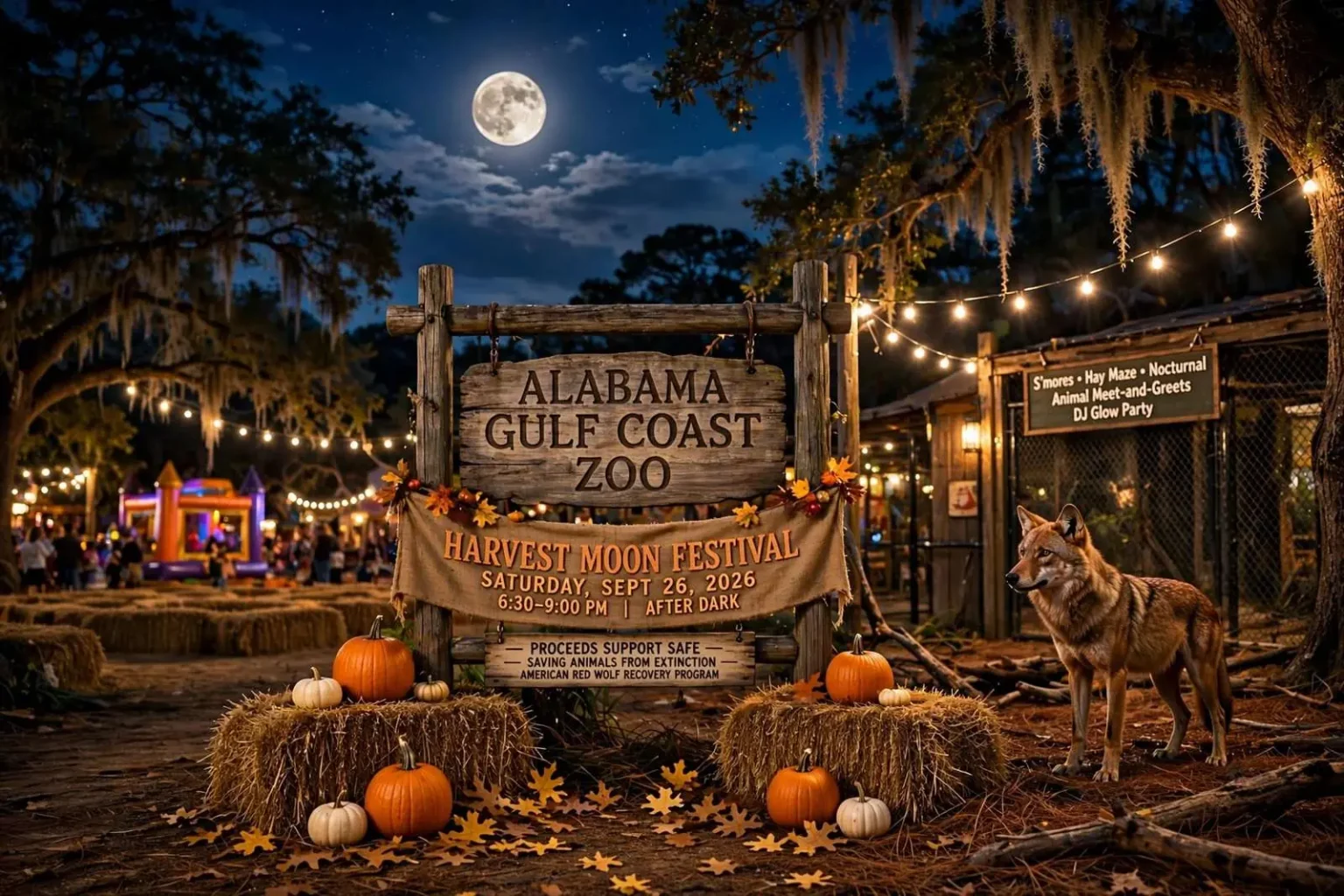
The zoo's after-hours fundraiser returns Saturday, Sept. 26, from 6:30 to 9 p.m. with nocturnal animal activities, a hay maze, s'mores and a DJ Glow Party. A portion of proceeds goes to the SAFE American Red Wolf Program, which the Gulf Shores zoo joined this year as Alabama's first partner facility.
GULF SHORES, Ala. — A zoo at night is a different place than a zoo in the afternoon, and later this month the Alabama Gulf Coast Zoo will open its gates after hours to let visitors find that out for themselves.
The Harvest Moon Festival, one of the zoo’s most popular annual events, returns Saturday, Sept. 26, 2026, from 6:30 p.m. to 9 p.m. The evening is built around activities for all ages, and it doubles as a key fundraiser for the animal care and conservation work the zoo carries out the rest of the year. The event is open to the public as well as to zoo members.
This year the festival also carries a specific conservation purpose. A portion of the proceeds will be donated to SAFE — Saving Animals From Extinction — with the money directed toward the American Red Wolf Program, a species effort the Alabama Gulf Coast Zoo joined this year as the first zoo in the state to become a partner facility.
What the evening includes
The published lineup covers a broad range of ages and energy levels. Bounce houses and a hay maze are on the grounds. There will be s’mores. Animal meet-and-greets and after-dark activities built around nocturnal species run through the evening, and a DJ Glow Party rounds out the schedule.
That mix is deliberate. An after-hours zoo event has to work for a toddler who will last ninety minutes and for a ten-year-old who wants to run. The hay maze and bounce houses handle the second group; the meet-and-greets and s’mores give families a reason to slow down. The glow party, with a DJ, gives the night an anchor point that is less about the animals and more about the atmosphere — which is part of the appeal of visiting a zoo when the sun has gone down.
Why animals behave differently after dark
The nocturnal animal activities are the piece that most distinguishes a festival like this from a daytime visit, and the reason is straightforward biology.
Many species that seem sleepy or inactive to midday visitors are not lazy. They are simply on a different schedule. Nocturnal animals are active at night, and crepuscular animals — a large category that includes many of the mammals people most want to see — are most active around dawn and dusk. A 6:30 p.m. start in late September falls squarely in that window.
The practical result is that behaviors invisible during a summer afternoon become visible: pacing, vocalizing, foraging, patrolling. Animals that spend the hot part of the day in shade come out to move around. Owls and other night hunters become alert. For visitors, that is a genuinely different experience of the same zoo, and it is one of the reasons after-hours events have become a fixture at zoos across the country.
Late September on the Alabama coast also helps. The evening is far enough past the peak of summer heat that walking a zoo path after sunset is comfortable, and early enough in the fall that the weather has not turned.
Ticket prices and how they break down
Tickets are available in advance, and pricing is tiered by age and by membership status.
- General admission, adults: $15
- General admission, children ages three to 17: $10
- Children two and under: free
- Zoo members, adults: $10
- Zoo members, children ages three to 17: $5
The membership discount is substantial in percentage terms — a third off the adult price and half off the child price. That structure is common at nonprofit zoos, where membership functions less like a season pass and more like a recurring donation with benefits attached. Members pay up front for the year, and the institution gets predictable revenue it can plan around rather than gate receipts that swing with the weather.
The free admission for children two and under is also worth flagging for parents doing the arithmetic. A family with an infant or a young toddler is not paying for that child’s ticket, which changes the calculation for households deciding whether an evening event is worth it.
A nonprofit zoo and the cost of 250 animals
The Harvest Moon Festival is described by the zoo as more than a fun night out, and the reason is structural. The Alabama Gulf Coast Zoo is a nonprofit organization, and it depends on events like this to care for the more than 250 animals that live there.
That number is the key to understanding why a single evening event matters. Two hundred and fifty animals is not a figure that scales down in the off-season. Every one of them eats every day, regardless of how many visitors came through the gate that week. A zoo’s largest fixed costs are the ones it cannot defer.
Funds raised through the festival go toward three stated purposes: animal diets, veterinary care and enrichment programs.
Each of those deserves a moment of explanation, because the terms are more specific than they sound.
Animal diets in a professional zoo setting are not simply “food.” They are formulated per animal and adjusted over time. A carnivore, a browsing herbivore, a bird and a reptile require entirely different sourcing, storage and preparation. Diets change with an animal’s age, health status, reproductive condition and season. Keeping a diverse collection fed is a logistics operation, and it runs seven days a week.
Veterinary care covers preventive medicine as well as treatment: routine examinations, dental work, imaging, bloodwork, vaccinations and the specialized handling that any of those procedures requires when the patient is a wild animal. Much of the expense is in the equipment and the expertise rather than in visible, dramatic interventions.
Enrichment programs are the least understood of the three by the general public and among the most important to the animals. Enrichment is the deliberate practice of giving animals problems to solve and choices to make — puzzle feeders, novel scents, varied substrates, structures to climb, opportunities to forage rather than simply be fed. The zoo’s stated goal for the programs is to keep its animals active, in good health and mentally engaged, which is exactly the point. An animal with nothing to do is an animal at risk of both physical and behavioral problems, and modern animal care treats mental stimulation as a welfare requirement rather than a luxury.
The zoo also uses support from events like the festival to run educational programs aimed at helping people learn about wildlife and inspiring them to protect the natural world.
This year’s cause: SAFE and the American red wolf
Choosing a cause to spotlight at the Harvest Moon Festival is an annual task for the zoo’s conservation committee. Its pick for 2026 is SAFE, short for Saving Animals From Extinction, and specifically that program’s work on the American red wolf.
SAFE is a species-conservation framework associated with the Association of Zoos and Aquariums. The idea behind it is coordination: rather than having individual institutions each pursue their own separate efforts, SAFE organizes participating facilities, field partners and funding around specific species with defined recovery goals. Zoos contribute in different ways depending on their capabilities — some hold and breed animals, some fund field work, some focus on public education, and many do a combination.
The American red wolf is among the most pressing cases in North American wildlife conservation. Historically found across the southeastern United States, the species was reduced to a remnant population and declared extinct in the wild in 1980, when the last known individuals were captured to establish a managed breeding program. The recovery effort that followed has depended entirely on cooperation between institutions holding animals in human care and the field programs working to return wolves to the landscape.
That structure is why partner facilities matter. A recovery program built on managed breeding needs places for animals to live — not just space, but staff trained in the species, veterinary support, and a willingness to manage animals according to a coordinated plan rather than an institution’s own preferences.
Jenkins and Walker
Earlier this year the Alabama Gulf Coast Zoo signed on as a partner facility in the SAFE American Red Wolf Program — the first Alabama zoo to do so, a first for the state.
The role involves housing and caring for red wolves through the interval before they are matched with a mate for breeding or returned to the wild. Two of those wolves, brothers named Jenkins and Walker, are living at the zoo as part of the effort.
That description is worth reading closely, because it explains something about how conservation breeding actually works. The wolves are not permanent residents in the way a typical zoo animal might be. They are being held during a specific phase of their lives, with the expectation that their futures will be determined by the needs of the broader program. A wolf may be moved to be paired with a genetically appropriate mate at another facility. A wolf may be identified as a candidate for release.
For visitors to the Harvest Moon Festival, that context turns a portion of the ticket price into something concrete. The money supports a program in which the zoo is not a bystander but a participating facility with animals on site.
What visitors should know
The essentials, in one place:
- What: The Harvest Moon Festival at the Alabama Gulf Coast Zoo
- When: Saturday, Sept. 26, 2026, from 6:30 p.m. to 9 p.m.
- Who it’s for: The public and zoo members alike, with activities for all ages
- Tickets: Available in advance; $15 adults and $10 for children three to 17 for general guests, $10 adults and $5 for children three to 17 for members, free for children two and under
- What it supports: Food, medical care, enrichment and education programs at the zoo, plus a share of the proceeds directed to SAFE and its red wolf work
The two-and-a-half-hour window is short by the standards of a full zoo day, which suits the format. This is an evening event rather than an all-day outing, and it is scheduled to end early enough that families with young children can still make a reasonable bedtime.
What to watch next
The clearest thing to follow after Sept. 26 is the red wolf work itself. Jenkins and Walker are at the zoo during a defined stage of the recovery program, and the next chapter in their story — a breeding pairing, or a step toward release — will be determined by the program they are part of rather than by the zoo alone.
Also worth watching is what the conservation committee selects in future years. The committee’s practice of choosing a cause annually means the Harvest Moon Festival functions as a rotating spotlight, pointing visitors each fall toward a different piece of conservation work.
For one Saturday evening in September, though, the ask is simpler: come see the zoo after dark, and know that the ticket does something.