Alabama health department investigating reports but confirms no measles cases so far in 2019
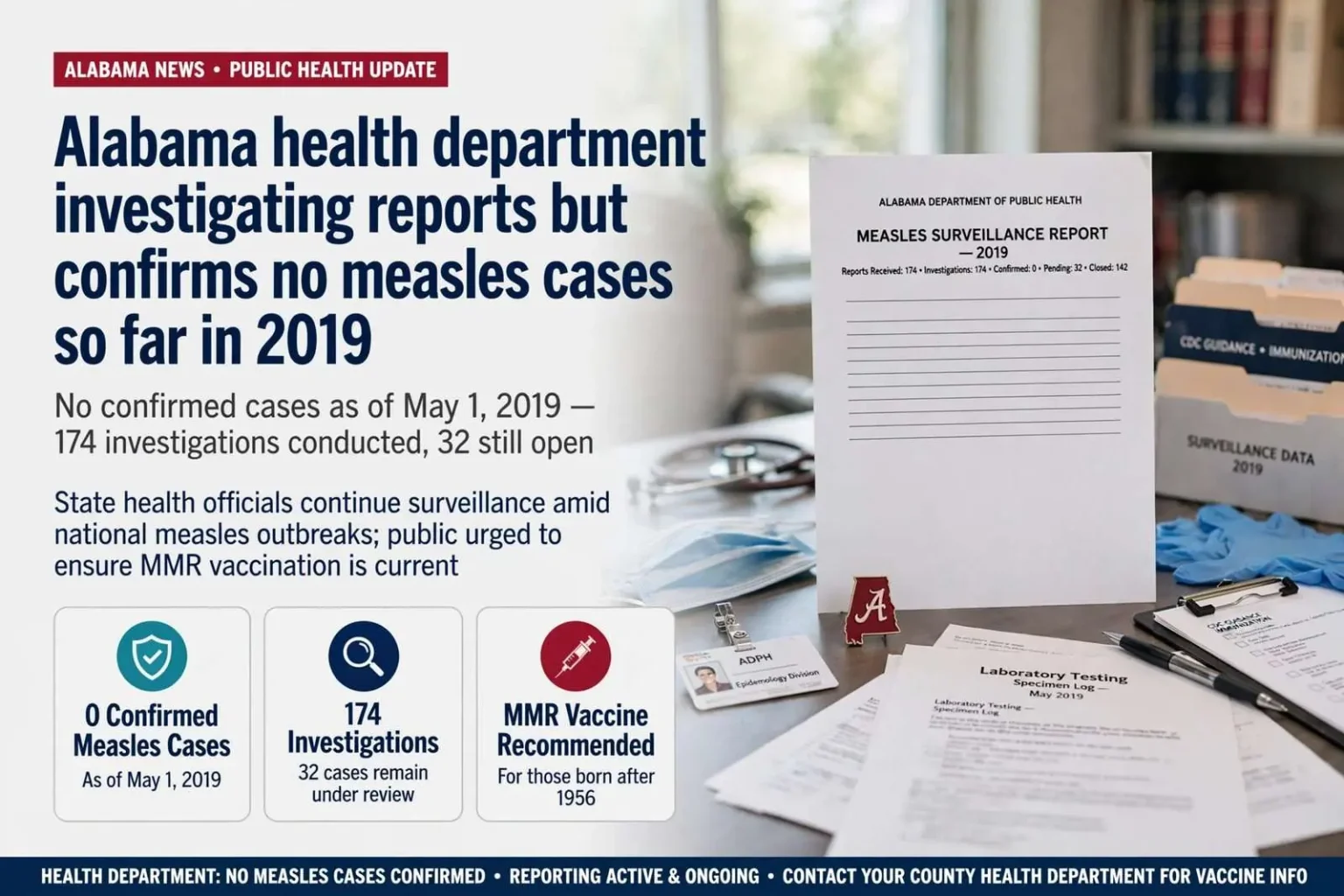
The Alabama Department of Public Health says no measles cases have been confirmed in 2019, though it has opened 32 investigations.
The Alabama Department of Public Health says it has not confirmed any cases of measles in the state so far in 2019, even as questions about the disease circulate. The announcement amounts to an official all-clear — but a carefully worded one, delivered against a national backdrop of outbreaks that had health departments across the country scrambling.
ADPH receives numerous daily reports for notifiable diseases, including any illness of public health importance. That reporting pipeline is the backbone of public health surveillance: physicians, laboratories, schools and hospitals are required to flag suspected cases of specified diseases to the state, and every report triggers an investigation before it can be confirmed, ruled out or attributed to something else.
As of May 1, the department had conducted 174 investigations, 32 of which remained open, with no confirmed measles cases in Alabama this year. The numbers illustrate how much investigative work sits behind a clean surveillance report — more than 170 inquiries into reported illnesses, each requiring case review, laboratory testing and follow-up with patients and providers, with a third still active at the beginning of May.
Most investigations end without a confirmed case of the disease initially suspected. Measles-like symptoms — fever, rash, cough — overlap with a long list of more common illnesses, and in a state with no active outbreak, the vast majority of reports are resolved as other conditions. But every report must be worked as if it were real, because the cost of missing a single case is measured in how fast measles can spread.
For a case to be confirmed, it must meet specific criteria. Confirmation requires the clinical picture — the characteristic fever and rash illness — combined with laboratory evidence, typically detection of the virus or a marked rise in measles antibodies. A doctor’s suspicion alone does not make a case; the criteria exist so that public health action rests on certainty rather than impression.
The department’s transparency about its process carries its own message. If measles is confirmed in Alabama, ADPH said it will issue a statewide news release and hold a news conference — an assurance that the public will not learn of a case through rumor, and that the state’s response machinery would activate the moment one is verified.
Why a Clean Report Still Matters
Measles is a highly contagious disease. The measles virus is among the most transmissible pathogens known to medicine: it hangs in the air of a room after an infected person has left it, and it finds unvaccinated hosts at a rate few diseases can match. That combination is what makes the department’s surveillance posture newsworthy even in a year with no cases.
Health officials urge anyone born after 1956 who has never been vaccinated to get the MMR vaccine from a physician, provider or pharmacy. The 1956 dividing line reflects the disease’s history — before that year, measles was so universal that virtually everyone was infected in childhood and carries natural immunity. Anyone born later who has not received the vaccine, or lacks documentation of it, has no such protection.
The MMR vaccine, which protects against measles, mumps and rubella, is among the most studied and most effective vaccines in use. Widespread vaccination is what turned measles from an ordinary childhood illness — one that infected millions of American children annually in the decades before the vaccine — into a disease that health departments now investigate case by case. The 2019 national outbreaks occurred overwhelmingly in communities with clusters of unvaccinated people, demonstrating how quickly the disease returns when immunity gaps open.
The vaccine’s availability is itself part of Alabama’s safety net. Measles vaccination is standard in childhood immunization schedules, required for school entry under state law with limited exemptions, and available to adults through physicians, county health departments and retail pharmacies — meaning the protection is within reach of nearly anyone who wants it.
About 95 percent or more of unvaccinated people exposed to a single case will contract the disease. That figure — the practical meaning of the virus’s basic reproduction — is the number that drives health officers’ urgency. Measles does not need close contact to spread; shared air is enough, which is why a single confirmed case in a community sends investigators scrambling to identify every location the patient visited and every person who may have been exposed.
What Measles Does to the Body
Complications can range from ear infections and pneumonia to encephalitis. Pneumonia is the most common cause of measles-related death, particularly in young children and adults, while encephalitis — inflammation of the brain — is the most feared, capable of leaving survivors with permanent neurological damage. The disease is especially dangerous for infants too young to be vaccinated, pregnant women and people with weakened immune systems.
For every 1,000 people with measles, one to two will die. The case fatality sounds small until it is multiplied across an unvaccinated population: in the pre-vaccine era, when measles swept through American communities every year, the death toll ran into the hundreds annually, with tens of thousands hospitalized. Before vaccination, measles killed more children in the United States than polio did in typical years.
Early signs include fever, cough, runny nose and red eyes, followed days later by a rash that starts on the face and spreads across the body. The sequence matters clinically: the three C’s — cough, coryza (runny nose) and conjunctivitis (red eyes) — plus fever precede the rash by several days, and patients are contagious before the rash appears, which is exactly what makes the disease so difficult to contain without vaccination.
The rash itself follows a characteristic path, emerging at the hairline and behind the ears before descending across the face, trunk and limbs over several days. Physicians who trained in the vaccine era may see only a handful of measles cases in a career, which is another reason the state’s reporting system exists — the surveillance net catches what individual experience might miss.
How the Investigation Process Works
Behind the department’s numbers is a defined workflow. A notifiable disease report arrives from a physician or laboratory; epidemiologists review the clinical details and initiate contact with the patient or family; laboratory specimens are collected and tested; and investigators trace possible exposures — schools, workplaces, waiting rooms, travel — to determine whether anyone else is at risk.
The 32 investigations still open as of May 1 represented that work in motion. Open cases close in one of two ways: laboratory results and clinical review either identify a different explanation for the illness, or they confirm the disease and trigger the response protocol the department has promised — a statewide news release and a news conference.
Alabama’s system mirrors the national structure, with county health departments serving as the front line for investigations in their communities and the state office coordinating across jurisdictions. When a case has national implications — a traveler with measles moving through multiple states — the network links local investigators with the Centers for Disease Control and Prevention.
What Residents Should Take From the Report
For Alabama families, the department’s message distills to three practical points. First, there is no confirmed measles in the state this year, so an unexplained fever and rash in May 2019 is far more likely to be one of the common lookalike illnesses than measles. Second, the system watching for the disease is active, thorough and functioning — 174 investigations in four months is a department doing its job. Third, the single most effective step an individual can take is to make sure their own household’s vaccination status is current.
Checking vaccination status is straightforward. Adults who are unsure whether they were vaccinated can consult their physician; documented immunity through laboratory testing is also possible for those who cannot locate records. Anyone planning international travel — where measles remains common in many countries — has particular reason to verify protection before departure, since imported cases are the standard way the disease re-enters the United States.
The department’s standing advice on symptoms remains useful even in a year with no cases. Anyone who develops the fever-cough-runny nose-red eyes combination followed by a rash should call a health care provider before walking into a clinic or emergency room — a step that lets providers isolate a potentially contagious patient on arrival rather than exposing a waiting room full of people, including infants too young for vaccination.
The 2019 outbreaks that framed the department’s announcement were a reminder that measles’ elimination from the United States in 2000 is a status maintained by vaccination coverage, not a permanent fact. Outbreaks in New York, Washington and elsewhere that year began with imported cases and spread in under-vaccinated communities, and each one cost millions of dollars in public health response — a price that grows with every immunity gap.
Alabama’s clean report card as of May 1 reflected both that coverage and that vigilance. The state’s investigators had looked at nearly two hundred reports and found no measles — the outcome health officials want, and the one that a well-vaccinated population, backed by a watchful public health system, makes most likely.
Residents with questions about measles, the MMR vaccine or their own vaccination status can contact their health care provider or their county health department, both of which can verify records and administer vaccines.