
Alabama Hospitals Now Required to Report Gunshot Wounds to Police
A new Alabama law requires hospitals to report non-accidental gunshot wounds. USA Health doctors say 30% of victims were unknown to police.
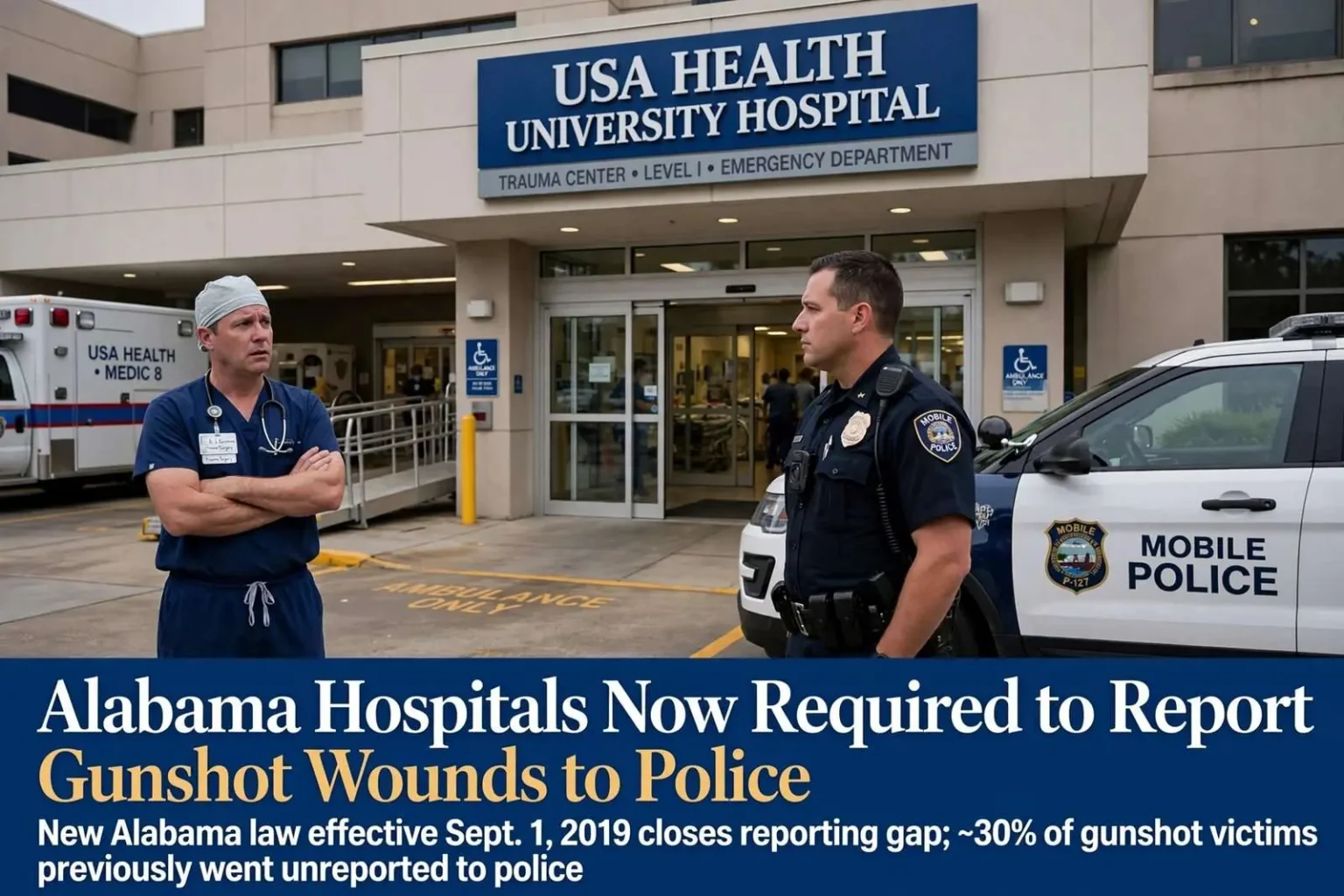
Alabama hospitals are now required under state law to report non-accidental gunshot wounds to law enforcement, closing a gap that left police in the dark about a share of the shooting victims passing through emergency rooms. The law took effect September 1, 2019, making Alabama no longer one of only three states where hospitals were not required to report such injuries. With the change, Alabama joined the large majority of states that treat gunshot wounds as a matter police must know about, leaving New Mexico and Wyoming as the only states without a mandatory reporting requirement on the books.
Before the law passed, a shooting victim brought to a hospital by private vehicle might never trigger a police report because of federal patient-privacy rules. Victims who arrived by ambulance from a public scene typically generated a police response automatically, but those who were driven to the emergency room by friends or family — a common occurrence in cities with high rates of non-fatal shootings — could slip through without any notification reaching investigators. The result was a quiet blind spot: hospitals were treating shootings that existed nowhere in police statistics, and the true scope of gun violence in the community was being understated.
What trauma doctors were seeing
Doctors at USA Health University Hospital in Mobile said the discrepancy was significant. Dr. Jon Simmons, the hospital’s chief trauma medical director, said staff believed they were treating more shooting victims than police knew about. To test the assumption, the hospital and the police department worked together on a data-sharing arrangement that allowed the two institutions to compare records without exposing patient identities, a careful workaround to the privacy rules that had kept the information apart.
By sharing de-identified data with law enforcement, he said, the hospital determined roughly 30 percent of its gunshot patients had been unknown to police. Nearly one in three shooting victims arriving at the region’s busiest trauma center had generated no report anywhere in the system — no investigation, no record, no outreach to the victim. For a police department trying to interrupt cycles of retaliation and connect victims with services, that missing third represented a serious gap in both enforcement and prevention.
The volume behind those numbers is substantial. Simmons said University Hospital treats approximately 300 gunshot victims each year, more than half of them within Mobile city limits. He noted the hospital was on pace for about 2,500 trauma admissions that year, with roughly 20 percent involving penetrating injuries such as gunshot and stab wounds. University Hospital serves as the region’s major trauma center, taking the most serious cases from across southwest Alabama, which makes its emergency department the closest thing the region has to a census of violent injury.
How the law came about
Mobile Police Commander Curtis Graves credited partnerships for moving the legislation forward, including conversations with State Representative Adeline Clark, who embraced the department’s concerns. The measure advanced with the practical experience of trauma physicians and street-level officers behind it, giving lawmakers a concrete picture of what the missing data meant for public safety. Support built around a simple premise: hospitals were already required to report certain wounds in most of the country, and Alabama’s absence from that list was an oversight worth correcting rather than a policy to defend.
Graves also leads Project Thrive, an MPD effort focused on helping victims of violent crime. The initiative reflects a shift in how departments in many cities approach shooting victims — treating them not just as witnesses or potential complainants, but as people whose survival and recovery determine whether a shooting ends a cycle or starts one. Connecting victims with counseling, financial assistance and community resources is intended to reduce retaliation and rebuild trust between neighborhoods and the officers investigating their cases.
Mandatory hospital reporting feeds directly into that approach. When police learn of a shooting at the same time the trauma team does, outreach can begin while the victim is still recovering, rather than weeks later if at all. Investigators also gain a more accurate map of where and how shootings are occurring — information that shapes patrols, monitoring and the allocation of limited detective resources. Public health researchers have long argued that reliable data is the foundation of any violence-reduction strategy, and the reporting requirement gives Alabama communities a more complete dataset than they have ever had.
A public health framing
Simmons said he hopes treating gun violence as a public health crisis — much like traffic crashes — will help reduce shootings over time. The comparison carries weight in a trauma center: traffic deaths fell dramatically over decades not because of any single solution, but because engineers, doctors, lawmakers and police each attacked the problem from their own angle — safer vehicles, better roads, seatbelt laws, enforcement and faster emergency response. Applying the same systematic approach to shootings means studying the data, identifying patterns and intervening where the evidence points.
Trauma surgeons see the argument from the other side of the operating table. Survivors of gunshots frequently arrive with wounds that will shape the rest of their lives — surgeries, rehabilitation, permanent disability — and many know the person who shot them or fear becoming victims again. A system that treats each arrival as a data point in a preventable epidemic, rather than an isolated crime, aims its resources at both the injury and the circumstances that produced it.
The law’s passage also aligned Alabama with a standard that most states have applied for years. In the states that already required reporting, hospital notifications have become routine public-safety plumbing — a phone call from a hospital employee to a law enforcement dispatcher whenever an assaultive gunshot wound is treated. The requirement does not compel victims to make statements, does not turn emergency rooms into interrogation rooms, and does not change the care a patient receives; it simply guarantees that a violent injury known to a hospital is known to police as well.
For Mobile, where University Hospital absorbs the region’s most serious trauma and where police have been working to build trust in neighborhoods affected by shootings, the new requirement lands at the intersection of both institutions’ work. Hospital staff gain partners who can respond to violence beyond the emergency room doors, and police gain visibility into a third of the region’s shootings that had been effectively invisible. Whether the law moves the numbers on shootings — the goal Simmons and Graves both pointed toward — will depend on what the newly complete data is used to build: interventions, services and the kind of coordinated response that reduced traffic deaths over generations of steady work.
The reporting requirement also has practical implications for hospitals themselves. Trauma centers already document injuries carefully for treatment and billing purposes, so the added duty is a notification, not a new recordkeeping burden. Hospital staff in most states are trained to make the call through a designated channel, and the process generally adds only minutes to an admission. What changes is the default: before the law, contacting police required a judgment call and a way around privacy rules; after it, the notification is expected and legally protected.
For victims, the presence of officers after a hospital notification can be an unfamiliar experience, and departments in other states have developed protocols to keep the interaction constructive — explaining why police were notified, offering victim services and making clear that cooperation is voluntary. That handling matters, because the same trust that determines whether a witness talks to detectives also determines whether a wounded person returns to the hospital when complications arise. Programs like Project Thrive exist precisely to manage that human side of the process, pairing enforcement with support so that a police notification does not feel like a second injury.
The law’s arrival in September 2019 marked the end of an unusual distinction for Alabama, and its sponsors and supporters framed it in exactly those terms — not as a new approach to gun violence, but as Alabama catching up to a nationwide standard. The measure’s quiet passage, driven by the partnership between a police commander and a state lawmaker and backed by the firsthand accounts of trauma physicians, showed how a practical data problem can build unusual coalitions. Whether the state’s newly complete shooting data leads to the preventive investments that doctors hope for remains the open question the law leaves behind.
Emergency physicians point out that the undercount the law addresses is not unique to Alabama’s largest city. Any emergency department outside a major trauma system can receive a shooting victim by private vehicle, and without a reporting duty, those cases could vanish from local statistics just as completely. The statewide requirement means the same standard now applies from Huntsville to the Wiregrass, giving every sheriff’s office and municipal department the same baseline awareness that Mobile’s officers gained through their partnership with University Hospital. It is, in effect, the formalization of a practice that had been working informally in one hospital system and is now expected everywhere in the state.


