Alabama House Prepares to Vote on Bill That Would Make Abortion a Felony
On April 30, 2019, Alabama House lawmakers voted on a bill to outlaw abortion statewide and make performing the procedure a felony.
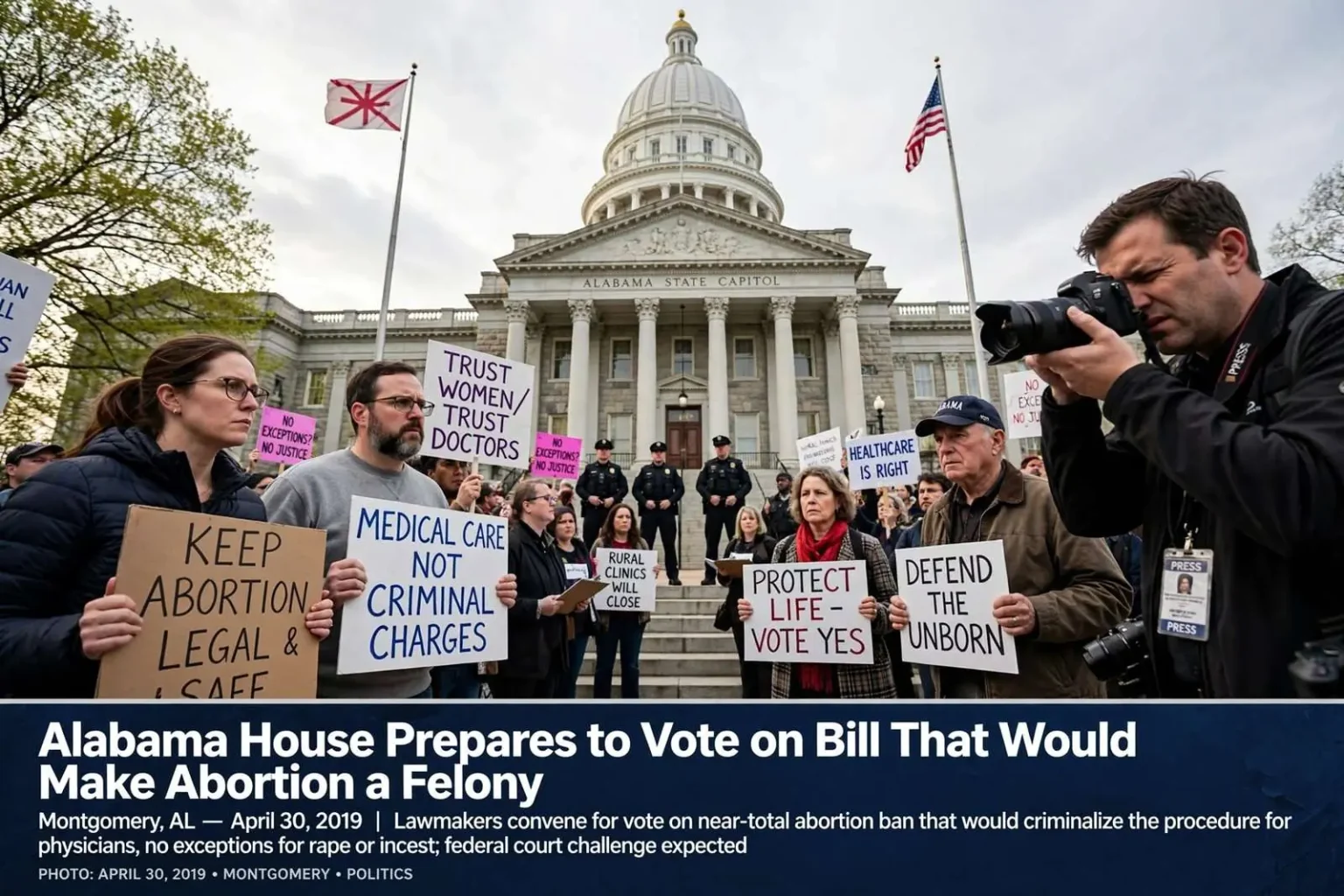
Lawmakers returned to the State House in Montgomery on April 30, 2019, expecting one of the most consequential votes of the session: a bill that would outlaw nearly all abortions in Alabama and make performing the procedure a felony.
Under the measure, a doctor who performed an abortion in Alabama would face felony charges, putting the state on track to have some of the most stringent abortion restrictions in the nation if it took effect. The legislation proposed no criminal penalties for the women undergoing the procedure, directing its enforcement instead at the physicians who performed one — a drafting choice that became one of the bill’s most debated features as the vote approached.
The House vote was expected during that day’s session, with the bill then heading to further steps in the legislative process before any law could take effect — a path that was widely anticipated to include federal court challenges regardless of the outcome.
A Deliberate Challenge
Supporters framed the legislation as a deliberate challenge aimed at prompting courts to revisit national abortion precedent. That strategy — passing a law designed to be litigated — reflected a long-running national debate in which states with strongly pro-life legislatures sought to produce a case capable of reaching the Supreme Court and potentially overturning or weakening Roe v. Wade, the 1973 decision that had established a constitutional right to abortion nationwide for more than four decades.
The reasoning was openly acknowledged by the bill’s backers: rather than crafting legislation to fit within existing precedent, the bill was written to force the courts to reconsider it. Similar legislative campaigns had been underway in other states, but Alabama’s proposal went further than most by banning the procedure from conception, with an exception only where the mother’s life or health was seriously endangered — and none for pregnancies resulting from rape or incest, a point that dominated public discussion of the bill in the days before the vote.
That absence of exceptions drew national attention far beyond Alabama’s borders. Legislatures in other states had enacted restrictions timed to earlier points in pregnancy or requiring specific procedures, but a near-total ban with felony penalties for doctors placed the state’s proposal at the far edge of the national landscape.
Opponents’ Warnings
Opponents warned the bill would criminalize care for women across the state, including in South Alabama’s hospitals and clinics. Critics raised practical questions about the measure’s reach: how doctors would navigate cases involving miscarriages, ectopic pregnancies, and other complications where standard medical treatment intersects with the law’s definitions, and how the absence of exceptions would affect victims of sexual assault.
Advocacy organizations on both sides mobilized as the vote approached. Supporters rallied at the State House in support of the measure, while opponents — including reproductive rights groups, medical professionals, and civil liberties organizations — warned of litigation that would keep the law from ever taking effect and of the consequences for women in a state where access to providers was already among the most limited in the country.
For many residents of South Alabama, the debate was not abstract. Abortion providers in the state had been concentrated in a handful of clinics in cities including Mobile and Huntsville, and restrictions enacted in earlier years had already narrowed access. A near-total ban, opponents argued, would end legal access in Alabama altogether and push patients to travel to neighboring states or, in some cases, to carry pregnancies they were not prepared for.
The Legislative Path
Passing the House was only one stage in a longer process. A bill must clear both chambers of the Alabama Legislature in identical form before heading to the governor’s desk, and amendments adopted in one chamber require reconciliation with the other. From there, a signature would make the bill law — though the effective date, the inevitable legal filings, and the question of which court would block or allow enforcement remained open as the session progressed.
The Alabama Legislature’s annual regular session, limited by the state constitution to 30 meeting days across roughly 105 calendar days in the first half of the year, gives each bill a compressed runway. Consequential legislation like this one typically consumes an entire session, with committee hearings, floor debates, and procedural maneuvers that can advance or stall the bill’s progress from one meeting day to the next.
The expected federal court challenges shaped the debate as much as the bill’s substance did. Both sides understood that a federal judge would likely be asked to block enforcement before the law could take effect, and that the case would begin in the U.S. District Court for the Middle District of Alabama, whose jurisdiction includes Montgomery. From there, an appeal would head to the federal appeals court in Atlanta, with the Supreme Court as the final potential stop.
Montgomery and the Weight of the Moment
Montgomery is no ordinary state capital. The city that served as the first capital of the Confederacy and later as the birthplace of the civil rights movement has long carried a symbolic weight in American political history, and national media gathered at the State House on April 30 reflected that gravity. Reporters, advocates, and spectators filled the hallways as the session convened, a level of attention usually reserved for the Legislature’s most contested fights.
Inside the chamber, the vote promised to be watched closely — not only for its outcome but for the margins, the amendments offered, and the debate transcript that would become part of the historical record. Whatever the House did that day would echo through the courts for years, and every senator and representative understood that the vote being asked of them was designed, by its own supporters’ admission, to be part of a legal strategy rather than a routine exercise of legislative preference.
What a Felony Law Would Mean for Doctors
The bill’s criminal framework centered on physicians. A doctor who performed an abortion would face a felony charge, and the practical effect of such a law — if it survived court challenge — would be to end the practice of abortion in Alabama’s hospitals and clinics entirely, since no provider could continue without risking prosecution.
Medical organizations raised concerns about the cascading effects of such a framework on obstetric care more broadly. Alabama already faced significant challenges in maternal health, ranking among the states with the highest maternal mortality rates, and rural hospitals had been closing their obstetric units for years. Opponents argued that criminalizing a category of care would deepen physician shortages in a state where rural counties already lacked sufficient obstetricians, and that the boundary between abortion care and the treatment of pregnancy complications could leave doctors uncertain about their legal exposure in emergencies.
For women in South Alabama, Mobile’s clinics served the Gulf Coast’s western reach, and patients from the Florida Panhandle and southern Mississippi regularly crossed state lines for care in either direction. A ban in Alabama would redraw that map, sending patients on longer journeys — often hundreds of miles — to the nearest state where the procedure remained legal, a burden falling hardest on those with the least means to travel.
The National Stakes
Alabama’s bill arrived amid a coordinated wave of state legislation across the country, as legislatures with anti-abortion majorities tested how far existing precedent could be pushed. Georgia had recently enacted a ban once a fetal heartbeat was detected, Mississippi and Ohio had passed similar measures, and other states were moving in parallel. Each was written with the courts in mind, and each contributed to the growing body of cases that abortion opponents hoped would eventually give the Supreme Court an opportunity to revisit Roe v. Wade.
The strategy’s underlying arithmetic was public knowledge among court watchers: federal appellate courts covered by more conservative circuits would be the first stop for any enforcement fight, and the composition of the Supreme Court itself had shifted with two appointments in the preceding two years. Whether a five-justice or six-justice majority would entertain a challenge to precedent was the question every commentator repeated, and no one could answer it with certainty on the morning of the vote.
For Alabama lawmakers, the vote represented a question of history as much as policy: whether their state would place itself at the center of a national legal confrontation, at the risk of years of litigation and the near-certainty that any law they passed would be blocked before taking effect. Supporters considered that risk the entire point. Opponents considered it evidence that the bill was theater rather than governance. The House would decide that day which framing it endorsed.
The Session’s Surrounding Context
The abortion vote did not arrive in a quiet legislative environment. The 2019 session carried a full agenda — budgets, infrastructure proposals, and the perennial fights over taxes and gaming — but the abortion bill dominated the State House’s attention, drawing overflow crowds to committee rooms and shifting the session’s rhythm around a single debate. Lobbyists, pastors, students, and activists from across the state made the trip to Montgomery, and the halls of the State House carried the atmosphere of a referendum even though only the Legislature’s vote would count.
Alabama’s political landscape made the bill’s prospects clear from the start. The Legislature had long been controlled by Republicans who campaigned on pro-life commitments, and the state’s voters had approved a constitutional amendment in the prior year’s election declaring that the state recognized the rights of the unborn — a measure that functioned as a preamble to the statutory fight that followed. The question was never whether Alabama’s Legislature would act on abortion restrictions, but how far the law would go and who would bear its penalties.
Waiting for the Vote
As the April 30 session gaveled in, the bill’s supporters and opponents alike settled in for a floor debate that had been years in the making. Amendments were expected — some offered to clarify medical exceptions, others to test the bill’s coalition — and each one had the potential to change the calculation in either chamber or to harden positions further.
Whatever the House did, the next steps were already visible: the Senate’s calendar, the governor’s desk, and the federal courthouse in Montgomery, where the first challenge would be filed within moments of any signature. The path from bill to law to courtroom had been mapped by everyone watching, and the only unknowns were the votes themselves — the record each legislator would leave, and the language they would use to explain it.
For residents of South Alabama, from Mobile’s clinics to the neighborhoods of the Eastern Shore, the debate in Montgomery carried practical stakes that no summary could soften. The bill’s passage would mark a turning point in the state’s approach to one of the most contested questions in American law, and its consequences — legal, medical, and political — would unfold in the months and years that followed, in courtrooms and communities far beyond the chamber where the vote was cast.