Alabama Humanities Alliance Unveils Statewide Exhibits and Events
The Alabama Humanities Alliance announced a statewide slate of Smithsonian exhibits, music tributes and grant opportunities running from Atmore to Foley.
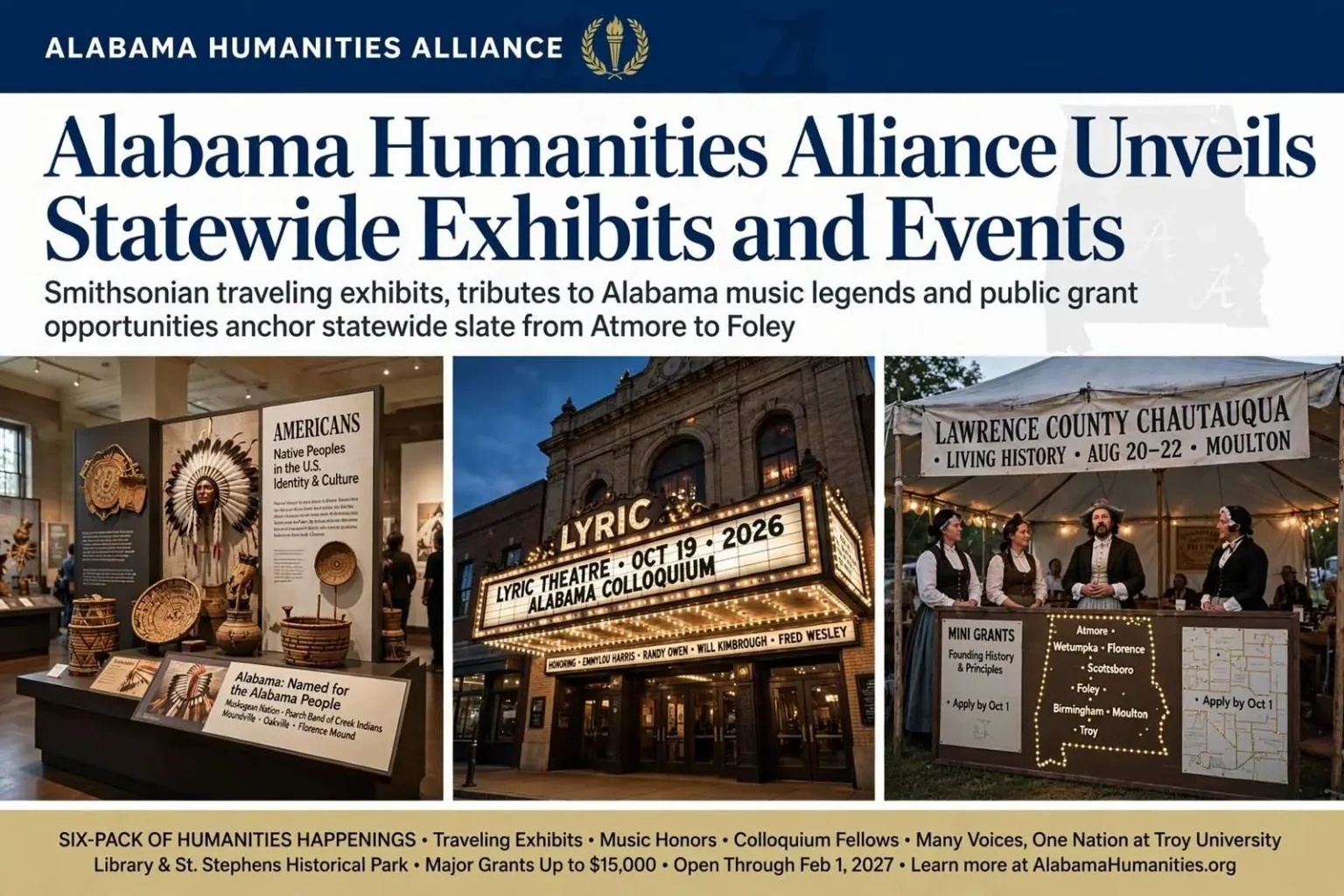
Smithsonian traveling exhibits, tributes to Alabama music legends and public grant opportunities will anchor a statewide slate of programming stretching from Atmore to Foley, the Alabama Humanities Alliance announced this week.
The alliance, known as AHA, outlined what it called a “six-pack of humanities happenings” covering exhibitions, live events and funding opportunities across the state.
‘Americans’ comes to Alabama
Next month, the Smithsonian exhibit “Americans” arrives in the state. Developed by the Smithsonian’s National Museum of the American Indian, the exhibit is billed as “a fascinating and thought-provoking exploration” of how deeply Native Americans are woven into the history, popular culture and identity of the United States.
“This exhibit feels tailor-made for a state like ours, where even our name, Alabama, derives from a Native nation,” the alliance said, noting the Poarch Band of Creek Indians is a sovereign nation within the state and that sites such as Moundville, Oakville and the Florence Mound reflect a “deep, complex, and ongoing” Indigenous history.
The public can explore “Americans” beginning with opening programs in Atmore on September 14-15. The exhibit will later travel to Wetumpka, Florence, Scottsboro and Foley through June 2027, with each community adding local stories told through art, history and public presentations.
Honoring Alabama musicians
Tickets are on sale for a program honoring four Alabama musicians who helped shape American music: Emmylou Harris, Will Kimbrough, Randy Owen and Fred Wesley. Part of AHA’s 2026 Alabama Colloquium series, the event takes place October 19 at Birmingham’s Lyric Theatre, where moderator Burgin Mathews will lead an onstage conversation with the honorees.
‘Considering America at 250’
Also part of the 2026 Alabama Colloquium series, an October 12 program titled “Considering America at 250” will honor Alabamians in history, civics, literature and law. It will welcome three new Alabama Humanities Fellows — attorney Bill Baxley, historian Kathryn Braund and poet Ashley M. Jones. The alliance will also recognize the Alabama USA Semiquincentennial Commission as its 2026 Champion of the Humanities and folklorist Joyce Cauthen as the Greenhaw Service to the Humanities award recipient.
‘Many Voices, One Nation’
Originally a permanent exhibit at the Smithsonian’s National Museum of American History, “Many Voices, One Nation” has been adapted into local “starter kit” versions for America’s 250th anniversary. Now open, the exhibits highlight the people, places and events that shaped life in Dale and Washington counties, AHA’s two host partners. They can currently be found at the Troy University Library and St. Stephens Historical Park.
Grants and living history
Throughout 2026, AHA’s Mini Grant program has prioritized public projects exploring the founding history and principles of America and Alabama. One such event is the Lawrence County Chautauqua, set for August 20-22 in Moulton. The “living history” experience features actors portraying key figures from Alabama’s past — including George Washington Carver, Rosa Parks and Wernher von Braun — alongside food, music and history under the big top each night.
AHA’s Major Grants are also back, offering up to $15,000 for eligible projects that bring Alabamians together to explore “what makes us human.” Applications for fall Major Grants are open with a final deadline of October 1, and a winter round will follow with a deadline of February 1, 2027. Both rounds are meant to help applicants plan 2027 public programming, and can support traveling exhibitions, oral history projects, lectures, festivals, documentary films and more.
What the Alabama Humanities Alliance does
The Alabama Humanities Alliance is a nonprofit organization devoted to supporting the study and public understanding of the humanities across the state. It operates as the state affiliate of the National Endowment for the Humanities’ network of humanities councils, which exists in every state and territory. Through grants, public programs and educator institutes, the alliance helps fund the work of museums, libraries, historical societies, community groups and individual scholars, with the aim of connecting Alabamians to the histories, stories and ideas that shape civic life. The slate of programming it announced this week is a characteristic example of that mission: it bundles together traveling exhibitions, live conversations, fellowship recognitions and grant deadlines into a single statewide calendar.
The emphasis on local storytelling is central to how these programs function. Rather than simply importing a national exhibit and displaying it unchanged, the alliance works with host communities to layer in regional material — the artwork, archives and speakers that make a national narrative specific to a given town. That approach is visible in how “Americans” will pick up local Indigenous history in each of its stops, and in how “Many Voices, One Nation” was built around the particular records of Dale and Washington counties.
The Smithsonian partnership
The Smithsonian Institution, the federal museum and research complex headquartered in Washington, D.C., develops traveling exhibitions like “Americans” and “Many Voices, One Nation” precisely so that communities far from the National Mall can engage with its collections. The National Museum of the American Indian, which produced “Americans,” opened its main building on the National Mall in 2004 and holds one of the largest collections of Native American art and artifacts in the world. Its “Americans” exhibit was designed to examine the paradox of how prominently images of American Indians appear in U.S. national symbols — on sports mascots, currency and monuments — even as the living histories of Native peoples are often overlooked.
For Alabama, the exhibit carries particular resonance because the state’s name comes from the Alabama people, a Muskogean-speaking nation whose homelands extended across what is now the Southeast. The Poarch Band of Creek Indians, based in Escambia County near Atmore, is the only federally recognized tribe in Alabama and operates as a sovereign nation. Sites such as Moundville Archaeological Park in Hale County, Oakville Indian Mounds in Lawrence County and the Florence Mound in Lauderdale County preserve evidence of the complex, centuries-old Indigenous cultures that preceded the state’s incorporation.
The figures behind the honors
The 2026 Alabama Colloquium honors a cross-section of the state’s musical and intellectual life. Emmylou Harris, the Grammy-winning singer whose career helped define country and Americana music, has deep Alabama roots. Randy Owen, as the lead singer of the band Alabama, helped make Fort Payne synonymous with a generation of country music. Will Kimbrough, a songwriter and multi-instrumentalist, and Fred Wesley, the trombonist best known for his work with James Brown and the J.B.’s, represent the breadth of the state’s contributions to American sound. Their October 19 conversation at Birmingham’s Lyric Theatre — a restored 1910 vaudeville house in the Theater District — is intended to trace those connections in the artists’ own words.
The “Considering America at 250” program, by contrast, looks to the nation’s Semiquincentennial, the 250th anniversary of the founding of the United States marked in 2026. Its recognition of figures such as Bill Baxley, a former Alabama attorney general, Kathryn Braund, a historian of the early Southeast, and Ashley M. Jones, the state poet laureate, reflects the alliance’s effort to place Alabama voices inside the national anniversary. The Alabama USA Semiquincentennial Commission was created to coordinate the state’s observance of that milestone, and the Greenhaw Service to the Humanities award — named for writer and folklorist Virginia Hamilton Adair’s fellow chronicler of Alabama, and more directly for the late journalist and author Frye Gaillard’s collaborator, the folklorist — honors sustained contribution to the field.
Why the timing matters
Taken together, the alliance’s announcements arrive at a moment when state and national commemorations are converging. America’s 250th anniversary has prompted cultural organizations across the country to revisit foundational stories, and Alabama’s own layered history — Indigenous, colonial, Civil War, civil rights and contemporary — gives the state unusually rich material to contribute. By stretching its programming from Atmore to Foley and from Florence to Scottsboro, the alliance is deliberately spreading that opportunity across regions rather than concentrating it in a single city, so that residents in small and mid-sized communities can take part in the national conversation on their own terms.
The Chautauqua tradition in Alabama
The Lawrence County Chautauqua, scheduled for August 20-22 in Moulton, draws on a distinctly American format. The original Chautauqua Institution in upstate New York began in the late 19th century as a training ground for Sunday school teachers and grew into a traveling movement of summer assemblies that brought lectures, music and entertainment to towns across the country by tent and platform. Modern living history Chautauquas borrow that revival-meeting spirit but replace the sermons with first-person portrayals: scholars in costume step into the roles of historical figures and answer questions in character. In Moulton, the lineup – George Washington Carver, Rosa Parks and Wernher von Braun – spans science, civil rights and the space age, three threads of American achievement that each touch Alabama directly, from Carver’s agricultural work at Tuskegee to Parks’s catalytic role in the Montgomery bus boycott to von Braun’s rocket program at Huntsville’s Redstone Arsenal.
That range is no accident. The alliance’s grants and programs are built to surface exactly these local connections, and the Mini Grant emphasis on founding history and principles is meant to give smaller organizations the resources to stage their own commemorations rather than relying solely on traveling Smithsonian material. For a county like Lawrence, hosting a Chautauqua under a tent is both a civic event and a reminder of how national anniversaries are ultimately observed at the community level.
How to take part
Residents interested in the programming can attend the opening Americans events in Atmore on September 14-15, visit the Many Voices, One Nation displays at the Troy University Library and St. Stephens Historical Park, or secure tickets for the Birmingham Colloquium events in October. Organizations with their own public-humanities ideas can apply for Major Grants before the October 1 fall deadline, with a second round closing February 1, 2027. Together, the exhibits, honors and funding opportunities form a single, extended invitation – extending into 2027 – for Alabamians to consider their state’s place in the American story.