Alabama lawmakers to discuss expanding high-speed internet access
Alabama lawmakers, including Sen. Clay Scofield and Lt. Gov. Will Ainsworth, are taking up a bill to expand rural broadband access through funding grants.
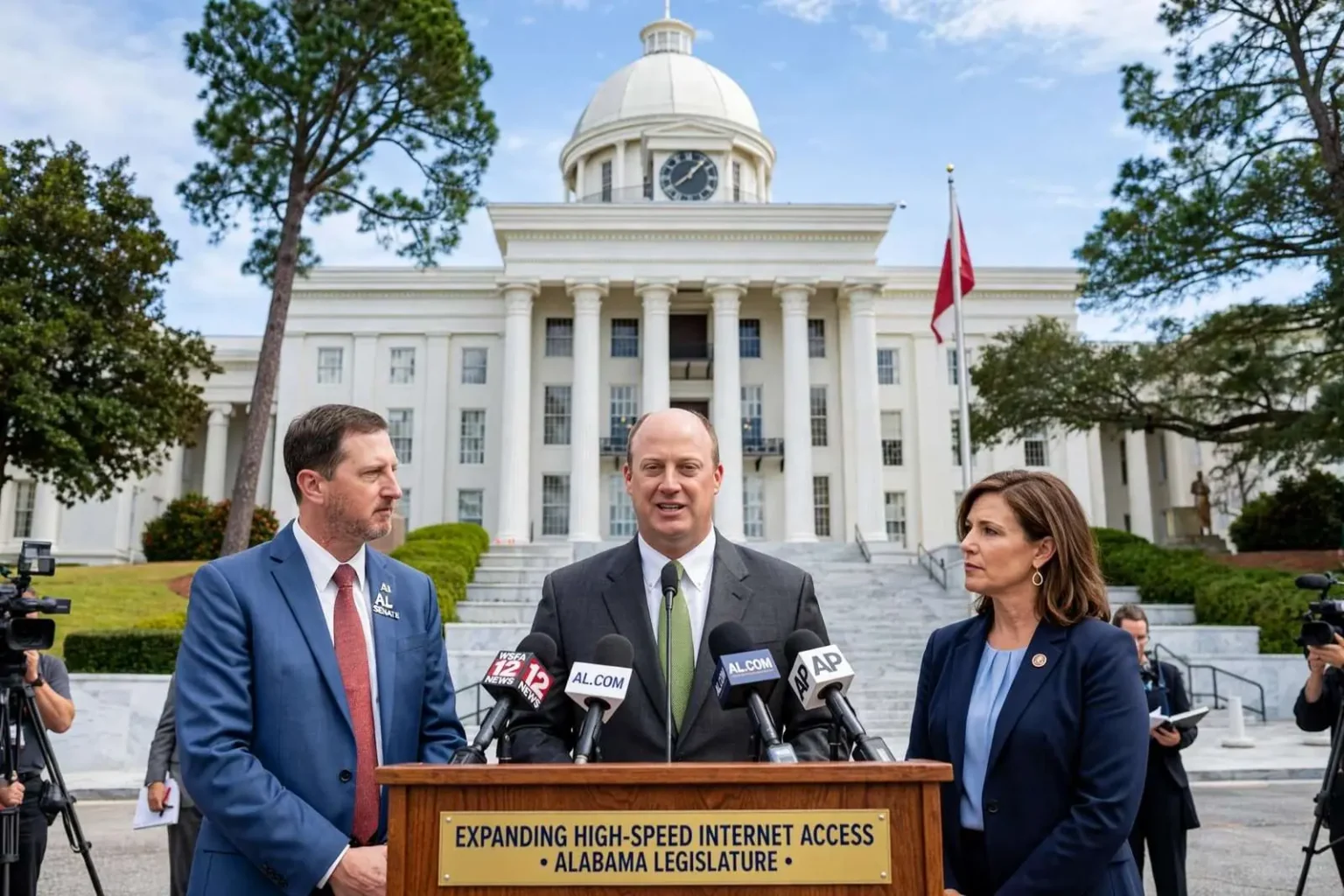
MONTGOMERY, Ala. — Alabama lawmakers are preparing to take up legislation aimed at expanding high-speed internet access across the state. State Sen. Clay Scofield (R-Guntersville) is sponsoring a bill that would amend state law to make more areas eligible for broadband funding grants. Members of the Alabama House and Senate are expected to join Lt. Gov. Will Ainsworth in discussing the importance of the legislation. Lawmakers say the infrastructure bills address what they describe as the unfairness faced by many rural residents and small businesses that lack reliable, high-speed internet service.
The legislation aims at a gap that has defined Alabama’s economy for years: the stretch of the state between its cities where broadband either does not reach or arrives too slow and too unreliable to count. State Sen. Clay Scofield, the Guntersville Republican whose Marshall County district sits squarely in that territory, is sponsoring a bill to amend state law so that more areas qualify for broadband funding grants — widening the door through which public money can flow to underserved communities.
The proposal arrives with high-level backing. Members of both the Alabama House and Senate are expected to join Lt. Gov. Will Ainsworth, who presides over the Senate, in a public discussion of the legislation’s importance. That lineup matters in Montgomery: broadband bills compete for attention with the state budget, and a coordinated push from the Senate’s leadership and both chambers signals that the issue is intended to move rather than to stall in committee.
Alabama’s broadband gap
The scale of the problem is easiest to see from outside the cities. In Alabama’s metropolitan cores — Birmingham, Huntsville, Mobile, Montgomery — households choose among multiple providers and speeds that compare with anywhere in the country. Drive into the rural counties that make up most of the state’s land area, and the choices collapse: a single telephone company’s aging DSL, a satellite service with high latency and data caps, or in the most unserved pockets, nothing workable at all. Students drive to library and school parking lots to use the wireless they cannot get at home; farmers and small manufacturers run their businesses over cell hotspots.
The consequences compound. Rural school systems whose students lack home internet cannot assign digital homework equitably; telemedicine — a lifeline for rural counties losing hospitals and physicians — requires upload speeds many communities have never had; and businesses weighing locations cross Alabama’s unserved areas off the list before a recruiter ever calls. Lawmakers describe the situation as a fairness problem, and the framing is deliberate: a resident’s ZIP code should not determine whether the basic infrastructure of modern economic life reaches their door.
The market alone has not closed the gap, which is the economic logic behind the legislation. Sparsely populated areas offer telephone and cable companies too few customers per mile to justify the capital costs of fiber or fixed wireless. That is why states have built grant programs — public funds that subsidize the private construction of networks in areas the market will not serve — and why eligibility rules matter so much. Where the law draws the lines of eligibility determines which communities can even apply.
What the bill would change
Scofield’s bill targets those lines. By amending state law to make more areas eligible for broadband funding grants, the legislation widens the pool of communities that can compete for state support — a recognition that existing definitions of “unserved” and “underserved” had left too much of rural Alabama on the outside looking in. Eligibility rules that hinge on census-tract data or provider-reported speeds have a way of declaring a place served on paper while the household at the end of the road still cannot stream a video call.
The state’s grant framework is the Alabama Broadband Accessibility Fund, created by the Legislature to subsidize deployment in areas lacking adequate service, and the coming debate is about how far its reach should extend. Every expansion of eligibility increases the competition for a limited pool of dollars; every restriction preserves the fund for the worst-served areas but risks leaving near-miss communities stranded. Scofield’s proposal slots into that balance — a bet that wider eligibility will speed deployment across more of the map.
The legislative machinery around the bill is as important as its text. With Lt. Gov. Ainsworth joining House and Senate members in publicly pressing the case, the legislation carries leadership momentum that smaller infrastructure bills rarely enjoy. Ainsworth, whose own north Alabama roots include Marshall County’s neighbors, has made rural development a recurring theme of his tenure, and broadband is its most concrete expression: the prerequisite, as he and other backers argue, for everything from remote work to rural health care to modern agriculture.
Why rural broadband is economic development
The lawmakers pushing the bills frame them as infrastructure in the oldest sense — roads and bridges for the digital economy — and the argument has local examples everywhere. Rural counties that lost textile and timber jobs in past decades have spent a generation trying to recruit replacements; the industrial recruiters who court modern manufacturers now lead with fiber availability, because automated plants, logistics operations and remote engineering teams all assume it. A county without broadband is invisible to the site-selection software that narrows corporate searches before any human visit.
Small businesses feel the same pressure from below. A rural restaurant, veterinarian or machine shop in 2020s Alabama runs on cloud software, card processing, online ordering and video calls with suppliers — services that degrade or fail entirely on a marginal connection. The lawmakers’ language about unfairness is aimed at that daily friction: rural entrepreneurs paying the same taxes as urban ones for infrastructure that does not reach them.
Education has become the issue’s most urgent front. Alabama’s schools have moved toward digital curricula, online testing and take-home devices, none of which work as designed when students lack home internet. The pandemic made the disparity visible in real time, with rural and low-income households parking outside libraries and schools to borrow wireless. Legislators from both parties have cited those scenes in arguing that broadband funding is, in practical terms, school funding.
The path through the Legislature
Alabama’s process for the bill follows the state’s familiar course: introduction and referral to committee, where telecommunications and local-government legislation is heard; committee debate over eligibility language and funding mechanics; and, if it advances, floor votes in both chambers. The expected show of unity from House and Senate members alongside the lieutenant governor is designed to carry the bill past the point where worthy infrastructure measures historically die — the budget-year squeeze, the jurisdictional competition between committees, the quiet burial of anything without a champion in leadership.
The money question runs underneath the whole debate. Grant programs are only as effective as their funding, and Alabama’s broadband fund has been replenished unevenly across budget cycles, competing with prisons, Medicaid and education for every dollar. Expanding eligibility without expanding the fund can thin out the grants; that tension will shape the bill’s final form, as will the parallel federal money — the federal government’s own broadband programs have been pouring infrastructure dollars into the states, and state eligibility rules determine how much of it Alabama’s unserved areas can capture.
Scofield’s Guntersville district gives the legislation a fitting sponsor. Marshall County sits among the state’s lake-and-farm communities where manufacturing plants, tourism businesses and schools all bump against the same connectivity ceiling, and the senator has carried rural-infrastructure legislation through previous sessions. A bill born from that district’s experience, backed by the Senate’s presiding officer and members of both chambers, represents the broadest coalition Alabama’s broadband push has yet assembled.
What it would mean for communities
If the legislation passes and the grants flow, the change arrives the slow way — construction seasons of fiber lines and wireless towers, county by county — but its effects last for decades. Households gain the ability to work, study and access telemedicine from home; rural health clinics gain the bandwidth for the specialist consults that keep patients from driving hours for routine care; and counties gain the checkbox that moves them onto corporate site-selection lists at all.
The fairness framing the lawmakers use is also a political statement about Alabama’s future. The state’s rural counties have watched population and investment concentrate in the metropolitan crescent for decades, and broadband is among the few levers state government can pull that reaches every community simultaneously. Whether the infrastructure bills deliver on that promise depends on the details still to be negotiated — eligibility lines, funding levels, the interaction with federal programs — but the starting point is a rare one: a problem, a legislative vehicle, and leadership from both chambers and the lieutenant governor’s office all pointed at the same gap.
For the residents and small businesses the bill describes — those who have lived with the unfairness of unreliable service while the cities streamed ahead — the legislation is the state acknowledging what they have said for years: that high-speed internet is no longer a luxury, and that Alabama’s rural communities cannot afford to wait for the market to arrive on its own.
The measure of success
The test of the legislation will not be the vote count but the coverage map. Alabama has measured its broadband gap for years through federal and state surveys that lag reality, and communities have learned to distrust “served” designations drawn from provider self-reporting. If the expanded eligibility Scofield’s bill creates translates into grant applications from counties that previously couldn’t qualify — and construction contracts in places that have waited a decade — the bill will have done what its sponsors promise.
The coalition behind it suggests the political will exists. Rural broadband has become one of the few genuinely bipartisan issues at the State House, uniting legislators from the Black Belt, the Tennessee Valley, the Wiregrass and north Alabama’s foothills — every district where the map turns white on the coverage charts. Lt. Gov. Ainsworth’s presence at the forefront, with House and Senate members alongside, gives the effort the leadership sponsorship that determines whether a bill becomes law or a press release.
Alabama’s lawmakers have chosen to describe the state’s broadband gap as an unfairness rather than a misfortune, and the legislation they are preparing treats it as something the state can fix. The grant eligibility lines the bill redraws will decide, quite literally, which Alabamians get to participate in the connected economy — and for the rural residents and small businesses who have waited longest, the session ahead is the closest thing to a promise they have yet received.