Alabama League of Municipalities Holds Off on Pushing to Delay 2020 City Elections
The Alabama League of Municipalities declined to push for delaying August's city elections, saying it will revisit the question in June depending on the state's COVID-19 restrictions, a decision that could affect races in Prichard, Fairhope and Daphne.
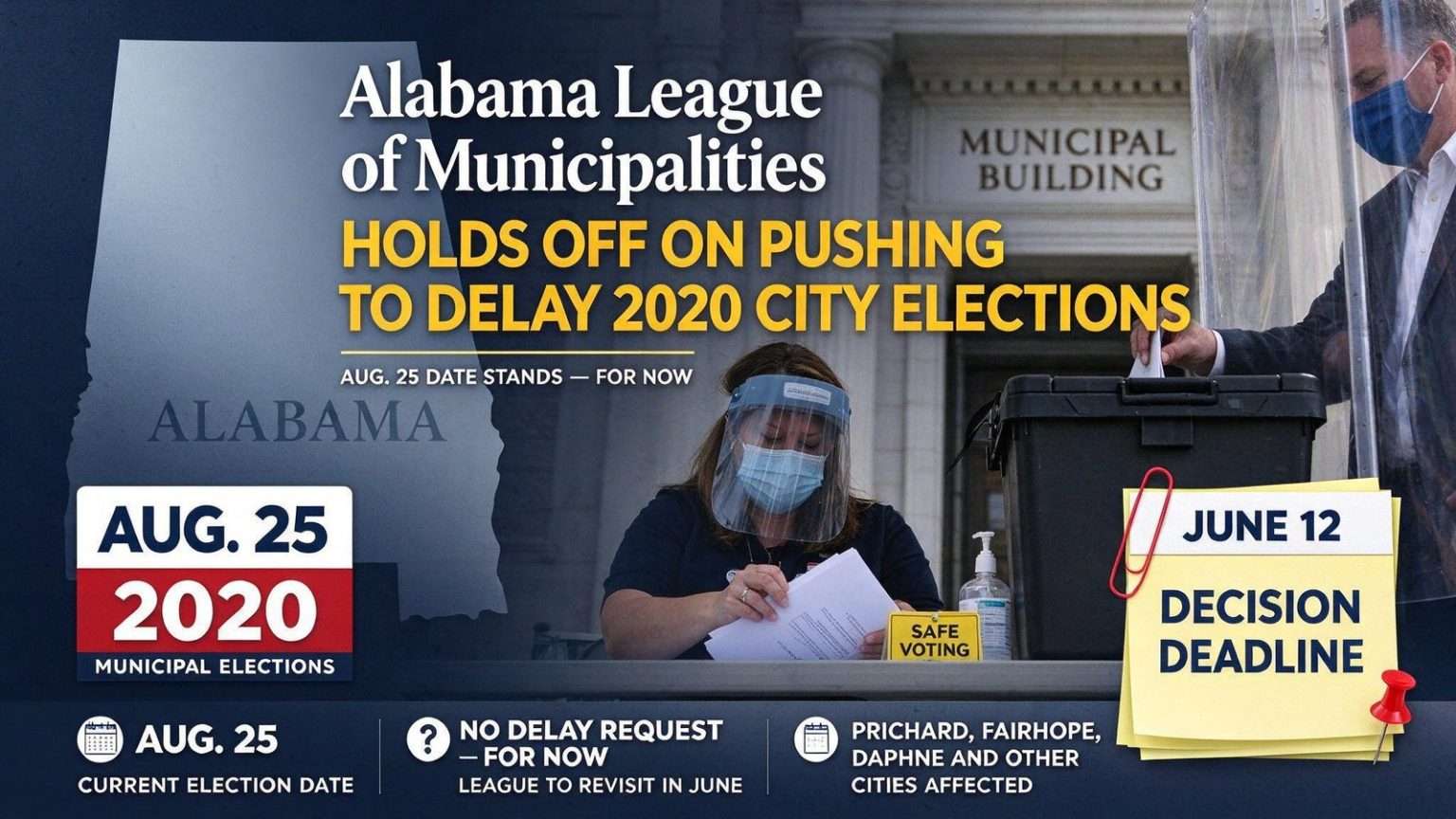
The Alabama League of Municipalities will not ask state lawmakers to postpone this year’s municipal elections for now, opting instead to wait and see how long Alabama’s COVID-19 restrictions last before deciding whether to seek a change in election dates that could affect races in Prichard, Fairhope, Daphne and dozens of other cities across the state.
The organization’s executive committee met Thursday morning and considered whether to lobby the Legislature to move the elections, which are scheduled for most Alabama cities on Aug. 25, to sometime in 2021. After discussion, the committee decided against taking any action immediately, according to ALM Deputy Director Greg Cochran, who briefed reporters afterward on a conference call.
A decision deferred, not abandoned
Cochran said the committee will revisit the question in June, when it will have a clearer picture of whether the state remains under a shelter-in-place order tied to the coronavirus pandemic. If restrictions are still in place at that point, the league could pursue a change through two different paths.
“They’ll seek the change only if we’re still in this condition,” Cochran said. “If the conditions do not improve by June, we can seek to move the elections by petitioning Gov. Kay Ivey.”
Under Alabama law, Ivey would only have the authority to shift the election dates herself if the state remained under a declared state of emergency at that time, Cochran said. Absent that emergency declaration, the league would instead need to ask the Legislature to pass a bill authorizing the delay. Individual cities could also petition the governor separately for the same relief, he added.
Cochran said the committee is aiming to make a final call by June 12, a timeline that would put the decision after the Legislature wraps up its 2020 regular session, narrowing the path mostly to a request routed through the governor’s office.
The sequencing mattered. A legislative route to a delay would have required a bill to move through both chambers before the session’s close, with all the committee time, floor debate and negotiation that entails; a gubernatorial route required only the persistence of the emergency declaration the state was already under. By scheduling its final call for after the session’s end, the committee effectively chose which door it intended to knock on.
How the idea took hold
The idea of delaying municipal elections gained traction after Ivey pushed back the state’s congressional runoff elections to July 14 because of the pandemic. That decision prompted league officials to start weighing whether a similar postponement might eventually be needed for city races, even though the executive committee ultimately decided it was premature to act.
“This came about after [Ivey] moved the runoff elections,” Cochran said. “We started to think about how we plan ahead in case we’re in this predicament into June. Most of the committee felt it was too early to change the dates at this time.”
The runoff move had established the precedent that Alabama election calendars were not fixed in a pandemic year — and had shown the mechanism, the governor’s emergency authority, by which they could be changed. It also created a practical complication: municipal qualifying and campaign seasons were already running, and a shifted runoff meant candidates and absentee coordinators were operating against dates that had themselves moved once.
A menu of dates, not a single demand
If the committee does eventually vote to seek a postponement, Cochran said the league would present the governor with a menu of alternate dates and let her choose among them, rather than proposing a single fixed date.
The approach was designed to keep the league’s request from becoming a negotiation over a specific day. Offering a range would let the governor weigh security conditions, holiday calendars and the state’s other election commitments, and would keep individual cities from lining up behind competing dates. It also preserved a key advantage of Alabama’s municipal structure: cities set their own election machinery, and a menu accommodates the state’s variation in qualifying deadlines and runoffs.
Any shift would ripple through the calendar beyond election day itself. Runoffs, certification deadlines, oath dates and the seating of new councils all hang off the August date, so a move to 2021 would push back the full transition of municipal governments — and, for mayors and council members whose terms end with the election, extend their current terms until a replacement is seated.
Who would be affected on the coast
A delay would not affect Mobile, since the city’s municipal elections are already scheduled for 2021. But it would directly affect this year’s races for Prichard’s City Council seats and mayor’s office, along with elections in Fairhope, Daphne and other municipalities across Baldwin County that are on the August ballot.
The distinction turned on the staggered rhythm Alabama cities follow: municipalities hold elections in the year before the state’s federal cycle — 2020 — but each city’s four-year terms begin and end on its own schedule, and Mobile’s terms ran a year offset from its neighbors. For Baldwin County’s fast-growing cities, the 2020 races would seat the councils that govern through the county’s ongoing population boom, making the question of when voters cast those ballots more than procedural.
In Prichard, where the mayor’s office and council seats are all on the 2020 ballot, the timing carried particular weight. The city has faced chronic fiscal strain, and whoever wins in August would steer budget decisions and city services through a recovery period. A delayed election would extend every incumbent’s term — and postpone the voters’ chance to render a judgment on them.
Opposition organizes
Not everyone welcomes the idea of pushing the elections back. Prichard District 1 City Councilman Lorenzo Martin has been among the most vocal critics of any potential delay, arguing it would infringe on residents’ right to choose their own leaders on schedule.
Martin has helped organize a group called Alabama Citizens’ Right to Vote and said he has been contacting municipal officials throughout Mobile County to build opposition to any postponement.
“Most of the leaders we’ve talked to are against moving the elections,” Martin said. “It’s not fair to the citizens and their right to vote.”
His argument framed the question as one of principle rather than logistics: other states had held primary elections during the pandemic with expanded absentee balloting and social-distancing precautions, and Alabama’s own runoff was moved only once. Municipal elections, conducted in city halls and polling places already adapted to public health requirements, could be administered safely, opponents argued, without rewriting the calendar.
What absentee voting offered
The alternative to postponement was expansion of absentee voting. Alabama’s existing absentee process already allowed any qualified voter to vote by mail with an excuse, and pandemic-era adjustments — extended application windows, curbside drop-off options in some jurisdictions — offered cities a way to hold their elections on schedule while protecting vulnerable voters.
Election officials had been gearing up along those lines when the league’s deliberations began. Municipal clerks handle their own elections, from poll worker recruitment to ballot preparation, and the spring’s planning work had been directed toward an August date run under public health protocols: spaced equipment, sanitizing stations, poll worker protective gear and renewed encouragement of absentee applications.
The cost question ran through those preparations too. A postponed election would require re-election machinery in 2021 for hundreds of municipalities — new ballots, new notices, re-qualification of poll workers — while a held election required only the incremental expense of pandemic adaptations. For small towns operating on thin budgets, that arithmetic was not abstract.
The waiting game
With the league’s decision now pushed to June, candidates and election officials in Prichard, Fairhope, Daphne and other affected cities are left to prepare for an Aug. 25 election date that remains, for now, unchanged.
The uncertainty lands hardest on campaigns. Municipal races in Alabama run on modest budgets and volunteer labor, and candidates plan their door-knocking, signage and fundraising around a fixed date. A shadow calendar — prepare for August, contingency-plan for 2021 — complicates both spending decisions and the personal lives of candidates who structure jobs and family schedules around a short, intense campaign season.
For the League of Municipalities, the deferred decision reflected its role: the organization serves cities of every size and disposition, and its executive committee’s caution mirrored the division among its own members between those seeking safety in postponement and those, like Martin’s coalition, demanding the election happen on time.
By the time June 12 arrived, the executive committee’s choice would determine whether Alabama’s city governments spent the summer preparing for a normal election or for the state’s most unusual one. Until then, the Aug. 25 date stood — and cities across the state planned for an election that might still be moved.