University of South Alabama Mobile
Alabama Lineman Alex Leatherwood Set for Reese’s Senior Bowl in Mobile
Alabama offensive lineman Alex Leatherwood, fresh off winning the Outland Trophy, has accepted an invitation to play in the Reese's Senior Bowl at Hancock Whitney Stadium in Mobile.
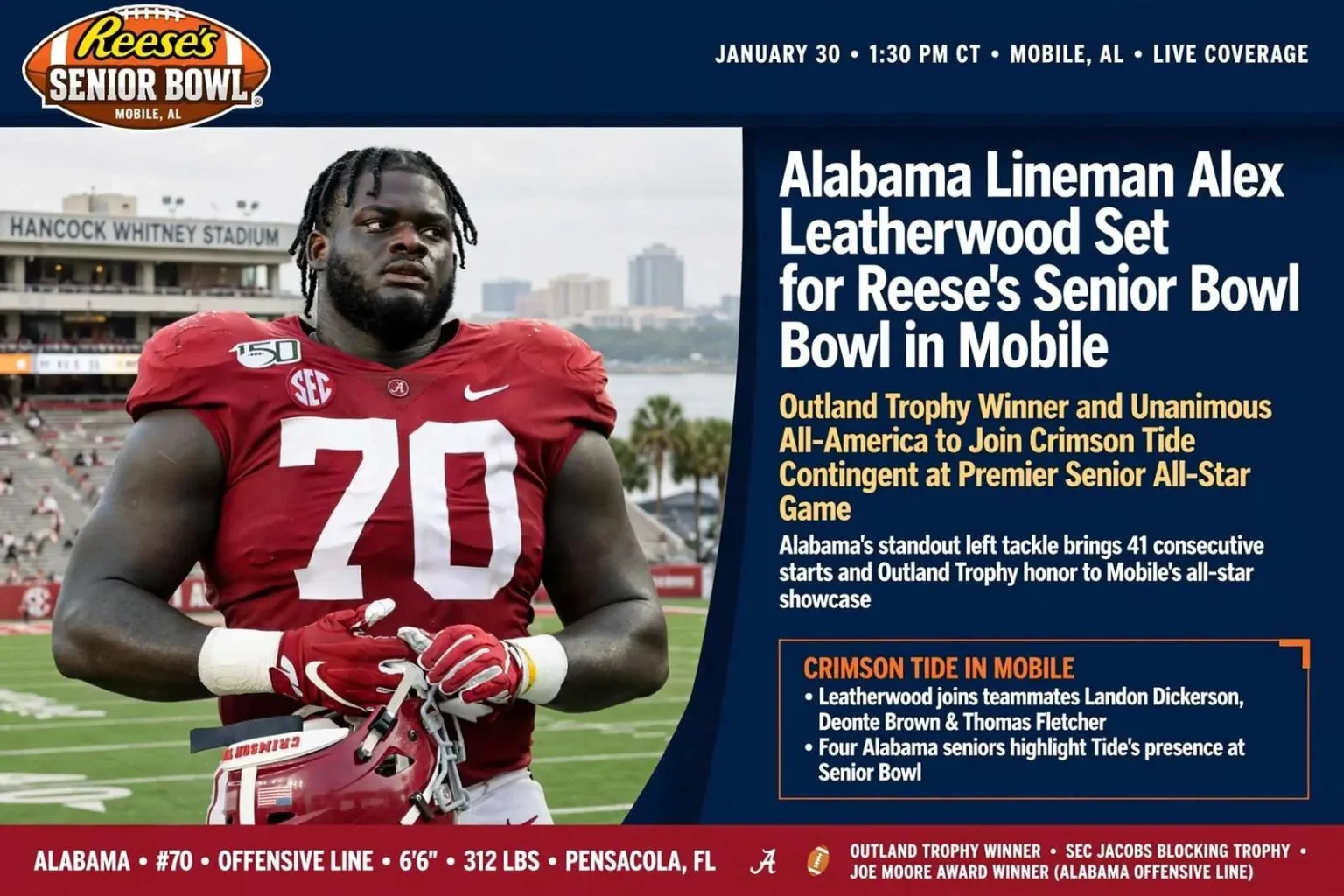
Alabama offensive lineman Alex Leatherwood has accepted an invitation to play in this year’s Reese’s Senior Bowl, continuing a standout season that has already earned him some of college football’s most prestigious individual honors. The decision puts one of the Crimson Tide’s most decorated linemen on the field in Mobile, where the nation’s premier senior all-star game has long served as the first major stop on the road to the NFL draft.
Leatherwood, a 6-foot-6, 312-pound native of Pensacola, Florida, was recently presented the Outland Trophy, awarded annually to the nation’s top interior lineman. The award placed him in a lineage of winners that includes some of the most celebrated linemen in college football history, and it confirmed what Alabama’s coaching staff had argued all season: that the anchor of the Tide’s offensive front was among the very best in the sport regardless of position.
For Leatherwood, the honor capped a career spent protecting the blind side of one of college football’s most scrutinized offenses. Playing left tackle at Alabama means facing elite pass rushers every week in Southeastern Conference play, often with the expectation that a single breakdown will be dissected nationally. Leatherwood’s consistency across that workload is a large part of what drew the attention of award voters and, now, of every personnel department in the NFL.
A Trophy Shelf Built on Consistency
The Outland Trophy was not his only hardware. Leatherwood also shared the Southeastern Conference’s Jacobs Blocking Trophy with teammate Landon Dickerson, an award given to the league’s top blocker, and helped anchor an Alabama offensive line that captured the Joe Moore Award as the country’s top offensive line unit. Sweep those three honors together and the picture is complete: the nation’s best interior lineman, the SEC’s best blocker, and the country’s best line all shared a common thread running through the Alabama locker room.
The Joe Moore Award in particular reflected a group effort. Alabama’s line opened rushing lanes for a high-powered offense and kept its quarterback upright through a national championship run, and the unit did it with a rotation of players who stepped in and out of the lineup without the protection deteriorating. That kind of depth is rare in college football and speaks to the development pipeline the Tide have built along the offensive front.
A unanimous first-team All-America selection, Leatherwood started 41 consecutive games during his career with the Crimson Tide and posted a 91.3 percent blocking grade for the season, a mark that reflects the consistency he brought to Alabama’s line week after week. Forty-one straight starts at any position demands durability; doing it on the offensive line at Alabama, against a schedule stacked with future NFL defenders, is a different level of achievement entirely.
The blocking grade, compiled from week-to-week performance evaluation, tells scouts what the trophy shelf already suggested: Leatherwood’s play was not carried by a few dominant highlights but by steady, repeatable execution. Offensive line evaluation prizes exactly that. Teams drafting linemen are buying reliability for the next decade, and a season-long grade in the low nineties is the kind of objective measure that moves a prospect up draft boards.
He will be joined in Mobile by fellow Alabama offensive linemen Dickerson and Deonte Brown, as well as long snapper Thomas Fletcher, giving the Crimson Tide a significant presence in this year’s all-star game. Four Alabama seniors on one roster is a statement about the program’s veteran depth, and it gives local fans a familiar rooting interest when practice begins. Few schools send an entire starting-line nucleus to the same all-star venue, and the grouping will let NFL evaluators study how the unit’s chemistry translates against new competition.
Why the Senior Bowl Matters
The Reese’s Senior Bowl gives NFL scouts and coaching staffs a close look at some of the top eligible prospects in the country as they prepare for the draft. The week is unlike anything else in the pre-draft calendar. Practices are open to every team in the league, coaching staffs from NFL franchises run the sessions, and every rep is charted, filmed and debated by the hundreds of evaluators who flood into Mobile for the week.
For offensive linemen especially, the game carries outsized importance. Line prospects rarely run and jump their way up draft boards at the scouting combine; their evaluation lives in the tape, and the Senior Bowl provides the only sanctioned setting where college standouts face elite pass rushers one-on-one in a structured environment before the draft. A strong week of practice in Mobile has historically done more for an offensive lineman’s stock than any other pre-draft event.
The game is scheduled to kick off at 1:30 p.m. on Jan. 30 at Hancock Whitney Stadium on the University of South Alabama campus. The venue, the on-campus home of the Jaguars, gives the Senior Bowl a modern home in the heart of Mobile and keeps the event anchored to the city that has hosted it for decades. Kickoff timing puts the game in the middle of a weekend that has grown into one of the Gulf Coast’s signature sporting occasions.
Organizers have already announced the contest is a sellout, reflecting the strong local interest the Senior Bowl draws each year to the Mobile area. That demand has become part of the event’s identity. Hotels fill along I-10, restaurants downtown absorb a week’s worth of football tourism, and the city effectively becomes the center of the NFL universe for a few winter days — an unusual position for a market without an NFL franchise of its own.
A Gulf Coast Tradition
The Reese’s Senior Bowl has long served as a showcase event for the Gulf Coast region, drawing top college talent, NFL personnel and fans to Mobile during the week leading up to the game. Generations of the sport’s biggest names have taken their first professional snaps here, and the event’s branding — from the annual poster to the practice-week autograph sessions — is woven into Mobile’s civic culture. Local businesses plan around the week, and the game’s charitable outreach extends its footprint well beyond the stadium.
The economic footprint is a point of local pride. The influx of league personnel, media and visiting fans produces one of the largest annual boosts to the city’s hospitality sector outside of Mardi Gras season, and Mobile officials have long treated the game as both an economic asset and a piece of the city’s identity. For a week each winter, the phrase “the Draft starts in Mobile” is less a slogan than a description of daily life downtown.
Leatherwood’s participation adds another high-profile name to a roster already stacked with standout players from around the country. His arrival in Mobile will be watched closely by draft analysts projecting the first round, where interior and tackle prospects with his combination of size, experience and award pedigree routinely draw early consideration. Every practice rep against a defensive end from another powerhouse program will be parsed as evidence.
The week also marks a homecoming of sorts for the Pensacola native, who grew up within easy driving distance of the Gulf Coast and played his college ball a few hours up the road in Tuscaloosa. Playing his final amateur game in front of family and fans from the region, rather than at a distant bowl site, gives the sendoff a personal quality that players have often described as one of the week’s quiet pleasures.
For Mobile, the story is familiar: the city’s January tradition once again lands one of college football’s marquee names. For Leatherwood, it is the first step in converting a decorated Alabama career into a professional one, and the setting could hardly be better suited to it. The rest of the nation will learn what SEC defenders already know; the scouting report starts in Mobile.
The Alabama Pipeline to Mobile
The concentration of Crimson Tide players at this year’s game continues a pattern that Mobile has grown used to. Alabama sends seniors to the Senior Bowl most years, and NFL teams have learned to treat the school’s prospects as pre-screened: they arrive having practiced against championship-level talent every day and having played in the sport’s most demanding conference. For evaluators, the question is rarely whether an Alabama lineman can play, but where he fits and how high he should be valued.
Coaching staffs assigned to the Senior Bowl squads get an especially close look. Running practices for a roster of this talent is a coveted assignment, and the staff that draws Alabama’s linemen will spend a week installing terminology, correcting technique and coaching in meetings with players they may well draft in April. The game’s structure turns that week into an extended job interview on both sides of the relationship.
Dickerson’s own story adds another layer to the Tide contingent. A graduate transfer who rebuilt his value in Tuscaloosa and battled through injury questions on the way to a championship season, he arrives in Mobile with something to prove and the tape to back an argument. Brown, a mauling guard, and Fletcher, a long snapper heading for a professional career of his own, round out a group that will practice together one final time before their paths diverge across the league.
Between now and kickoff, the attention on the Alabama group will only build. Draft media will descend on practice fields to file reports on each lineman’s footwork and hand placement, mock drafts will shuffle, and Mobile will once again host the conversation that decides where the sport’s next generation of stars begins. For Leatherwood and his teammates, the week is the bridge between everything they accomplished in Tuscaloosa and everything that comes next — and it starts with an invitation accepted, in a stadium just down the road from where they grew up.