Alabama moving toward Medicaid work requirement and higher copays
Alabama Gov. Kay Ivey is moving to add a work requirement and higher copays for some able-bodied adult Medicaid recipients in Alabama under new federal.
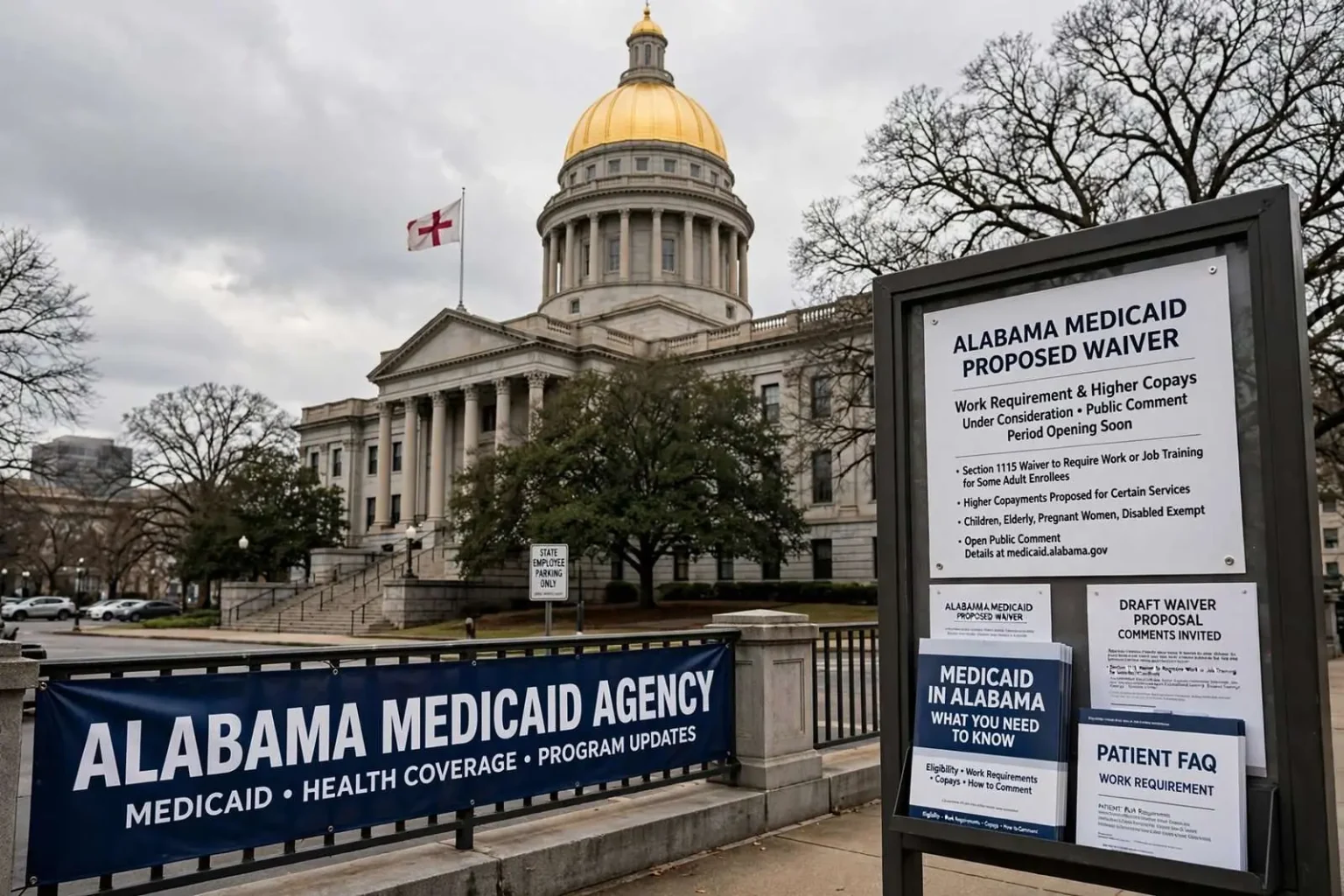
Alabama appears likely to join a growing list of states considering a work requirement for some adult Medicaid recipients, according to state Medicaid officials and Gov. Kay Ivey. The shift follows new federal guidance from the Trump administration that opened the door for states to test such requirements through the Medicaid waiver process — a first in the program’s history since its creation in 1965.
The guidance, released by the Centers for Medicare and Medicaid Services, lets states seek permission to test ‘a work requirement’ for adult Medicaid enrollees, tying continued eligibility for some recipients to employment, job search or training activity. Following the guidance, 10 mostly Republican states submitted waiver proposals that would let them deny coverage to ‘able-bodied’ recipients who are unemployed. Alabama was not among them at the time, but state officials signaled that the state intends to study and likely pursue a similar path.
Medicaid covers about one in four Alabamians, making it the largest health insurance program in the state despite serving a population that is overwhelmingly children, elderly residents and people with disabilities. This year the Legislature appropriated more than $800 million for the program, including a $105 million supplement drawn from the state’s BP oil spill settlement — an extraordinary one-time infusion that underscored how strained the program’s regular funding source has become.
The State’s Position and the Money Behind It
Gov. Kay Ivey said she instructed Medicaid Commissioner Stephanie Azar in October 2017 to begin working on work requirements and higher copays. “Improving Medicaid delivery and controlling costs is central to my budget,” Ivey said. The governor’s framing reflects a persistent reality in Alabama budgeting: the Medicaid Agency is the single largest consumer of the state General Fund, the bucket of tax revenue that also funds prisons, courts, and other state agencies, and its costs have grown faster than the revenue that supports it.
Unlike most states, Alabama does not levy a meaningful share of dedicated growth taxes into its General Fund, so Medicaid’s rising costs — driven by medical inflation, pharmacy prices and enrollment — squeeze every other agency during budget negotiations. That structural pressure explains why successive governors have looked for ways to control the program’s trajectory, and why a one-time settlement infusion like the BP supplement has been needed to fill gaps in recent years.
Alabama is also one of the states that has not expanded Medicaid eligibility under the Affordable Care Act, which keeps its program among the most restrictive in the country in terms of who qualifies. Parents in a typical Alabama family must earn well below the federal poverty line to remain eligible, and most childless adults cannot qualify at all — a fact that shapes any discussion of work requirements, because the adults remaining on Alabama’s rolls are a narrower and often sicker population than in expansion states.
Agency communications director Robin Rawls said a requirement could be ‘an incentive to encourage people to move into the workforce,’ though no official proposal exists yet and public comment would be required before any waiver could move forward. That public comment window matters: federal law requires states to solicit input on waiver proposals, and the notice-and-comment process gives providers, advocates and beneficiaries a formal opportunity to shape the final design of any requirement adopted in Alabama.
Who Would and Would Not Be Affected
More than half of Alabama’s roughly 1,050,117 Medicaid-eligible patients are children, and of the 126,000 eligible in Mobile County in 2016, 58 percent were under 19. Those numbers are central to understanding the stakes of the policy debate: any work requirement aimed at adults would leave the majority of the state’s Medicaid population untouched, because children are not subject to work rules under any version of the policy being discussed.
The federal guidance makes clear any work requirement would not apply to children, the elderly or pregnant women. Exceptions are also generally expected for people with serious medical conditions and disabilities, the populations for whom employment is not a realistic condition of coverage. What remains is a comparatively small group of working-age adults without dependents or with adult dependent status who are not employed — the group states describe as ‘able-bodied’ and whose coverage the waiver proposals would condition on work or work-related activity.
Advocates for the requirement argue that connecting coverage to employment encourages self-sufficiency and better health outcomes, pointing to evidence that working populations tend to be healthier. Critics counter that the adults affected often face barriers to employment that a coverage requirement does not remove — lack of transportation, chronic illness, limited education and scarce jobs in rural counties — and that taking away coverage for noncompliance can worsen the very conditions that keep someone from working.
How a Waiver Would Actually Work
Medicaid is a federal-state partnership, and states cannot simply change eligibility rules on their own. The mechanism is the Section 1115 waiver, a demonstration project authorized by the Secretary of Health and Human Services that lets states test programs outside the normal rules of the statute. The new federal guidance signaled that the agency would look favorably on waiver applications that include work and community engagement requirements, a reversal of policy from prior administrations that had denied such requests.
Arkansas became the first state to implement a work requirement under the new policy environment, with other states following in sequence, and early experience in those states has supplied both evidence and cautionary tales about how such programs perform in practice — including questions about how many affected enrollees are unaware of reporting requirements and lose coverage without realizing it. Any Alabama proposal would have to navigate those implementation questions, from notification systems to exemptions, all of which cost money to administer.
Higher copays, the other element the governor asked the agency to study, would add modest out-of-pocket costs for some services. Federal rules already permit small copayments for certain Medicaid services while exempting others, and states have long balanced the revenue such cost-sharing generates against the risk of discouraging low-income patients from seeking care at all.
A recent report found Alabama already runs the leanest Medicaid program of any state by the average medical benefit received per enrollee — meaning the state spends less per person covered than any other. That statistic cuts both ways in the debate: it supports arguments that the program is efficiently run and leaves little fat to trim, while also illustrating how limited the current benefit structure already is. As the agency develops its proposal and the required public comment period unfolds, the details of who is covered, what counts as work, and what exceptions apply will determine how far-reaching the change actually is for the one in four Alabamians the program serves.
What It Means for Mobile County and the Coast
The policy conversation lands differently across Alabama’s counties, and Mobile County illustrates why. With 126,000 Medicaid-eligible residents in 2016, the county holds one of the largest Medicaid populations in the state, spread across urban Mobile neighborhoods, suburban communities and the rural southern end of the county where access to clinics and hospitals is thinner. Any administrative change to eligibility — including new reporting requirements tied to work — affects tens of thousands of households in the county alone.
Healthcare providers in the region follow the debate closely because coverage changes flow directly into hospital finances. Rural hospitals across Alabama have closed in recent years, and facilities that remain operate on thin margins where Medicaid reimbursement is a significant share of revenue. When enrollment drops, whether through eligibility changes or administrative churn, the cost of caring for the uninsured does not disappear; it shifts to hospitals, local governments and other payers, a dynamic known as cost-shifting that has shaped state healthcare debates for a decade.
Employers, too, have a stake in the outcome. Healthcare, shipbuilding, aerospace and tourism drive the Gulf Coast economy, and businesses that pay for employee health coverage watch any policy that might shift costs or affect the size of the insured workforce. A work requirement tied to coverage could, in theory, push some recipients into employment; it could also remove coverage from people who are already working in jobs that do not offer insurance — the retail, food service and care work that employs many low-wage Alabamians.
The Road Ahead for the Proposal
The sequence from here is procedural but meaningful. The Medicaid Agency would need to draft an actual waiver proposal — none exists yet — specifying which enrollees would be subject to a requirement, what activities would count as satisfying it, what exemptions would apply, and how compliance would be tracked and reported. The proposal would then go through the required public comment period, be revised, and travel to the federal Centers for Medicare and Medicaid Services for approval, a process that in other states has taken months and sometimes years, with litigation frequently following.
Lawmakers will also weigh in, since the Legislature controls the program’s funding. Any requirement that costs money to administer — and tracking systems, notification mailings and eligibility workers all cost money — has to find a place in a General Fund budget that has already been stretched to cover the program’s growth. The $105 million BP settlement supplement that helped balance this year’s appropriation is one-time money, and its absence from next year’s budget will sharpen every funding conversation at the Statehouse.
For the Alabamians the program serves, the practical message from state officials is that no one is losing coverage today. With no proposal on the table and public comment still to come, the work requirement debate remains exactly that — a debate — while the program continues to cover its roughly one million beneficiaries across all 67 counties. But the direction from the governor’s office and the new federal posture in Washington both point the same way, and Alabama appears likely to join the states testing a new set of rules for the nation’s largest health insurance program for the poor.