Alabama on the Verge of Its Best NFL Draft Class Ever
With 15 players in position to be first-round picks in 2020, Alabama appears poised for the most dominant NFL Draft class any program has ever produced.
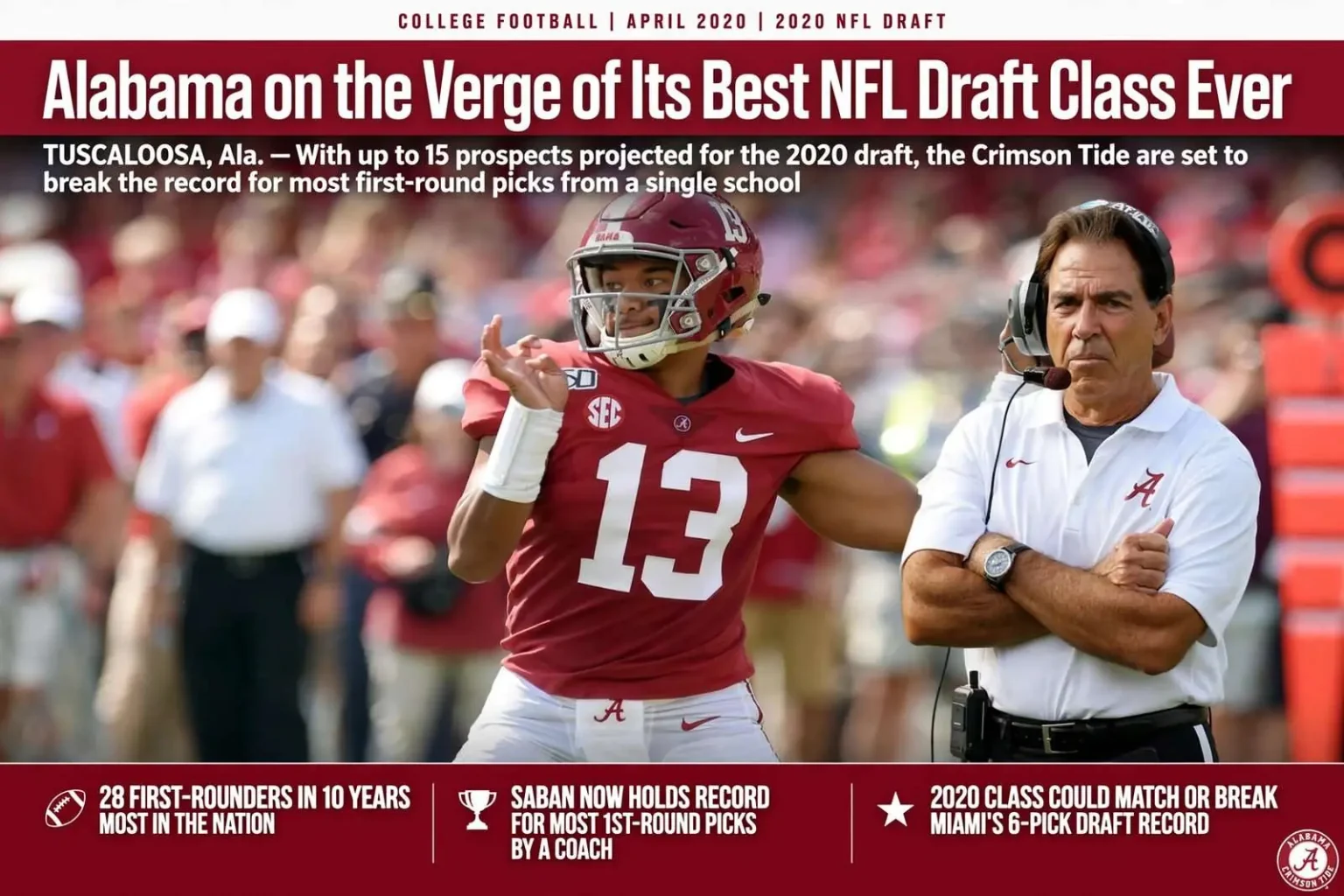
TUSCALOOSA, Ala. — Since Nick Saban arrived in Tuscaloosa in 2007, Alabama has become a factory for NFL first-round draft picks, and the 2020 draft is shaping up as the program’s masterpiece. The Crimson Tide have produced 28 first-round selections in the past 10 drafts — a total that pushed Saban past Joe Paterno for the most first-round players developed by any coach — and the class on the board this spring could break records that have stood for a generation.
The numbers alone tell a story no other program can match. Twenty-eight first-rounders in a decade means Alabama has, on average, sent nearly three players per year into the first round — more than most conferences manage in the same span. But the deeper point is what those picks represent: elite high school recruits who arrived in Tuscaloosa, developed in one of college football’s most demanding systems, and left as professional-ready players at nearly every position on the field.
A Pipeline Unlike Any Other
Over that same 10-year span, the rest of Alabama’s colleges combined for just six first-round picks. Auburn accounted for two of them, Cam Newton and Nick Fairley, both taken in the 2011 draft that followed the Tigers’ national championship season. Troy produced Leodis McKelvin, a top-10 selection, and UAB gave the NFL Roddy White, who turned his first-round opportunity into a long and productive career in Atlanta.
That list — four schools’ worth of names — is worth pausing on. It includes a Heisman Trophy winner, a national champion quarterback, and a Pro Bowl receiver, and it still totals barely a fifth of what the Tide produced on its own. Five Alabama schools have now produced first-round talent, a point of genuine pride for the state’s football culture, but the distribution is starkly lopsided. Tuscaloosa has become to NFL drafts what a few select institutions are to their own fields: the place where the raw material and the finished product both happen at scale.
Saban’s record in this regard now stands alone. The tally of first-round picks developed under a coach is a measure that spans eras — Bear Bryant, Joe Paterno, Bobby Bowden all built their legends partly on the professionals they sent into the league. When Saban passed Paterno, he did so in fewer seasons than any of his predecessors needed, a function of both the recruiting caliber Alabama has sustained and the NFL readiness for which the program has become known.
The 2020 Class Could Redefine the Record Books
Alabama’s run shows no sign of slowing. Heading into the 2020 draft, as many as 15 Alabama players are considered legitimate candidates to go in the first round — a list led by quarterback Tua Tagovailoa and receiver Jerry Jeudy, both viewed as near-certainties at the top of the board.
Tagovailoa’s case is the most scrutinized. The left-handed quarterback from Hawaii rebuilt Alabama’s offense around his accuracy and timing, led the Tide to a national championship with one of the most famous second halves in college football history, and entered the draft conversation as the kind of prospect scouts describe as a franchise player — with the inevitable asterisk that injuries placed next to his name. Jeudy, by contrast, arrives with a clean bill of health and a reputation as the cleanest route runner in the class, the kind of receiver whose college tape shows separation that translates without adjustment to the professional level.
Behind them stretches a depth chart’s worth of talent: receivers, tackles, defensive linemen, linebackers, and defensive backs, each group stocked with players who started multiple seasons against SEC competition. The record for most first-round picks from a single school in one draft is six, set by Miami in 2004 — the high-water mark of the Hurricanes’ dynasty era, when Miami’s roster was so loaded that half a starting defense went in round one. Alabama’s roster this year is the first since then that analysts believe can approach that number.
Analysts across ESPN, The Sporting News and other outlets have projected double-digit Alabama names among the top prospects, suggesting the program could challenge the mark. Projections this far out are inherently soft — combine performances, medical rechecks, and team-specific needs reshuffle every board between now and draft night — but the consensus itself is the story. No program in the modern draft era has been projected anywhere near this territory.
Reality Will Trim the List
Saban’s total of 34 first-round players is not likely to grow by 15 next year. Injuries, underclassmen returning and late surges will trim the list, the way they do every year for every program. Some of the 15 will return to school for another season of college football; some will slide into the second round as teams weigh need against value; some will see another player’s rise at the same position push them down the board.
That is the normal arithmetic of draft season. A school sending even eight players into the first round would shatter the modern record; five or six would tie Miami’s mark. Either outcome would confirm what the rest of the sport already concedes — that no program has ever concentrated this much first-round talent on a single roster at a single time.
For the players themselves, the stakes are life-changing. First-round status carries not just the money of the rookie contract but the security of a guaranteed platform: a five-year team option, a roster spot a franchise has committed real capital to defend, and a career trajectory that second-round picks spend years fighting to earn. When a dozen or more Alabama teammates cross that line in the same spring, it represents the largest single transfer of young wealth any college program has ever delivered to its players in one draft.
What It Means for the Program
The draft record matters inside Tuscaloosa for a reason beyond trophies: it is the program’s recruiting pitch, made self-evident every April. High school prospects choosing among Alabama and its rivals are not weighing which campus has the nicer weight room; they are weighing which path leads most reliably to the league. A 2020 draft that makes history answers that question more loudly than any recruiting brochure could.
It matters to the NFL differently. Scouts and general managers have learned to trust Alabama tape in a way that reshapes evaluations — the assumption being that a player who started and produced for Saban has already been coached hard, held to professional standards, and tested against the best competition college football can assemble. That trust is itself a form of program capital, built over a decade of first-rounders who produced in the league at rates that justified their draft slots.
And it matters to the state. Alabama football’s dominance is the economic and emotional engine of a fan culture that stretches from the Gulf Coast to the Tennessee line, and every record-setting draft night is another chapter in a story that has made Tuscaloosa a destination rather than a stop. Rival programs across the SEC have spent a decade trying to copy the model — the facilities, the staffing, the development systems — and none has matched the output.
The depth of talent suggests Alabama is positioned for the best overall draft any college has ever had. Whether the final number lands at four, six, or somewhere record-breaking in between, the trendline underneath it is already secure: no coach in the history of the sport has developed more first-round talent than Nick Saban, and the class of 2020 may be the clearest expression yet of how he built it — one five-star recruit, one spring practice, and one first-round card at a time.
The comparison to Miami’s 2004 class is instructive for another reason. The Hurricanes’ six-pick draft was the product of years of talent stacking — multiple elite recruiting classes maturing together, held together long enough to win a national championship before the league picked the roster apart. Alabama’s 2020 group follows the same arc: a national title core, seasoned through multiple College Football Playoff runs, now cashing in together. The difference is scale. Miami’s dynasty era produced great drafts; Alabama’s system produces great drafts as a matter of routine, which is why the sport’s analysts treat a historic 2020 as plausible rather than miraculous.
Draft night will also settle a running debate about how college talent converts to the professional game. Alabama’s recent first-rounders have, on the whole, validated the program’s evaluations, giving scouts little reason to discount this class no matter how high the count climbs. For the players waiting in Tuscaloosa and their families, the weeks between now and the draft carry the usual mix of medical rechecks, private workouts, and team visits — the unglamorous machinery that turns a projected pick into a real one. For everyone else, the only real suspense is arithmetic: not whether Alabama makes history in 2020, but how loudly it does.