
Alabama Opens 2021 Alligator Hunt Registration, With 260 Tags Across Five Zones
Alabama's alligator hunt registration is open, with 260 possession tags across five zones and a $22 fee per zone for eligible residents.
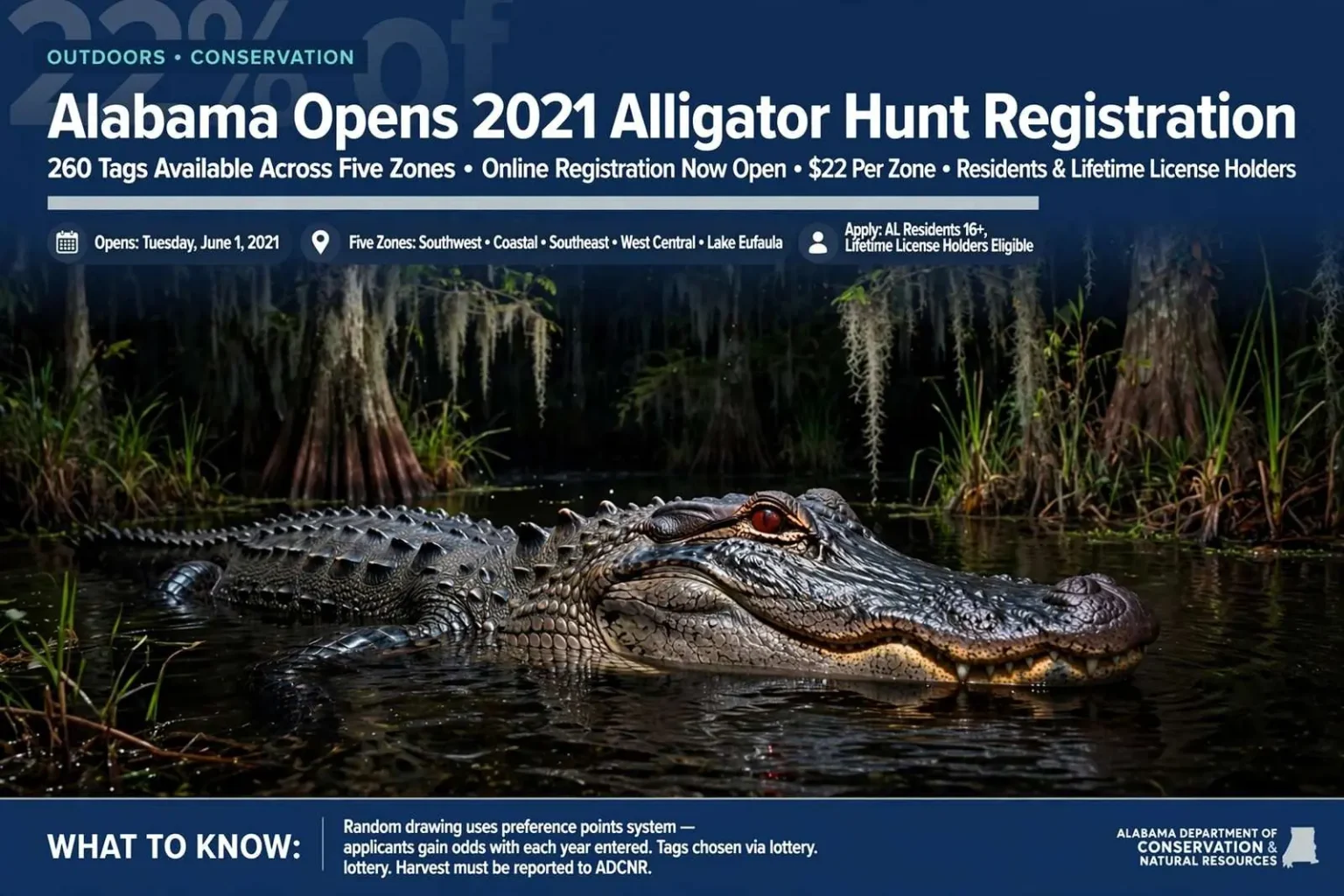
Alabama hunters can now put in for a shot at an alligator tag. The Alabama Department of Conservation and Natural Resources opened online registration for the state’s regulated alligator hunts on a Tuesday morning, giving residents across the state a window to enter one of the Southeast’s most distinctive hunting drawings. Only 260 Alligator Possession Tags will be distributed statewide, spread across five hunting zones, and the fee to apply is $22 per zone.
The numbers explain why the program attracts so much attention each summer. With a few hundred tags available in a state with hundreds of thousands of licensed hunters, the odds of drawing are slender, and many applicants enter year after year without ever being selected. Those who do draw a tag receive the right to harvest one alligator during a regulated season in a specific zone — a permit that, for many families, becomes the centerpiece of summer plans and, in some cases, a tradition passed between generations of hunters.
Eligibility
Applicants must be Alabama residents or Alabama lifetime license holders and at least 16 years old. Lifetime license holders remain eligible to apply even if they have since moved out of state, a provision that keeps longtime Alabamians connected to the hunt regardless of where life has taken them. The residency requirement reflects how tightly the state manages the resource, a scarcity that shapes the whole program: alligator hunting in Alabama exists only through a limited-quota system, and the drawing is reserved for the people who support the state’s conservation funding through license purchases.
The age minimum also shapes who can take part. Hunters younger than 16 can still participate in Alabama’s hunting tradition through other seasons under supervision, but the alligator drawing is an adult pursuit, in part because of the physical demands involved. Landing and securing a large alligator at night from a boat is hard, wet, often chaotic work, and the regulations are built around participants who can legally and physically handle the responsibility.
How the draw works
Tag recipients are chosen at random, but the selection runs on a point system tied to how many years a hunter has entered. The longer someone has been applying without drawing a tag, the better their chances become. The structure is a common tool in limited-quota wildlife drawings across the country: it tempers pure luck with persistence, so that the pool of unsuccessful applicants accumulates weight over time rather than starting from zero each summer. For a hunter in year ten of applying, the drawing is a fundamentally different proposition than it is for a first-time entrant.
The application itself is deliberately simple. A hunter selects a zone — or zones — pays the $22 fee per zone entered, and waits for the random selection to run its course. Applying in multiple zones multiplies the chances but also multiplies the cost, a tradeoff applicants weigh based on how far they are willing to travel and how familiar they are with a given area’s waters. Preference points generally attach to the drawing process, meaning that skipped years can matter as much as entered ones, a detail serious applicants track closely.
The five zones
Hunts are divided among the Southwest Alabama Zone, the Coastal Zone, the Southeast Alabama Zone, the West Central Alabama Zone and the Lake Eufaula Zone. Each zone is assigned its own allotment of tags, with the coastal and southwest zones covering the waters closest to Mobile and Baldwin counties. Those two zones take in the heart of Alabama’s alligator country: the Mobile-Tensaw Delta, the Mobile River, the Alabama River system, and the labyrinth of sloughs, bayous and backwaters where the state’s densest alligator populations live.
The Coastal Zone’s waters near Mobile Bay and Baldwin County are classic big-alligator habitat. The delta region north of the bay — one of the largest wetland systems in the country — supports a robust population of American alligators, and night hunters there run boats along the banks with lights, scanning for the telltale red shine of alligator eyes. The Southwest Zone, covering counties to the north and west of Mobile, draws on the same river systems and produces its share of large animals as well.
The Lake Eufaula Zone, by contrast, centers on one of the state’s best-known reservoirs along the Georgia line. Lake Eufaula — formally Walter F. George Lake on the Chattahoochee River — has produced some of the largest alligators ever taken in Alabama, and its zone draws applicants from across the eastern part of the state. The Southeast and West Central zones round out the map, giving hunters in the Wiregrass and the Black Belt region waters closer to home. The Black Belt’s rivers, oxbow lakes and swamps are prime habitat, and locally the animal is a familiar if unwelcome visitor to farm ponds and golf course water hazards.
Why the hunt exists
The regulated hunt is itself a conservation success story. The American alligator was once hunted so heavily for its hide that the species landed on the federal endangered species list in 1967. With federal protection, habitat conservation and careful state management, populations rebounded across the Gulf South to the point that the species was declared fully recovered, and limited hunts were reinstated as a management tool. Alabama opened its first modern alligator season in 2006, and the program has run each summer since under the watch of the state’s wildlife agency.
Biologists treat the tags as more than a recreational opportunity. Alligator populations are monitored through surveys and nuisance complaints, and the annual harvest helps keep numbers in balance with habitat and human activity. Without a managed season, growing populations produce more conflicts — alligators in swimming pools, on boat ramps, in stock ponds — and more dangerous ad hoc removals. A regulated hunt channels demand into a system with quotas, check stations and data collection, which is why conservation agencies across the Southeast have adopted the model.
What a tag actually involves
Drawing an Alligator Possession Tag is the beginning of the work, not the end. Tag holders must complete the state’s training requirements, hunt only within their assigned zone during the designated season dates, and report their harvest through the state’s check-in process. The season is conducted at night, typically in August, when alligators are most active in warm water. Hunters use rods, reels and hooks, snatch hooks, bows and harpoons to catch the animal before restraining and dispatching it — a process with specific legal requirements designed to be as humane and safe as possible.
The scale of the animals is part of the appeal. Alabama’s zones regularly produce alligators well over 10 feet long, and the state record animals — taken from the Alabama River and the Mobile-Tensaw Delta waters — weighed more than 800 pounds. A successful hunt can yield hundreds of pounds of meat along with a hide that, properly handled, becomes leather. Many tag holders celebrate the harvest the way deer hunters celebrate a trophy: with photos at the check station, a cooler full of meat shared with family, and a story that gets retold every summer.
The hunt also has an economic footprint that rural communities feel. Tag holders hire guides, buy equipment, book lodging and bring parties of family and friends into small river towns during the season. Check stations and local businesses in the delta communities and around Lake Eufaula plan around the alligator season the way other towns plan around a fishing tournament. For a two-week window, the hunt is a genuine regional event.
Getting an application in
For hunters hoping to take part, the message from the opening of registration is straightforward: the window to apply is limited, the fee is modest, and the odds reward patience. The $22 per-zone fee goes back into the conservation funding system that supports the state’s wildlife management, meaning that even unsuccessful applicants contribute directly to the resource. Hunters can confirm eligibility, review zone boundaries and season dates, and complete their registration through the Department of Conservation and Natural Resources’ online licensing system.
Applicants would be wise to study the zones before choosing. Distances across Alabama are substantial — a hunter in Huntsville entering the Lake Eufaula Zone faces a long drive, and the same is true in reverse for south Alabama residents drawn in the West Central Zone. Local knowledge matters more in alligator hunting than in almost any other Alabama pursuit: reading water depth, current, bank structure and prey availability at night determines where the animals will be. Many successful hunters spend years scouting a zone before ever drawing a tag, using the application cycle itself as a long apprenticeship.
Whether this year’s drawing ends in a tag or another preference point, the registration opening marks the unofficial start of Alabama’s alligator summer — the months when the state’s rivers and swamps, and the people who hunt them, turn their attention to one of the wildest traditions the state has to offer. Only 260 hunters statewide will end the season with a harvest. The rest will return to the drawing board, and to the list, with their odds a little better next year.