
Alabama Opens Registration for 14th Annual Alligator Hunt With 260 Tags Across Five Zones
Alabama opens registration for the 14th annual alligator hunt: 260 tags across five zones, including Southwest Alabama and Coastal zones. Deadline July 10.
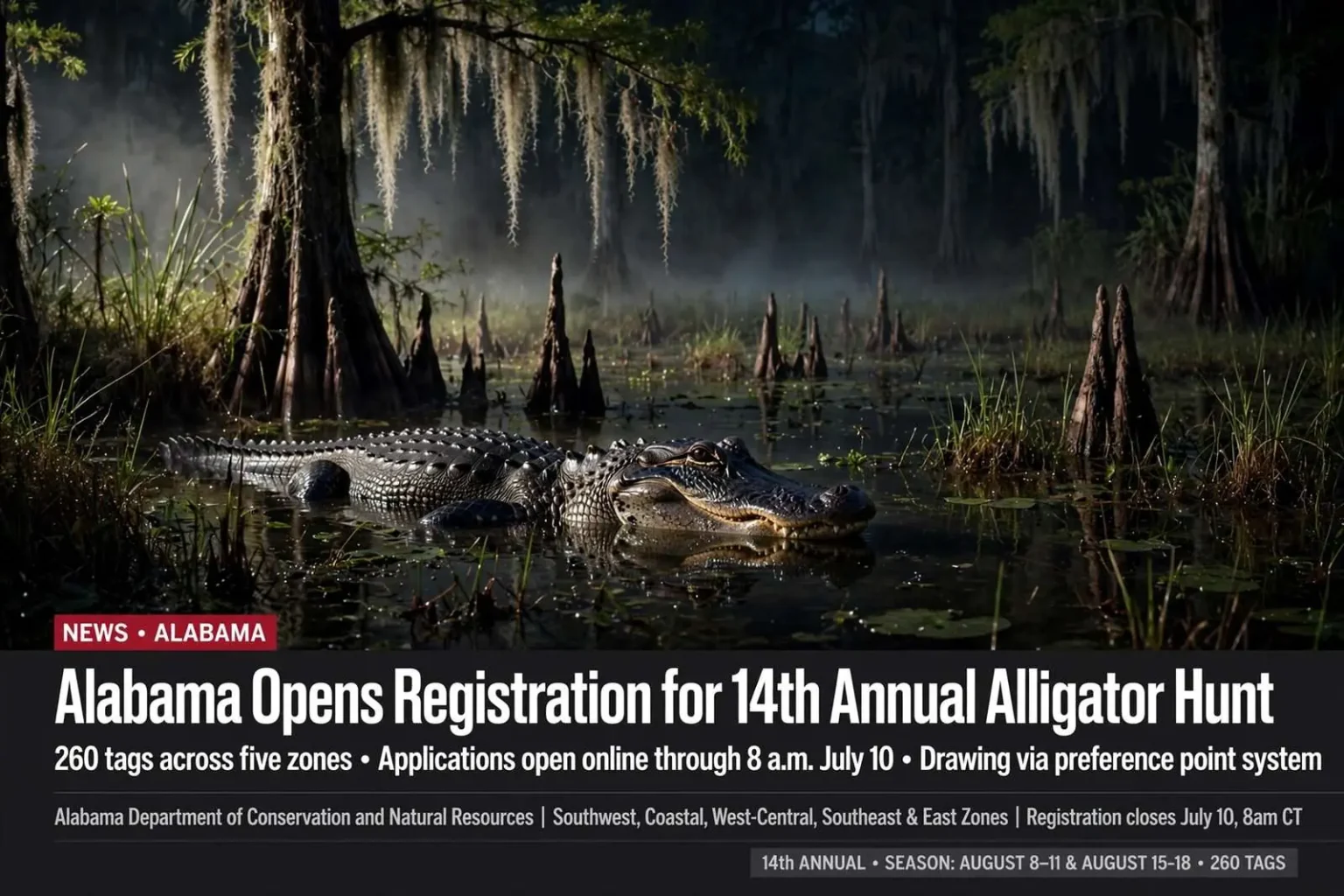
Registration is open for Alabama’s 14th annual regulated alligator hunt, with the Alabama Department of Conservation and Natural Resources taking applications online through 8 a.m. on July 10 for a season split across five hunting zones sharing 260 tags. The drawing is one of the most sought-after in the state’s outdoor calendar, drawing thousands of applications each summer for a limited number of slots to pursue one of North America’s largest reptiles in Alabama waters. The season’s structure — zone by zone, tag by tag — reflects decades of careful management that turned a once-wiped-out species into a carefully rationed hunting opportunity.
Only Alabama residents and Alabama lifetime hunting license holders ages 16 or older may apply, though lifetime license holders can apply even if they have moved out of the state. The administrative fee is $22 and applicants may register once per zone. While the Alligator Possession Tag itself is free, selected hunters and their assistants must carry valid hunting licenses in the field. The lifetime license provision means hunters who invested in Alabama’s lifetime license decades ago keep their eligibility even after relocating across state lines — a perk that keeps longtime Alabamians in the annual pool.
Tags are awarded by random computer selection using a preference point system that improves the odds for repeat applicants as long as they keep applying. The preference point mechanism rewards persistence: each year an applicant is not drawn, their odds improve in subsequent drawings, discouraging casual one-time applicants from clogging the pool and giving dedicated hunters a realistic path to an eventual tag. Applicants can check their selection status after noon on July 10, and those drawn must confirm acceptance online by 8 a.m. on July 17 before alternates are notified to fill vacancies.
Where the Hunts Happen
The Southwest Alabama Zone carries 100 tags and covers private and public waters in Baldwin and Mobile counties north of Interstate 10, plus waters in Washington, Clarke and Monroe counties east of U.S. 43 and south of U.S. 84. Its two hunt windows run sunset August 8 to sunrise August 11 and sunset August 15 to sunrise August 18. The zone’s waters — the Mobile-Tensaw Delta’s tributaries, the rivers and creeks of Washington, Clarke and Monroe counties, and the impoundments and sloughs north of the interstate — hold one of the densest alligator populations in the state, which is why it draws the largest tag allocation.
The Coastal Zone holds 50 tags for private and public waters in Baldwin and Mobile counties south of Interstate 10, with the same two hunt windows. That slice of the coastal plain includes the brackish lower reaches of the Mobile Bay system, the Fish River, Magnolia River and Weeks Bay watersheds, and the drainage networks threading through Baldwin County’s growing southern communities — territory where suburban development and thriving alligator populations now share the same map.
The remaining tags are distributed among the state’s other zones, spreading the opportunity across waters in west-central, southeast and east Alabama so that the hunt is not solely a Gulf Coast affair. Each zone carries its own season dates, rules and waters list published by the department, and hunters must confine their harvest to the zone and dates specified on their tag.
How an Alligator Hunt Works
Each tag holder may harvest one alligator, with hunting allowed only from official sunset to official sunrise. The nighttime restriction defines the experience: hunters pursue gators by spotlight from boats, stalk animals that have hunted these waters for decades, and typically take large animals with harpoons, snatch hooks and, once the animal is restrained, a shotgun or bangstick to finish the kill. It is among the most physically demanding hunts Alabama offers, and success is never guaranteed — many tag holders see their window close without a harvest.
The hunts operate under strict reporting requirements. Successful hunters must tag their harvest immediately, and department biologists collect data from captured animals — length, weight and biological samples — at mandatory check stations or appointments. That data feeds the population models the department uses to set tag numbers each year, keeping the harvest sustainable. The 14th annual hunt is itself the product of that feedback loop: tag counts and zone structures have been adjusted over the years as biologists track how the state’s alligator population responds to the harvest.
A Species Saved, Then Shared
The American alligator, which can exceed 14 feet and 1,000 pounds, was nearly wiped out by unregulated harvest before Alabama moved to protect the species in 1938, believed to be the first state ban of its kind. Removed from the endangered species list in 1987, the population has continued to expand, allowing the state’s annual regulated hunt since 2006. That arc — from state-level protection nearly a century ago to a fully recovered population supporting a limited public hunt — stands as one of the region’s clearest conservation success stories.
The recovery transformed the Gulf Coast’s relationship with the species. Alligators now thrive in the Mobile-Tensaw Delta, the rivers and bays of Baldwin County and every major drainage in south Alabama, where they play their historic role as apex predators in the wetland food web. Their resurgence has also brought them into closer contact with people — golf course ponds, subdivision lakes and boat launches — which is part of why the state maintains both regulated hunting and a nuisance alligator program through its wildlife and fisheries division.
The hunt gives the public a structured way to participate in managing that success. Tag numbers are deliberately conservative relative to the estimated population, and the hunting method — nighttime boat-based pursuit of a specific, targeted animal — produces minimal collateral impact on other wildlife. For the department, the annual drawing doubles as a public education event, drawing attention to the species’ history, the delta’s ecology and the funding model in which hunters and license buyers finance the conservation of non-game species as well.
Advice for Applicants
Hunters planning to apply should note the deadline discipline the process requires. Applications close at 8 a.m. on July 10, results post after noon that same day, and drawn hunters must confirm online by 8 a.m. on July 17 — miss that confirmation and the tag passes to the alternates list. Applicants may register once per zone, so strategy matters: hunters most interested in a specific zone should apply there, while those flexible on location can spread their single entries across multiple zones.
Drawn hunters should prepare well before their August window. Scouting waters in daylight, arranging a boat and crew experienced with large alligators, assembling the required equipment and reviewing the department’s alligator hunt regulations are all part of the pre-season work that separates successful parties from empty boats. Assistants must be lined up in advance, since they too must hold valid hunting licenses while afield.
Registration is handled online through the department’s outdoor licensing system, the same portal that handles hunting licenses and other limited-quota applications. With 260 tags across five zones and thousands of hunters in the pool, most applicants will wait years for a tag — and thanks to the preference point system, every year they wait improves their odds for the next draw.
August’s hunt windows place the season at the height of Gulf Coast summer, when nights on the delta and the coastal rivers are humid, warm and alive with the sounds of the wetlands. The timing is deliberate: late summer is when alligators are most active, when water levels typically recede enough to concentrate animals in observable areas, and when the state’s biologists can gather the most useful data from the harvest. It also means hunters endure mosquito season, afternoon thunderstorms and boat ramps crowded with crabbers and anglers alongside their own kind.
The Delta and Its Alligators
The Mobile-Tensaw Delta, where many Southwest Zone tag holders will hunt, is one of the South’s great wetland ecosystems — a labyrinth of rivers, bayous, bottomland hardwoods and marshes spreading across hundreds of thousands of acres north of Mobile Bay. The delta supports Alabama’s densest alligator population along with black bear, bald eagles and a staggering diversity of fish and amphibians, and conservation agencies have spent decades acquiring and protecting its wetlands. An alligator tag for this zone is, for many hunters, a rare sanctioned passage into the wildest landscape on the Gulf Coast.
Baldwin and Mobile county waters south of Interstate 10 offer a different experience. The Coastal Zone’s rivers and bays wind through some of Alabama’s fastest-growing communities, and hunters there share the water with kayakers, fishermen and shoreline homes — a reminder that the state’s alligator resource thrives in close proximity to people. The department’s regulations for the zone account for that reality, and successful hunters are asked to handle their harvest discreetly at public landings.
A Tradition With Deep Roots
Alabama’s 1938 protection law predates the federal endangered species framework by decades, and the state’s early action is credited with preserving the alligator population that later reseeded the Gulf Coast. The national recovery — from near-extirpation across the Southeast to removal from the endangered species list in 1987 — became a textbook case of wildlife management, and Alabama’s share of that story is a point of pride in the state’s conservation community.
Since the first regulated hunt in 2006, the annual season has built its own traditions. Families apply together and draw tags together; harvests from the delta and coastal rivers routinely appear among the largest alligators taken in the country; and the mandatory biological checks give the state a running scientific record of its alligator population that few species enjoy. The 14th annual season continues that record, one 260-tag drawing at a time.
For hunters who enter this year’s drawing, the path is the same as it has been for more than a decade: apply by July 10, watch for results that afternoon, confirm by July 17, and spend August’s two dark-of-night windows pursuing one of the wildest hunting experiences Alabama offers. The state’s alligator resource — nearly lost once, now abundant enough to share — will be in the water either way, and the drawing will decide who gets to take part in managing it.