
Alabama’s Oyster Restoration Gets $7.1 Million Boost to Link Brood and Sink Reefs
The Alabama Department of Conservation and Natural Resources has been awarded $7.1 million in oil spill restoration funds for a new project linking brood and sink oyster reefs, adding to grassroots restoration work already underway near Cedar Point and Heron Bay.
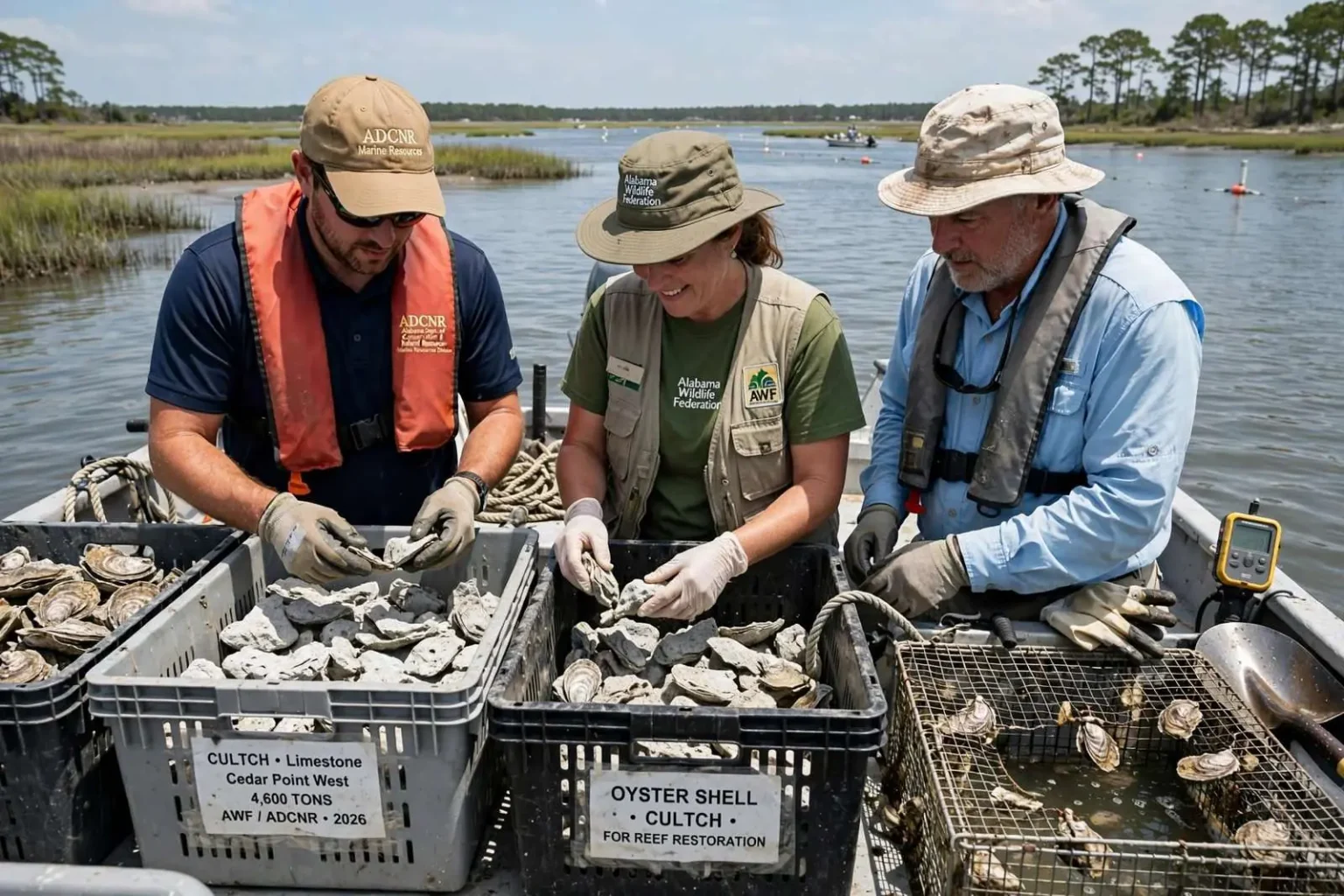
The Alabama Department of Conservation and Natural Resources has been awarded $7.1 million in Natural Resource Damage Assessment funds for a new project aimed at rebuilding the state's struggling oyster population — the latest in a series of restoration efforts along the Alabama Gulf Coast. Linking Brood and Sink Reefs The project, "Improving Resilience for Oysters by Linking Brood Reefs and Sink Reefs," aims to increase oyster abundance and restore population resilience by connecting reefs through larval transport and the construction of oyster reefs across a range of habitats and salinities.
The plan calls for creating a network of high-vertical-relief brood, or protected, reefs that link to existing and newly created sink reefs — areas that are harvested or protected — allowing larvae to travel between them and strengthening the overall population's ability to rebound. ADCNR Commissioner Chris Blankenship serves as the lead trustee for Alabama on the NRDA Trustee Council, which oversees project selection and implementation for funding tied to the Deepwater Horizon oil spill settlement. ADCNR's Marine Resources Division and Deepwater Horizon Restoration Section are working with the University of South Alabama and Auburn University to identify restoration sites and techniques most likely to produce strong results.
Officials say the project, expected to take about two years, will build on the Marine Resources Division's existing management knowledge of the fishery to better understand the biological, physical and chemical factors that affect restoration success — insight the agency plans to use to build and enhance additional oyster reefs going forward. Grassroots Efforts Already Underway While the larger NRDA-funded project moves forward, ADCNR's Marine Resources Division is already teaming up with local oyster catchers and the Alabama Wildlife Federation to bolster oyster habitat along the coast in the short term. Craig Newton, the Marine Resources Division's district supervising biologist, said the state's oyster harvest has been increasingly concentrated in a shrinking footprint over the past two decades.
"Since the 2000s, our oysters have been primarily restricted to one main area," Newton said. "Historically, our oysters have been anywhere from Whitehouse reef off Alabama Port south to the Cutoff at Jemison's (Bait Shop across from Heron Bay), with Buoy reef, Cedar Point, Heron Bay and Portersville Bay as areas of significant harvest. All these places had oysters. For the last 15-20 years, we've been mostly restricted to Heron Bay and Cedar Point." Alabama Wildlife Federation Executive Director Tim Gothard said the organization's 50-acre Cedar Point West Oyster Cultch Planting project continues a partnership between AWF, ADCNR's Marine Resources Division, Vulcan Materials Company and Cooper Marine. "This is our second large-scale cultch planting project in the Cedar Point area," Gothard said.
"Those projects would not take place without these key partners. AWF is committed to the Coastal Alabama Comprehensive Oyster Restoration Strategy, developed by ADCNR Marine Resources Division in conjunction with NOAA." Gothard said the roughly 4,600 tons of limestone rock cultch placed at the site gives oyster larvae — known as spat — a window of up to a decade or more to attach and develop under the right conditions. "Ultimate success over time would be oysters of multiple age classes established on the site, including oysters of commercial harvest size, and the ability for a portion of those oysters to be harvested and utilized for food, per MRD oyster harvest rules and regulations," he said.
AWF began work on the Cedar Point West project in July 2026 using No. 4 washed limestone from Vulcan Materials' Pride Quarry in Tuscumbia, with Cooper Marine handling barge transport and JW Marine deploying the rock across the restoration area. It is the fourth oyster cultch planting led by AWF; earlier plantings included 2,600 tons near Dauphin Island and 1,000 tons near Gaillard Island in Mobile Bay.
A Steep Decline From Historic Highs The scale of the challenge facing Alabama's oyster industry is significant. The state's most recent harvest, which typically begins in October, produced 5,153 sacks — or 210,000 meat pounds — of oysters from state waters, compared to the most recent peak of 1.2 million meat pounds harvested in 1992. More than 80 percent of Mobile Bay's historic oyster population has vanished since 1950, largely due to overharvesting, pollution and habitat loss. Newton said oyster catchers and environmental groups recognized the decline and began stepping up on their own. "There have been grassroots efforts over the past couple of years," he said.
"They've taken it upon themselves to do whatever they can to provide somewhat of a quick relief and provide some benefits to the oyster population." Those efforts have traditionally centered on cultch planting — deploying a hard substrate made mostly of limestone rock, oyster shell and mussel shell into areas with favorable environmental conditions, giving larval oysters a place to attach and grow into harvestable adults. "After you add that substrate to the water, you rely on natural processes to result in the settlement of larval oysters, and then those grow into mature oysters to have the oyster population that everybody wants," Newton said.
Choosing the Right Material and Sites One of the larger cultch projects came from the AWF Oyster Restoration Initiative roughly a month ago, when limestone rock was hauled from the Tuscumbia area to the Tombigbee River, loaded onto barges and transported the length of the state to the Dauphin Island area, where about 4,600 tons of washed limestone were placed near Cedar Point. "In the past few years, AWF has done an excellent job of coordinating with MRD biologists to identify water bottoms for enhancement that are most likely to benefit oyster populations," Newton said. "They planted No. 4 limestone, which was selected because of its long-term durability. Oyster shells generally last about five years before they break down. Limestone lasts upwards of 10 years." Newton said the sites were chosen for specific environmental reasons — proximity to Alabama's most productive and stable existing reefs, some shielding from freshwater surges out of the Mobile River, and stable dissolved oxygen levels. "When you get a freshet (sudden influx) from large amounts of rain in the watershed, it reduces the salinity in the bay to a level that oysters can't tolerate," he said. Restoration hasn't always gone smoothly. Newton said a 2023 planting of 77 acres of No. 4 limestone in the Cedar Point Beach area saw promising short-term results, with upwards of 6 million larvae settling on the new reef — but that most of those larvae died the following year due to freshwater, oyster drills and other environmental stresses.
"The good news is the reef material is still there and can grow new oysters this year if the conditions are right," Newton said. This year's 50-acre planting in the Cedar Point West area aims to build on that lesson, with hopes for both short-term settlement success and longer-term survivorship. Oyster Catchers Lend Decades of Knowledge Marine Resources Division Director Kevin Anson credited the oyster catchers who have volunteered their expertise to the restoration push. "We have a group of seasoned oyster catchers who have been catching oysters nearly their entire lives," Anson said. "They have seen this transition from really good catches of oysters back in the 90s, and they've seen in recent years the dramatic decline in the populations of oysters. So, they took it upon themselves to volunteer their time to deploy oyster shell that they have sourced from seafood dealers. They wanted to put something back, literally, back into the system and their industry." The Marine Resources Division issued special permits allowing the oyster catchers to deploy oyster shell and sample oysters using tongs before returning them to the water — what Anson described as "a good faith exercise" that helped identify promising locations and gather additional input from people who work the reefs daily. "Heron Bay is the longest term productive oyster area in the state, even during these more dynamic environmental times," Anson said. "There were also a couple of areas in Dauphin Island Bay.
We're looking for areas where oysters can maintain when salinity drops." Looking Ahead Newton said the restoration effort is also branching into new methods, including planting live oysters rather than relying solely on shell and rock cultch. An initial planting of small oysters saw limited success, prompting a follow-up effort using larger, 2-inch oysters in hopes of better survival rates. "It's important to keep working on these novel approaches," Newton said. "Traditional methods aren't working like they used to when we could just plant the bottom with oyster shells anywhere on the reef. I'm proud of these other groups executing these projects. We have to think outside the box and find alternative methods to affect positive change on oyster restoration efforts. The NRDA oyster project and partnering with AWF and the oyster catchers will do just that." The newly funded NRDA project is expected to build on these grassroots efforts over the next two years, combining scientific research from the University of South Alabama and Auburn University with on-the-ground restoration work already underway across Alabama's coastal waters.
Oyster Keepers and a Growing Farm Industry
Other restoration work is running alongside the state and AWF projects. Mobile Baykeeper's Oyster Keepers Program placed 240,000 oysters on restoration reefs in 2025 alone and aims to return five million oysters to Mobile Bay by 2028. The program launched in 2023 with a pilot of four pier gardens on Dauphin Island and in Bon Secour Bay; today 44 pier owners are enrolled, each hosting four cages holding 160 live adult oysters on their residential docks. Together the cages filter 8,000 gallons of water daily and produce 400 million larvae a year. Volunteers have also grown nearly 2 million juvenile oysters for restoration sites since 2001.
The restoration push is unfolding alongside the rise of commercial oyster farming on the Alabama coast over the past two decades. The state is now home to more than a dozen commercial farms, including Murder Point Oysters and Navy Cove Oysters, which use off-bottom techniques that raise oysters in floating cages above the seafloor.
Related: Gulf Aquaculture Project Off Fort Morgan
Separately, a long-delayed aquaculture project in the Gulf's nearshore waters off Fort Morgan has moved forward after years of waiting on permits and agreements. First funded during former U.S. Sen. Richard Shelby's time in Washington, the project is testing whether finfish, oysters and seaweed can be raised to marketable size in open Gulf waters roughly two miles offshore, where a platform and fish pen were installed in 2025. The effort secured a protected species agreement from NOAA and permits from ADCNR's State Lands Division, the U.S. Army Corps of Engineers and the U.S. Coast Guard.
Marine biologist Ashley McDonald, who returned to the Dauphin Island Sea Lab as integrated multitrophic aquaculture project manager, said the project "has basically been dead in the water, waiting on permits and agreements." The model, which originated with a group in Canada and is patterned on a New Hampshire operation that combines steelhead trout, blue mussels and kelp, is meant to be small in scale and individually owned, giving smaller commercial harvesters a way to branch out without competing with commercial harvest. Off Fort Morgan, the team is growing red drum, oysters in hanging baskets and macroalgae, all with genetics local to Mobile Bay. "They are all native species," McDonald said. "Their genetic component is local to Mobile Bay, so these are local, homegrown animals."
How NRDA Funding Works
Natural Resource Damage Assessment is the legal process, set up under the federal Oil Pollution Act of 1990, through which federal and state trustees measure the harm an oil spill does to natural resources and require the responsible party to pay for restoring them. For the 2010 Deepwater Horizon spill, a 2016 court-approved settlement committed BP to pay up to $8.8 billion for natural resource damages across the Gulf. Alabama’s portion is directed by the state and federal trustees on the Alabama Trustee Implementation Group, which selects projects through public restoration plans before money is spent.