
Alabama Power Brings Back ‘Safe-T-Zone’ Electrical Safety Training for First Responders
Alabama Power resumed its Safe-T-Zone electrical safety training for first responders at the Mobile Control Center after a three-year COVID pause.
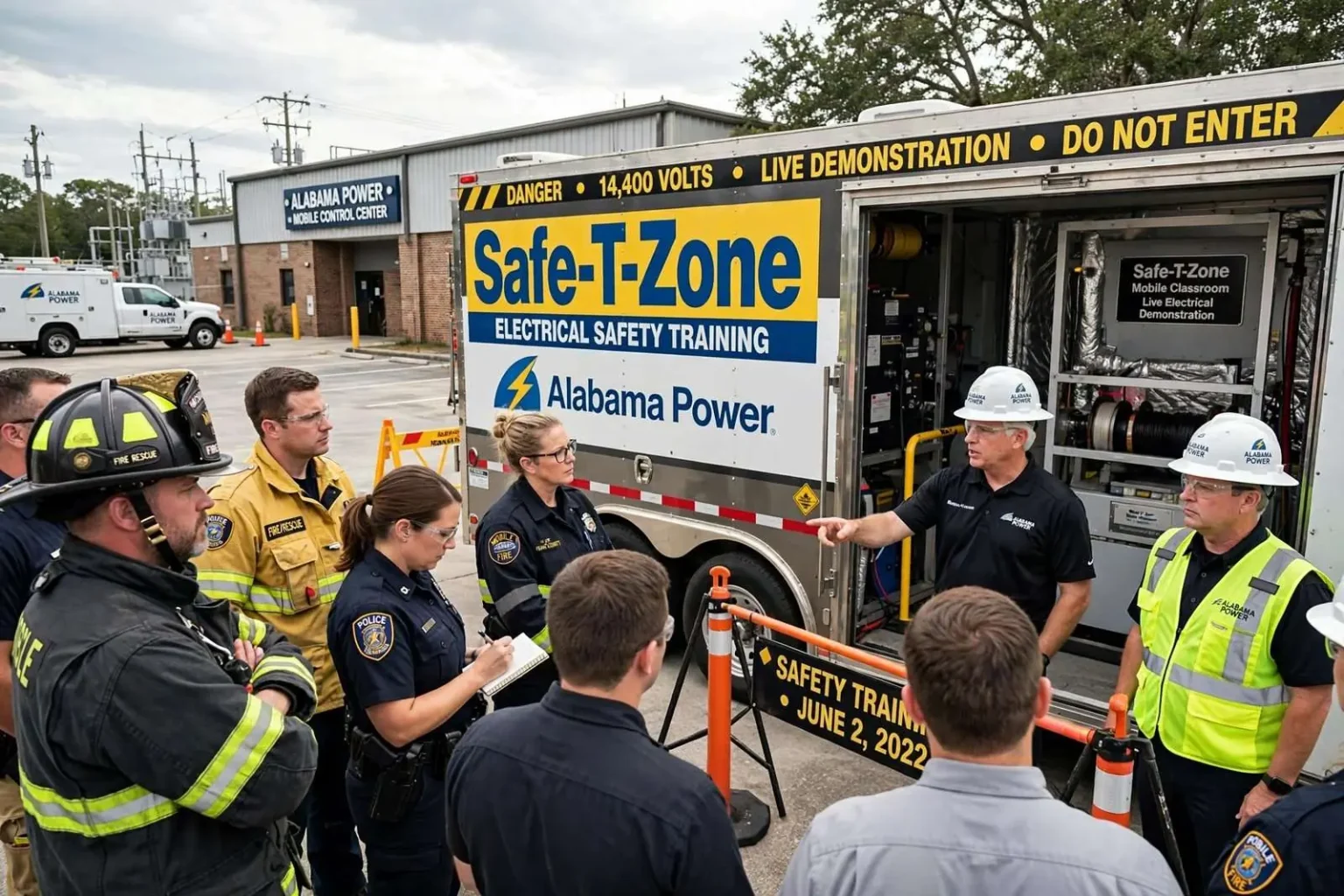
MOBILE, Ala. — Alabama Power held two electrical safety training sessions at its Mobile Control Center on June 2, 2022, marking the return of the popular “Safe-T-Zone” program after a three-year pause caused by the COVID-19 pandemic. First responders from across the Mobile area attended the sessions, where Alabama Power employees demonstrated how to handle different electrical emergencies using a specially equipped “Safe-T-Zone” trailer capable of generating up to 14,400 watts of electricity.
Back After a Three-Year Break
The 2022 sessions ended a hiatus that began when the pandemic forced the utility to shelve its in-person training events in 2020. For a program built around hands-on demonstration — crews showing first responders, up close and live, what electricity does to materials, equipment, and the human body — there was no practical way to run it over video conferences, so the trailer sat idle through three hurricane seasons’ worth of turnover in area fire departments, police departments, and emergency agencies.
Beth Thomas, external affairs manager for Alabama Power’s Mobile Division, said the company was glad to resume the in-person training. “We are really looking forward to interacting with first responders. Alabama Power works very closely with first responders on a regular basis,” Thomas said.
That working relationship is constant in the Mobile area. Utility crews and first responders overlap at storm scenes, vehicle accidents involving utility poles, structure fires where service lines are live, and the wide range of emergencies in which a downed or damaged electrical component is part of the picture. Training first responders on what they can safely approach — and what they must wait on utility crews to address — protects everyone involved, and it speeds response when crews and emergency personnel arrive at the same scene and understand each other’s work.
She added that the turnout was encouraging and asked attendees to share what they learned with colleagues, family and friends who were unable to attend. The request treats the session’s value as multipliers rather than a one-time event: every firefighter or officer who attended walked out with information that can pass through an entire shift, an entire department, and into the households of the people they know.
Inside the Safe-T-Zone
The program’s centerpiece is the Safe-T-Zone trailer, a mobile classroom capable of generating up to 14,400 watts of electricity — enough to run live demonstrations that no static presentation can match. With that power available on site, Alabama Power employees can show first responders actual arcing, actual current flow through representative materials, and the real behavior of energized lines, all in a controlled setting designed to fail safely.
The demonstrations cover the situations first responders encounter most: a vehicle into a pole with lines down across the car, what happens when different materials contact energized equipment, the reach of electricity through water and ground, and the safe distances that responders must maintain around downed lines. Seeing an arc jump the way it actually jumps does more to establish respect for the hazard than any diagram, and the format is why the program has been popular with area departments since long before the pandemic pause.
The sessions also let utility employees hear from first responders in return. Questions from firefighters and officers about scenes they have faced give Alabama Power crews a picture of how their infrastructure appears to outsiders at an emergency — information that shapes how the company communicates with dispatchers and departments when crews are en route.
Timed for Hurricane Season
The training came as the Gulf Coast entered another hurricane season, a period when downed power lines and other electrical emergencies become more common. The Atlantic season begins June 1, and coastal Alabama’s history — from Hurricane Frederic in 1979 through Hurricane Sally in 2020 — has made electrical safety a seasonal subject for the region’s emergency agencies.
Thomas said the timing was intentional. “As we kick off hurricane season here along the Gulf Coast, it’s a great time to refresh everyone on safety tips around electricity,” she said. “We certainly hope no one has to use these tips or remember them.”
The hope is a familiar one in coastal communities, and the reason the training matters even when the season is quiet. Every tropical system that reaches the northern Gulf Coast leaves a legacy of damaged lines, and the recovery period after landfall is when first responders and the public encounter electrical hazards most often — trees on lines in neighborhoods being cleared, generators feeding power into damaged homes, and service equipment pulled from walls by wind and water.
The Message to the Public
Alabama Power encouraged the public to treat every downed power line as energized and to stay clear of any electrical equipment that may have been damaged by storms. The guidance is the foundation of the utility’s public safety messaging, and it holds regardless of how a line looks: a wire on the ground may appear dead, but restoration switching and generator backfeed can energize a line without any visible sign.
The advice extends to the practical details of storm aftermath. Residents are urged to keep children and pets away from downed lines and damaged equipment, never to touch a vehicle or fence that is in contact with a line, and to report downed lines to the utility rather than attempting to move or cover them. After a storm, standing water adds another dimension, since water can carry current well beyond where the line itself lies.
Generator safety rides alongside that message during every coastal storm season. Improperly connected generators can send power back through a home’s wiring and into the utility grid, creating hazards for neighbors and for line crews working to restore service — one of the many scenarios that the Safe-T-Zone demonstrations help first responders recognize at the scene.
Why the Program Endures
The Safe-T-Zone has run long enough that some of the first responders attending in 2022 may have been children or new hires when earlier sessions traveled through the area, and its return after the pandemic reflects how the utility and local departments view the training: as infrastructure in its own right. Tools and trucks can be replaced after three idle years; the working relationships and the shared vocabulary between utility crews and emergency responders have to be maintained continuously.
Alabama Power, which traces its history to 1906 and serves customers across most of Alabama as part of the Southern Company system, maintains training and public safety programs throughout its service territory, with the Mobile Division’s sessions tailored to the hazards of a coastal, hurricane-exposed market. The Mobile Control Center itself is a working hub for the region’s electrical operations, which means the first responders attending June 2 were being trained at the same facility their local crews coordinate with during storms.
For the departments that attended, the takeaways were concrete: refreshed safe distances, renewed familiarity with how energized equipment behaves, and a direct connection to the utility personnel they will work beside during the next named storm. For Alabama Power, the sessions restored a rhythm interrupted in 2020 — and did so, deliberately, in the first week of hurricane season, when the lessons are most likely to matter.
What First Responders Take Back to Their Departments
The value of a session like the Safe-T-Zone is measured in the decisions first responders make later. A firefighter arriving at a wreck with power lines draped across a crushed car needs to know, without hesitation, whether the occupants can be reached and under what conditions — and that judgment depends on training that most departments cannot deliver on their own, because it requires live, high-voltage demonstration equipment and utility expertise.
The sessions also address the quiet hazards that responders encounter away from storm scenes. Everyday emergencies — a ladder touching a service drop, a dig-in that strikes underground conductors, a vehicle fire under a line — all carry electrical components, and the demonstrations give responders a framework for assessing them. Alabama Power employees walk attendees through those scenarios step by step, explaining not only what to do but why the electrical system behaves the way it does.
Departments across the Mobile area send personnel to the sessions with the expectation that the knowledge will circulate internally. Fire and police agencies train their own members constantly, and a utility-hosted session slots into that rhythm: attendees bring back material for shift briefings, and the demonstration stories — the arcs, the sounds, the real physics — are the parts that stick in retelling.
A Coastal Region That Prepares
Mobile’s emergency preparedness culture has been shaped by storms that hit hard and repeat often. The area’s agencies drill for hurricane response each spring, and electrical safety is a recurring element because post-storm electrical hazards are among the most persistent dangers in the days after landfall, when residents are clearing debris, running generators, and returning to damaged homes.
Holding the Safe-T-Zone sessions in that same window reinforces the seasonal message at exactly the moment agencies are refreshing their own plans. The coordination between the utility’s training calendar and the region’s hurricane preparations is part of a broader pattern on the Gulf Coast, where utilities, emergency management agencies, and first responder departments run their pre-season preparations in parallel and cross-pollinate through events like this one.
The pandemic pause made that coordination visible by its absence. Three hurricane seasons passed without the in-person training, and departments that gained new personnel in that stretch — as most did — sent members to the 2022 sessions who had never seen the demonstrations at all. The June 2 turnout reflected that backlog, alongside the regular attendees who treat the sessions as an annual refresher.
For the public, the sessions’ most important export is simple and unchanged: a downed line is always treated as live, damaged equipment is left alone and reported, and the professionals trained at the Mobile Control Center are the ones who make contact when electricity is part of the emergency.


