Alabama Power Crews Repair Utility Pole After Overnight Crash on Mobile’s McVay Drive
<p>Mobile police are assisting Alabama Power crews repairing a utility pole damaged when a van crashed into it near McVay Drive North and East Riviera Drive, causing traffic delays.</p>
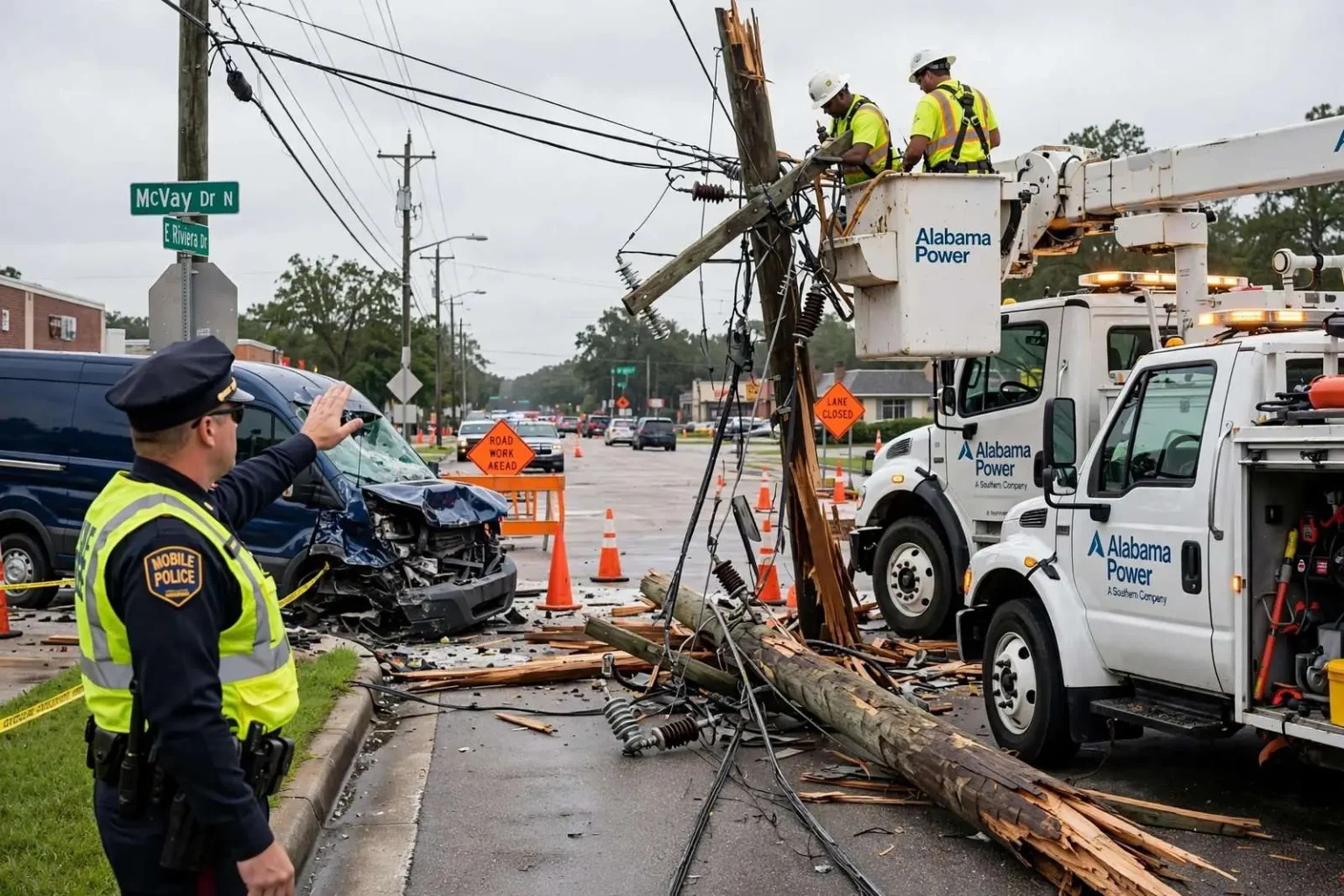
Mobile police are helping direct traffic at a busy intersection while Alabama Power crews repair a utility pole knocked down in a crash late Monday night. The overnight collision left one of the area’s main corridor junctions working at reduced capacity into the next day, with utility equipment, police presence and lane restrictions all converging on the same stretch of road as the Tuesday morning commute built.
According to a Mobile Police Department news release, a vehicle crashed into a power pole in the area of McVay Drive North and East Riviera Drive late Monday. The department said a van was involved in the collision. The department reported no fatalities in connection with the crash, though it did not specify whether anyone was injured — a formulation that leaves the injury picture open while confirming the incident did not rise to the level of a fatal collision.
Alabama Power crews have been working through Tuesday to restore the damaged pole, and the ongoing repair work has caused delays for drivers passing through the intersection. Mobile police officers have been posted at the scene to help manage traffic while the work continues, an arrangement that keeps the work zone functioning during the utility repair and gives drivers a visible, uniformed presence guiding them through a junction where the normal signal and lane patterns have been disrupted.
Crashes into utility poles are among the most disruptive collisions a roadway can absorb, because the repair timeline belongs to the utility rather than to the tow truck. A wrecked vehicle can be cleared in under an hour; a snapped pole requires crews, equipment and often a temporary power shutdown before anyone can work safely at the top of the structure. The intersection stays compromised until all of it is done.
What a Pole Repair Involves
Pole repairs of this kind typically require utility crews to shut down power temporarily to the surrounding lines, close a lane or more near the work zone, and coordinate with local law enforcement to keep traffic moving safely around the equipment and downed lines. The sequence is procedural for a reason: crews cannot begin raising a new pole or transferring lines while current is live on the circuit, so the electrical work upstream of the crash site has to be de-energized first.
Once the lines are safe, the physical work proceeds in stages — removing the damaged pole, setting the replacement, rehanging the conductors and equipment attached to it, and only then restoring power and reopening the full roadway. Each stage moves on its own clock. Utility poles carry more than wires in many locations, and every attachment has to be transferred and secured before the circuit can be re-energized and the lanes released.
For Alabama Power, the state’s largest electric utility and a subsidiary of Southern Company, pole replacement after vehicle strikes is routine work handled by district crews stationed to cover exactly this kind of event across its service territory. The company maintains tens of thousands of miles of distribution lines across Alabama, and its crews follow the same sequence whether a pole comes down in a storm or in a Monday-night crash — assess, de-energize, replace, restore.
The presence of Mobile police officers at the scene serves two purposes at once. The first is traffic control: an intersection with restricted lanes and heavy equipment in the roadway needs active management, particularly when drivers arrive unfamiliar with the disruption. The second is scene preservation, since the crash remains an open case for the department even as the utility work proceeds around it.
Why Drivers Were Asked to Be Patient
Officials are urging drivers in the area to use caution and be patient until repairs are complete. The advice is standard for work zones, and it is especially pointed where the disruption sits at a busy intersection during daylight business hours. Delays in a corridor like this ripple outward quickly — drivers who normally pass through the junction divert to parallel streets, loading those alternates with traffic they were not built to absorb, and the congestion spreads block by block until the repair is finished.
Work zones with utility crews present carry hazards beyond simple delay. Lane shifts appear where they did not exist the day before, equipment and workers operate close to the travel way, and police-directed traffic follows hand signals rather than the signals drivers expect. The combination demands slower speeds and fuller attention than the same stretch of road requires on a normal day, which is the substance behind the caution advisory.
Overnight crashes into fixed objects raise a familiar set of investigative questions as well — visibility, speed, impairment and fatigue all rank among the leading factors in single-vehicle, after-midnight collisions, and a van leaving the roadway hard enough to take down a pole invites all of them. Departments typically hold those details until the investigation firms up, which is why Monday-night crashes in Mobile often generate only a bare-bones release on Tuesday.
The Mobile Police Department did not release additional details about the driver or the circumstances leading up to the crash. That gap is typical in the hours after an overnight collision, while investigators complete their work and any reports are finalized. Until more is released, the confirmed picture stands as the department stated it: a late-Monday crash involving a van, a struck power pole at McVay Drive North and East Riviera Drive, no fatalities, and repairs continuing through Tuesday.
Living With the Corridor’s Traffic Reality
The McVay Drive area sits in one of Mobile’s established interior neighborhoods, where collector streets feed the larger commercial corridors and a single blocked junction can reshape the morning for miles around. Intersections like McVay Drive North and East Riviera Drive handle school traffic, neighborhood errands and commuter cut-through traffic all at once during peak hours, so a disruption there is felt not just by the drivers who pass through daily but by everyone whose route touches the surrounding grid.
City practice in these situations leans on the same playbook every time: officers on the ground, cones and closures around the damaged equipment, and public messaging asking drivers to avoid the area or plan extra time. The playbook exists because the alternative — leaving a damaged pole and live-wire work zone to sort itself out — is not an option. Power infrastructure in the middle of a roadway is a hazard until it is repaired, no matter how inconvenient the repair is for traffic.
For residents of the surrounding area, the practical takeaway was straightforward — expect the intersection to be compromised until Alabama Power finishes, take an alternate route if the schedule allows, and follow officers’ directions through the work zone if not. Utility pole repairs after vehicle strikes resolve reliably; the only variable is time, and on a damaged-pole job the time belongs to the crews doing the work.
Drivers who did have to pass through Tuesday were left with the same counsel police issue at every scene of this kind: slow down, put the phone away, and give the crews and officers working the junction the room they need to finish and reopen the road.
The Utility Behind the Repair
Alabama Power’s role in a scene like this one is easy to underestimate until a pole comes down. The utility keeps line crews, bucket trucks and replacement hardware positioned across its divisions so that storm damage and vehicle strikes can be answered the same day, and a Tuesday repair job in Mobile draws on the same dispatch structure that mobilizes hundreds of crews when hurricanes cross the Gulf Coast. The difference is scale, not procedure: the same crews who ride out storm season handle the single-pole jobs that follow an overnight crash.
The company’s distribution poles are also the quiet backbone of neighborhood service. When one is knocked over, the outage extends beyond the immediate block — every customer fed by the affected circuit loses power until the line can be safely de-energized and rebuilt, which is why repairs sometimes begin at switches and connections well away from the crash scene itself. Residents who lose service during a pole repair are usually seeing the upstream safety shutdown rather than damage to their own lines.
That reality is also why the intersection cannot simply reopen the moment the vehicle is towed. The pole, its hardware and its conductors all have to be replaced and verified before the circuit is re-energized, and the roadway around the work has to stay closed while the bucket truck and its outriggers occupy the lane. Traffic control and electrical work proceed on the same schedule, tied together until the last connection is made and the crews pull away.
Until then, the intersection operates on borrowed capacity, and the department’s reminder to use caution around the work zone is the cheapest insurance any driver passing through can buy.