
Alabama Power Deploys Mobile Crews to Assist With Hurricane Ian Restoration
Alabama Power deployed 65 workers from its Mobile division to Savannah, Georgia, to help restore power after Hurricane Ian struck the Gulf Coast.
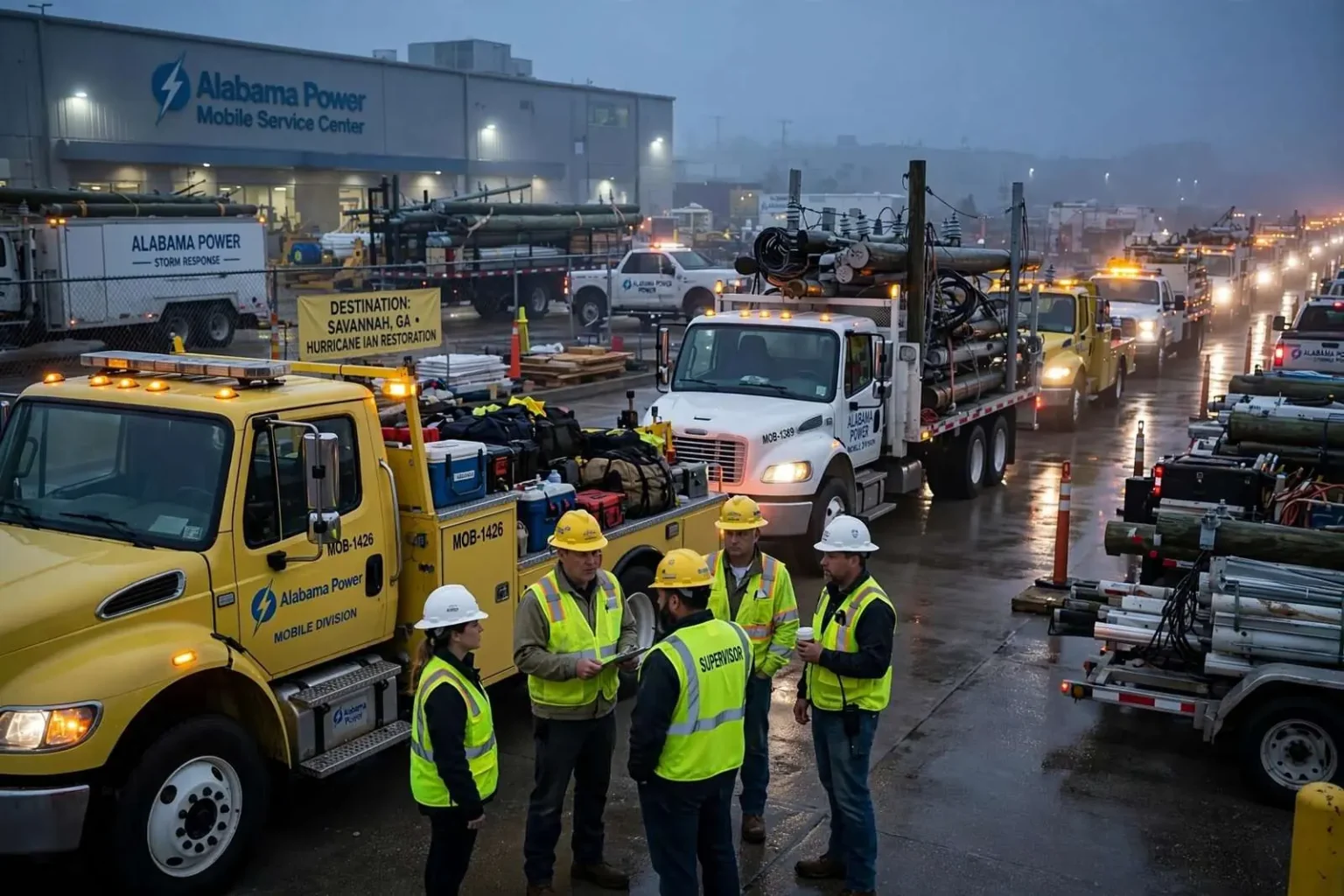
Alabama Power dispatched a team of 65 workers from its Mobile division early Thursday morning, bound for the Savannah, Georgia, area to assist with Hurricane Ian storm restoration efforts. The pre-dawn departure sent line workers, supervisors and support personnel rolling north with trucks, tools and materials, part of a carefully choreographed move to get trained crews in position before the worst of the storm arrived on the Georgia coast.
The Mobile division convoy is one piece of a much larger picture. Company officials said the deployment is part of a mobilization involving approximately 400 employees and 300 contract workers from across Alabama, all heading toward regions battered by the powerful storm. Moving that many people and that much equipment in a matter of days requires coordination across the utility’s divisions, from Birmingham to the coast, and a fleet of bucket trucks, digger derricks, pole trailers and fuel support vehicles.
Storm work of this scale is familiar territory for the state’s largest electric utility. Alabama Power, a subsidiary of Southern Company headquartered in Birmingham, serves customers across much of the state and has built its storm response capability over decades of hurricanes, tornadoes and ice storms. That experience — knowing how many crews a given amount of damage requires, how to stage trucks safely ahead of a storm’s arrival, and how to keep workers fed, rested and supplied — is precisely what neighboring utilities call on when disaster strikes.
Storm’s Path and Impact
Hurricane Ian made landfall on Florida’s western coast as a Category 4 storm at 3:05 p.m. EST on Wednesday, Sept. 28. The storm’s arrival on the heavily populated Florida peninsula triggered a massive emergency response, with millions of customers losing power as Ian’s winds and storm surge tore through coastal communities.
By Thursday morning, Ian had weakened to a tropical storm with sustained winds of 65 mph as it continued tracking northeast along the Florida coast. The forecast track carried the storm across the peninsula and back over open water, setting up a second expected landfall in the Carolinas and dragging rain bands and gusty winds across northeastern Florida and southeastern Georgia in the process.
The storm’s effects were expected to reach the Savannah area throughout the day Friday, prompting the preemptive staging of restoration crews from neighboring states, including Alabama. Getting crews on the ground before the storm arrives is a deliberate strategy: workers can be housed in hotels safely inland, briefed on the outage restoration plan, and ready to roll into damaged areas the moment conditions allow utility officials to give the all-clear.
How Mutual Aid Works
Alabama Power’s response reflects the mutual aid agreements utility companies maintain across the Southeast, enabling rapid deployment of line workers and equipment when major storms strike neighboring service territories. The arrangements run on reciprocity: a utility that sends crews to a neighbor in distress can expect the same help when the next hurricane points its eye toward Alabama’s own Gulf Coast.
Under the mutual aid framework, utilities coordinate through regional and national trade associations to match available crews with the hardest-hit systems. The requesting utility typically pays the costs of the visiting workers, and the sending utility keeps its employees on its own payroll and subject to its own safety rules. That structure lets utilities borrow each other’s labor forces without waiting for contracts to be negotiated in the middle of a crisis.
Pre-staging matters as much as the paperwork. Crews traveling from Alabama to the Savannah area are positioned outside the projected damage zone so they can begin work immediately after winds fall below safe operating limits. Restoration generally proceeds in order: transmission lines and substations first, then main distribution lines, then lateral lines serving neighborhoods, and finally individual service connections. Working from the source outward restores the most customers with each repair.
What the Crews Bring
The workers Alabama Power is sending are not simply line technicians. Storm deployments typically include overhead and underground line crews, vegetation specialists who clear fallen trees from wires, dispatchers, material handlers, fleet mechanics to keep rolling equipment running, and safety coordinators who watch for hazards such as downed lines, weakened structures and flooding.
Each crew travels with its own equipment, and the company’s storm trailers carry spare poles, crossarms, transformers and wire so that crews do not depend on the host utility’s warehouses for every part. In a widespread disaster, local supply yards can be damaged or depleted, and a truck that arrives self-sufficient is a truck that can start working sooner.
The pace of the work is demanding. Line crews often work long shifts during storm restoration, pausing only when weather or fatigue makes the work unsafe. Hurricanes bring particular dangers: energized lines hidden under debris, standing water near electrical equipment, and weakened trees that can fall hours after the winds have passed. Utilities remind residents traveling through damaged areas to treat every downed power line as live and to stay far away from crews working near energized equipment.
A Region That Knows Storms
Alabamians working the Savannah restoration understand the assignment from personal experience. The state’s own Gulf Coast communities — Mobile, Baldwin County and the beach towns of Gulf Shores and Orange Beach — have absorbed direct hits and near-misses over the years, from Hurricane Ivan in 2004 to Hurricane Katrina in 2005 to Hurricane Sally in 2020, each of which left tens of thousands of utility customers in the dark and called for weeks of around-the-clock line work.
That shared history is what makes the mutual aid network function. Crews from Georgia, Florida, Mississippi and beyond have streamed into Alabama after past storms to help rebuild feeders and replace poles across the Gulf Coast. Sending 65 workers and hundreds of others from divisions across the state toward Savannah is, in practical terms, the repayment of a debt the region’s utilities have always honored in both directions.
Coastal Georgia carries its own hurricane scars. The Savannah area and the barrier islands around Chatham County have been grazed by several tropical systems in recent memory, and local utilities there have hardened parts of their grid while accepting that a Cat-4-class storm elsewhere in the basin can still knock out power across a wide region with rain, wind and falling trees. Ian’s track toward the Southeast coast made crew staging there an easy call for utilities around the region.
What Comes Next
How long the Alabama crews stay in Georgia depends on the damage Ian ultimately leaves behind. A quick-moving storm that spares major substations and transmission corridors could allow much of the workforce to rotate home within days. A storm that wrecks coastal infrastructure could hold crews in the field for a week or longer, with replacement workers cycling in to keep shifts staffed and rested.
For customers in the affected area, the sight of out-of-state license plates on bucket trucks is the visible sign of an invisible agreement among Southeastern utilities: when a storm is bigger than any one company, the region’s line workers converge on the damage until the lights come back on. Alabama Power’s 65 workers from Mobile, and the roughly 700 employees and contract workers the company says it is mobilizing in all, are the latest contribution to that tradition.
Back home, the utility keeps its own crews and emergency plans in reserve, watching the tropics as the hurricane season continues. The same workers who roll toward a neighbor’s disaster are the ones Alabamians will count on when the next storm takes aim at the Gulf Coast — an arrangement that has served the Southeast well for generations and shows no sign of changing.
The Economics of Storm Response
Restoration work on this scale is also a significant logistical and financial undertaking. A host utility pays mutual aid crews under the standing agreements, and the costs of a major hurricane response — overtime wages, fuel, materials, hotel rooms and equipment wear — can run into the millions of dollars over a multi-week restoration. Utilities plan for those expenses with storm reserves and insurance arrangements precisely so that the response can proceed without delay while the accounting is sorted out later.
Contract lineworkers make up a substantial share of any major deployment, and the 300 contract workers Alabama Power says it is mobilizing reflect that reality. When a storm damages enough of a system at once, even the largest utilities cannot field enough in-house crews to handle the load, and the Southeast’s network of contracting firms supplies trained, experienced hands who work storm after storm alongside company crews.
Coordination hubs anchor the effort. Storm command centers track every crew, every outage and every material order from a central location, feeding work orders to field supervisors and keeping the restoration sequence moving. Damage assessment teams ride ahead of the line crews to survey downed lines and map the work, so that trucks are dispatched to the repairs that will restore power to the greatest number of customers first.
For the workers themselves, a deployment like the one rolling toward Savannah means long days away from home, sleeping in hotels and working through fatigue and rain. It also means the satisfaction of a job the region understands: turning the lights back on for a community that has just been through a hurricane. Alabama Power’s Mobile crews left before sunrise Thursday knowing exactly what awaits them, and with the experience of past storms to guide them through it.