Alabama Power Explains Decision to Cap-in-Place the Plant Barry Coal Ash Pond
Alabama Power says capping the Plant Barry coal ash pond in place costs a fraction of removal, but environmentalists say only excavation protects the river.
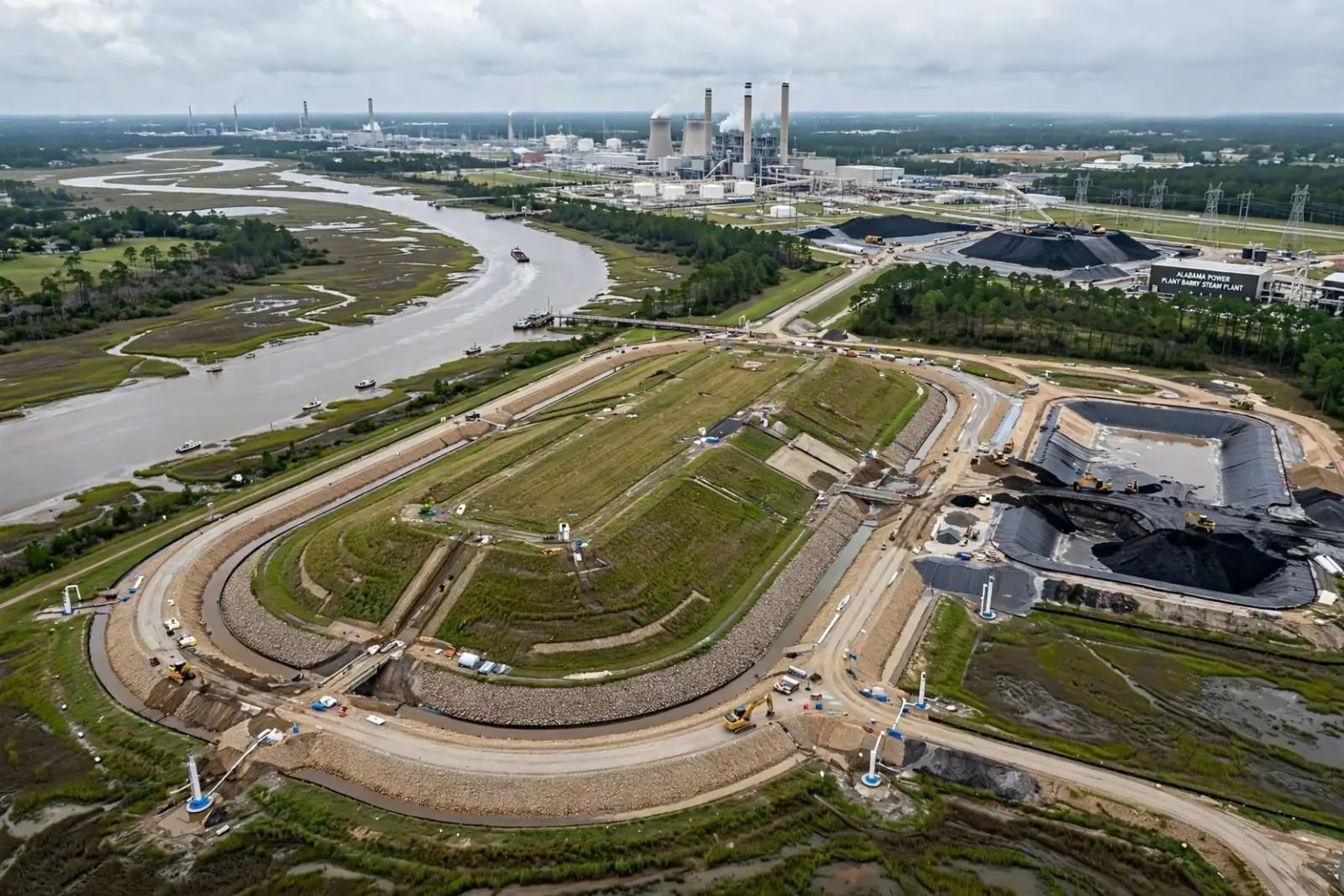
When federal coal-ash rules took effect in 2015, Alabama Power faced a choice for its ponds: install liners or close them within five years. For the massive coal ash pond at its Plant Barry steam plant north of Mobile, the utility chose to close it in place — a decision it says is far cheaper and faster than digging the material up. The choice placed the Mobile County facility at the center of a decade-long debate that has played out at coal plants across the Southeast, where utilities have weighed the cost and disruption of excavation against the long-term stewardship obligations that come with leaving ash where it lies.
Company spokesman Michael Sznajderman said closing the pond by removal would cost three to five times more and take three to five times longer than capping it in place, while sending trucks through communities for years. The Plant Barry closure alone is expected to take about 13 years and is part of a program-wide effort the company estimates will exceed $2 billion. Those figures, company officials argue, capture the real-world consequences of excavation: thousands of truckloads of material moving on rural roads, years of heavy construction, and a price tag that ultimately flows through to the customers who rely on the utility’s power.
The 600-acre pond along the Mobile River holds about 21 million cubic yards of coal ash and was within 84 percent of its designed capacity when last surveyed. It stopped accepting new ash in April, Sznajderman said. Coal ash is the fine powder and coarse residue left over after coal is burned to generate electricity, and it can contain trace amounts of heavy metals such as arsenic, lead and mercury. Utilities have historically mixed the material with water and stored it in large surface impoundments adjacent to their plants, which is why so many ponds sit along rivers and other waterways that once supplied cooling water.
Plant Barry, located in the Axis community north of Mobile, has long been one of the largest generating stations on the Gulf Coast, and its ash pond is among the largest such impoundments in Alabama. The scale matters for the surrounding area: the Mobile River is a working waterway that feeds Mobile Bay, one of the most productive estuaries on the northern Gulf Coast, and it supports commercial fisheries, recreational fishing and a port economy that reaches far beyond the county line. Any decision about how to close a pond of this size carries implications for water quality, floodplain management and the long-term health of the delta region downstream.
What capping in place actually involves
Capping in place means the ash stays where it is, but the pond is engineered into a stable, dry landform rather than simply abandoned. Under the federal standards, a utility must stop placing ash in the impoundment, dewater the pond, and install a cover system designed to keep rain and surface water from percolating through the waste. The cap must be inspected and maintained for decades, and the utility must continue to sample groundwater wells around the site to confirm that contaminants are not migrating beyond the closure area into surrounding aquifers or surface water.
Alabama Power points to additional voluntary steps: moving some ash farther from the river, building a redundant dike and a specially engineered barrier, adding stormwater controls, and monitoring groundwater for at least 30 years. Company engineers describe the layered approach as a defense-in-depth strategy — no single measure is expected to do the whole job, but together they are intended to isolate the ash from water on every front. The relocated ash is moved to lined storage farther from the riverbank, the redundant dike provides a second structural barrier behind the primary containment, and the engineered barrier is designed to block lateral movement of groundwater through the ash mass.
Stormwater controls address one of the biggest practical risks at any large impoundment: heavy rain. The Gulf Coast’s subtropical climate delivers intense downpours and the occasional tropical system, and an uncovered or poorly drained ash pond can face pressure on its berms and walls during major storm events. By reshaping drainage, hardening slopes and routing runoff away from the closed cell, the company aims to reduce the chance that storm events could stress the containment structures. Long-term groundwater monitoring, meanwhile, provides the data trail that regulators and neighbors can use to judge whether the closure is performing as designed.
“None of the results from groundwater monitoring poses a risk to neighbors, nearby waterways or water sources,” Sznajderman wrote. The company has emphasized that line in public communications, pointing to its sampling network around the Barry site as evidence that the closure approach is working. Groundwater monitoring under the federal rule requires wells at multiple points around the impoundment, sampled on a regular schedule and compared against established protection standards, with results reported to state and federal regulators.
Environmental groups push for excavation instead
Environmental groups disagree. Mobile Baykeeper Director Casi Callaway has argued the only solution that protects the Mobile River is to excavate the ash and move it to an upland, lined landfill. The advocacy group, which has spent decades working on water quality issues across Mobile and Baldwin counties, has made coal ash one of its signature campaigns, arguing that ponds left beside rivers remain a permanent hazard no matter how well they are engineered. From that perspective, the question is not whether a cap can be built to specification, but whether any structure beside a tidal river can be trusted for the centuries that coal ash remains a potential hazard.
Critics of cap-in-place closures point to the region’s vulnerability to hurricanes and flooding, the soft delta soils along the lower Mobile River, and the sheer size of the Barry pond. Excavation advocates note that modern lined landfills, built on higher ground away from waterways, are designed specifically for long-term dry storage of coal ash and can accept material from closed ponds. The counterargument, utilities respond, is the scale of the undertaking: moving 21 million cubic yards of ash means a construction project measured in decades, with heavy truck traffic through nearby communities and a bill many times larger than closure in place.
The debate in Alabama mirrors a national one. Some utilities in the Southeast and Midwest have committed to excavating their ponds, in several cases after pressure from regulators, lawsuits or citizen groups, while others have followed the cap-in-place route that Alabama Power chose. Federal rules allow both paths for most ponds, provided the closure meets engineering standards and groundwater conditions around the site do not show uncontrolled contamination. Where monitoring does show exceedances, the rules can require more aggressive remedies, which is why the sampling data at sites like Barry carries weight on both sides of the argument.
For residents of north Mobile County, the practical stakes are concrete: the health of the river system they live beside, the truck traffic and construction activity that any closure method brings, and the cost that eventually shows up in electric bills. Community meetings on the Barry closure have drawn questions about emergency planning, property values and the timeline, and both the company and its critics agree the project will be a presence in the area for well over a decade regardless of which approach is ultimately judged right.
Who pays for the cleanup
State regulators have allowed the Public Service Commission to pass justified closure costs to customers, including a 3 percent rate increase that took effect in January. The Alabama Public Service Commission regulates the rates Alabama Power charges, and under state practice the utility can recover the prudently incurred costs of environmental compliance through its rates. That mechanism spreads the cost of the coal ash program across the utility’s customer base rather than concentrating it on shareholders, an arrangement the commission has defended as the standard way to handle legally mandated environmental work, and one consumer advocates have periodically challenged as too generous to the company.
The 3 percent increase took effect in January and applies across the utility’s residential and business customers in its service territory, which covers much of southern and central Alabama. For a typical household, the change added a few dollars to a monthly bill, a modest sum individually that adds up to a substantial revenue stream given the size of the company’s customer base. Regulators review the underlying costs through rate proceedings, where the utility must document its spending on pond closures and demonstrate that the work was necessary and properly priced.
The $2 billion program-wide estimate covers Alabama Power’s ash ponds across its generating fleet, not just the Barry site. Smaller ponds at other plants are being closed on their own schedules, some by closure in place and some by excavation, depending on site conditions and the condition of each impoundment. The Barry pond, because of its sheer volume, dominates the program both in cost and in duration, and its 13-year timeline makes it one of the longest environmental construction projects planned anywhere on the Alabama coast.
What happens over the next decade
Work at the Barry pond proceeds in stages. Crews first stopped the inflow of new ash, which the company confirmed happened in April. Dewatering follows, reducing the liquid stored in the pond and lowering the pressure on containment structures. Construction of the cap, the dike improvements, the relocated ash storage and the stormwater systems then proceeds incrementally, with each phase inspected as it is completed. Groundwater sampling continues throughout, generating the monitoring record that will accompany the site long after the visible construction ends.
The 30-year monitoring commitment means the site will require care into mid-century even under the company’s own plan. Closed ponds become permanent features of the landscape, mounded and vegetated cells that must be mowed, inspected and repaired after storms. State and federal inspectors can visit the site, and the company files periodic reports documenting the condition of the cap and the results of each round of sampling. Environmental groups, for their part, have pledged to keep watching the data, arguing that sustained public attention is what keeps closure commitments honest.
For now, the two sides remain far apart. The company describes its plan as a responsible, engineering-based solution that balances environmental protection with affordability for the customers who fund it. Mobile Baykeeper and allied groups describe the same plan as a gamble that leaves millions of cubic yards of ash beside a tidal river in hurricane country. The disagreement is likely to surface again in regulatory filings and courtrooms as the closure proceeds, but on the ground, the work has begun: the pond has stopped growing, the engineering is underway, and the Mobile River runs past one of the largest environmental projects on the Gulf Coast.