Alabama Power says Plant Barry coal ash dam is safe and reliable
Alabama Power says the dam holding coal ash at its Plant Barry plant on the Mobile River is safe, but environmental groups warn of a breach.
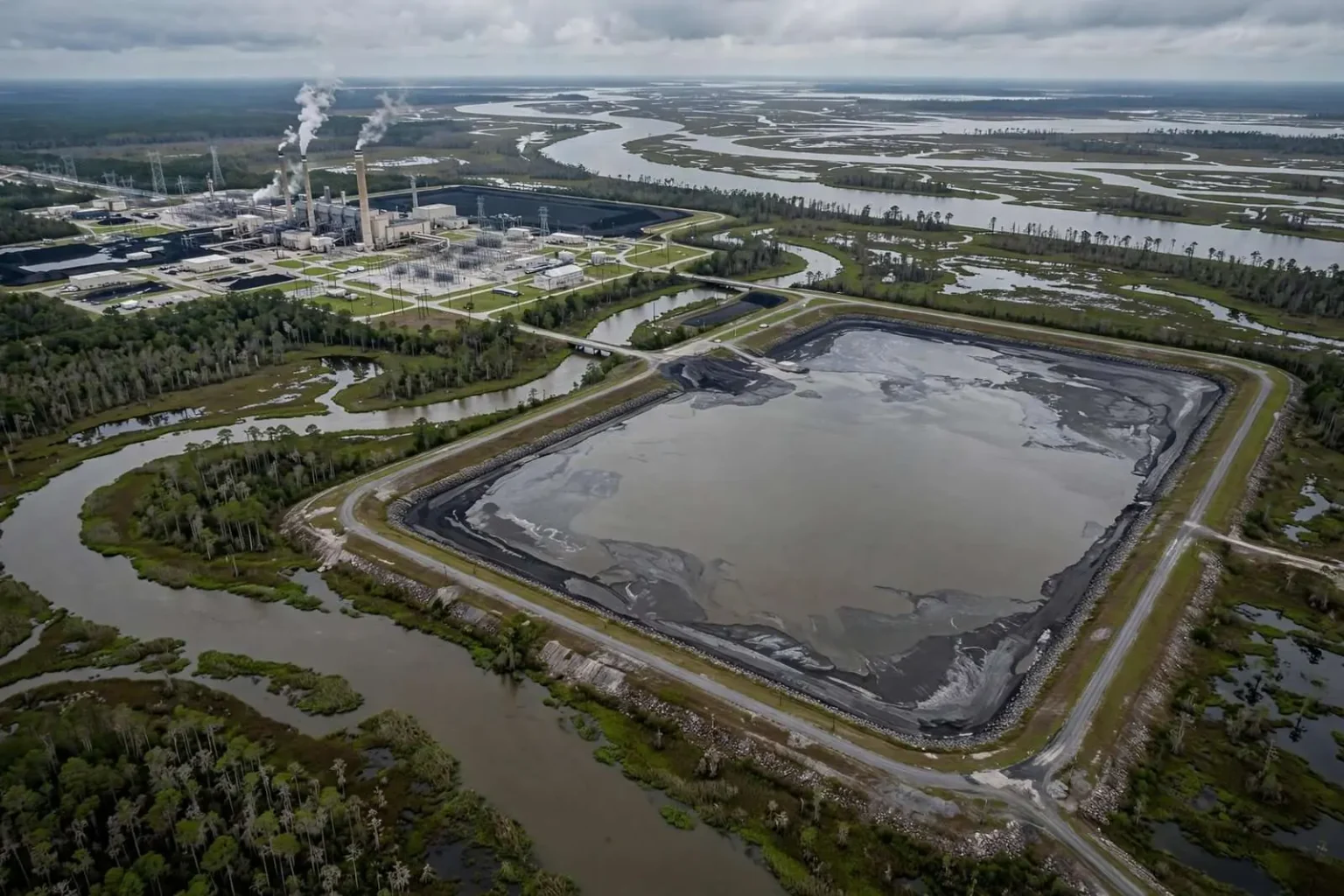
Alabama Power says the dam holding back a massive coal ash pond at its Plant Barry steam plant on the Mobile River is safe and reliable, even as environmental groups warn of the risks of a breach. The disagreement has become one of coastal Alabama’s most consequential environmental debates — a fight over how the state should handle decades of ash left behind by decades of coal-fired electricity, on a river system that millions of people rely on for drinking water, fishing and recreation.
The plant, in Mobile County, stores about 21 million cubic yards of coal ash in an unlined pond. Coal ash is the powdery residue left after coal is burned to generate electricity, and it contains trace amounts of heavy metals — arsenic, lead, mercury among them — that can pose risks if they leach into groundwater or wash into waterways. At Barry, that ash has been sluiced for decades into an impoundment beside the Mobile River, north of the city in the wooded bottomlands near the community of Bucks.
Mobile Baykeeper and other advocates want the utility to excavate the material and move it to a lined landfill rather than cap it in place. The clean-up question is simple to state and enormously expensive to answer: dig up roughly two decades’ worth of ash and haul it to dry, lined storage away from the river, or seal the pond in place and monitor it indefinitely. The dispute places Alabama’s largest utility against the region’s most prominent water-quality advocacy group, with federal regulators, state officials and river communities all waiting on the outcome.
Geography is at the center of the argument. The ash pond sits on the Mobile River a short distance upriver from where the river’s currents meet Mobile Bay, upstream of neighborhoods, industrial facilities and the intakes and recreation areas that line the working river. The Mobile system drains much of Alabama — one of the largest river systems flowing into the Gulf of Mexico — so whatever enters the water above the bay flows directly through the estuary that the region’s seafood economy depends on.
The plant itself has been a fixture of the local landscape for generations, burning coal to power the Gulf Coast’s homes and industry while sending its byproduct into the adjacent impoundment. Coal ash ponds like Barry’s were standard practice for utilities across the Southeast for decades — the ash is mixed with water and piped into engineered diked ponds, where solids settle out — a method that made sense when the material was viewed as little more than inert residue. The modern debate is really about reassessing that assumption with sixty years of hindsight.
What a Failure Could Mean
The U.S. Environmental Protection Agency has rated the dam at Barry’s ash pond as having a significant hazard potential, meaning a failure would be unlikely to cause loss of life but could do major economic and environmental damage. The rating — one step below “high hazard” in the federal classification system — reflects the pond’s location: the dam does not loom over a subdivision, but the wetlands, waterways and working landscape downstream would bear the brunt of any release.
Inundation maps the company filed show a breach could spread ash as far as five miles from the dam. That footprint reaches into the Mobile-Tensaw Delta, the vast wetland complex where the Mobile River system meets Mobile Bay — one of the most ecologically productive estuaries in North America and the nursery for much of the Gulf Coast’s commercial and recreational fishing. A plume of ash into those waters would be a nightmare scenario for the region’s seafood industry and for the river towns that sit downstream of the plant.
Company officials point to a rigorous inspection program that they say has been in place for more than 40 years. Spokesman Michael Sznajderman said each impoundment is inspected thoroughly each year by licensed professional engineers, with more frequent checks by plant personnel. The company also points to the engineering built into the dikes themselves: Alabama Power maintains the dikes were designed to handle a 1,000-year flood event, and it has never had a major structural failure at any of its ash ponds, with all of its dams deemed satisfactory in the most recent federal inspections.
The utility’s confidence rests on that inspection record — but it is the self-inspection part of the arrangement that troubles the other side. Environmental groups commissioned their own dam safety report, which questioned whether self-inspections are enough and noted the pond sits in a low-lying, flood-prone area. The groups’ concern is straightforward: the dam is inspected by the same company that owns it, the pond sits in a floodplain in a hurricane-prone state, and the material inside it is unlined, meaning any failure or seepage puts contaminants directly in contact with groundwater and surface water.
The stakes were made unforgettable by disaster elsewhere. In December 2008, a dike failed at the Tennessee Valley Authority’s Kingston coal plant in eastern Tennessee, releasing more than a billion gallons of ash slurry across riverside homes and farmland in one of the worst environmental disasters in American history. Kingston became the case study cited on every side of the Barry debate — proof to environmentalists of what can go wrong, and a cautionary tale that pushed utilities, including Alabama Power’s peers across the region, to accelerate their own ash-pond closures.
The National Coal Ash Reckoning
The argument at Barry is playing out against a shifting national backdrop. The U.S. Environmental Protection Agency issued the first federal rules governing coal ash disposal in 2015, requiring utilities across the country to assess their impoundments, publish groundwater monitoring data and close ponds that cannot meet the new standards. The rule left utilities a choice that sounds a lot like Alabama’s: close in place with engineered caps and long-term monitoring, or excavate and relocate the ash to modern lined landfills.
Across the Southeast, utilities have made different calls. Some have committed to closing ponds on site after removing free water and installing caps, while others — under legal and community pressure — have hauled ash by rail and truck to engineered landfills. The cost difference is measured in the hundreds of millions of dollars at a single plant, which is why the decision at Barry is being watched as closely as any in Alabama, and why advocates have pushed regulators and courts to demand more than the cheapest path.
For now, the pond at Barry keeps holding, the inspections keep coming back satisfactory, and the two sides keep talking past each other. The utility argues that its more than four decades of engineering oversight demonstrate the impoundment is managed to the standards that apply to major dams — the same class of infrastructure that holds back reservoirs and municipal water supplies across the state. Environmental groups counter that time is not a neutral factor: the pond’s contents get no younger, the Gulf Coast’s storms get no gentler, and the communities between the dam and Mobile Bay get no further away.
What happens at Plant Barry will shape more than one pond. Utilities across Alabama and the broader Gulf Coast are working through the same closing decisions for ash impoundments built generations ago, and the outcome at Barry — whether Alabama moves its ash or caps it beside the river — will set a benchmark for how the state balances utility economics against environmental risk. For the residents of Mobile County, the question is not abstract: 21 million cubic yards of ash sit behind a dike on the river that runs through their city, and the debate over its future is ultimately a debate about what level of risk a community should be asked to accept.
Until the matter is resolved, both sides agree on at least one thing — the status quo has an expiration date. Federal coal ash rules require ponds like Barry’s to stop receiving ash and to close, and the only open question is how, on what timeline, and with how much of the material moved off the riverbank. Whichever way Alabama Power and its critics land, the Mobile River will carry the consequences — good or bad — for generations.
In the meantime, the watchdog role falls to groups like Mobile Baykeeper, which has spent years monitoring water quality around the plant and pressing the case in public comment periods and, where necessary, in court. Their argument is straightforward: a lined landfill located away from a river floodplain is the only disposal method that protects the aquifer and the bay regardless of what storms, floods or time bring, and the extra cost of doing it right pales beside the cost of cleaning up after a failure.