Alabama prison hunger strike ends after water shut off to cells
An Alabama prison hunger strike protesting solitary confinement ended after Holman Correctional Facility staff shut off water to inmates' cells.
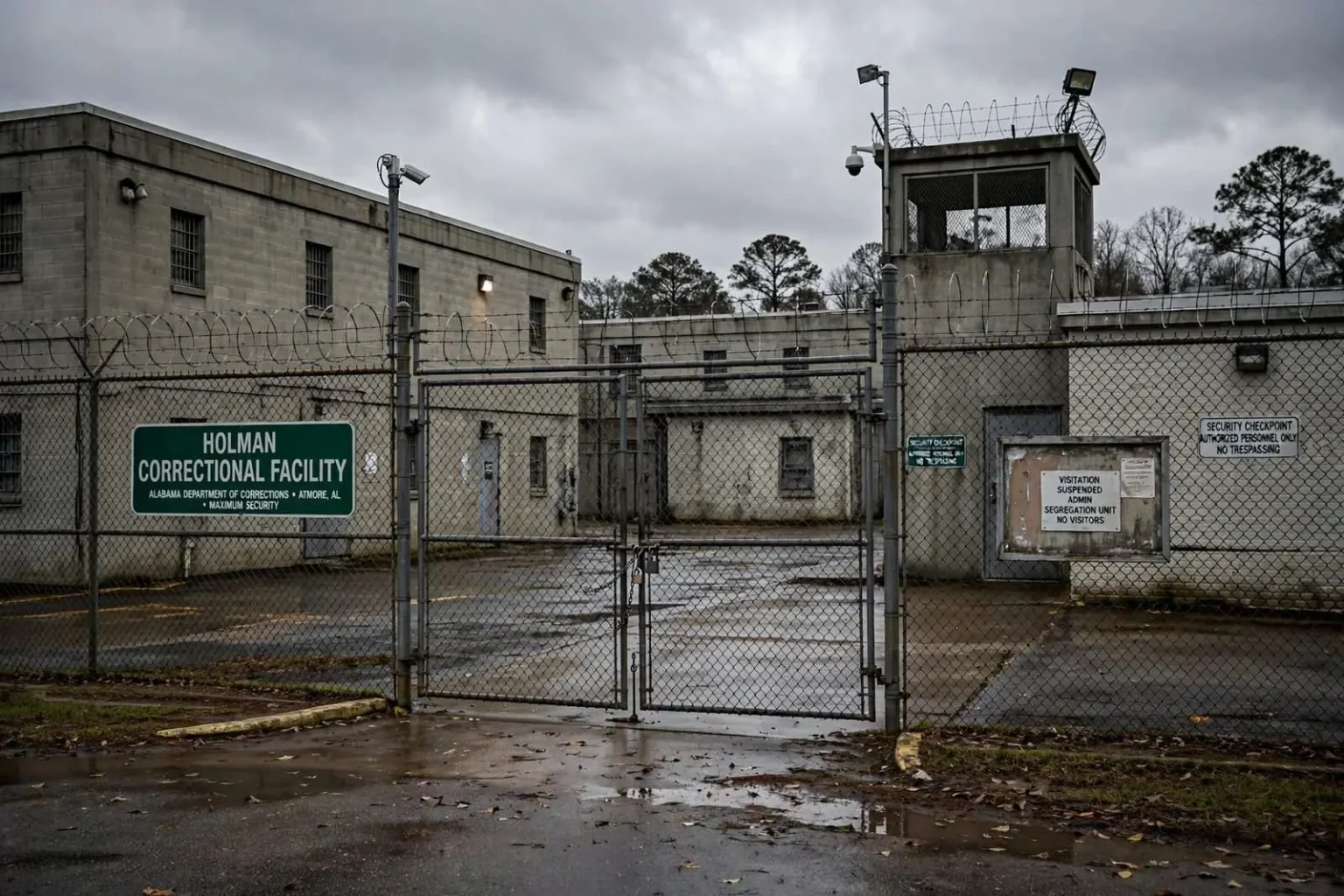
ATMORE, Ala. — A hunger strike by Alabama inmates protesting their placement in solitary confinement has ended after prison authorities shut off the water to their cells, according to the state Department of Corrections. Corrections spokesman Bob Horton told the Montgomery Advertiser that the water was turned off so medical staff at Holman Correctional Facility could monitor the inmates’ water intake — a step intended to establish what the striking prisoners were actually consuming as the protest entered its later days. The strike ended late Thursday, bringing to a close a week in which the treatment of inmates in the state’s isolation units drew renewed attention.
Eight inmates began refusing food on Monday, saying they had been unjustly placed in solitary confinement at the prison in Escambia County. The inmates had been transferred to Holman in February for security reasons following a contraband raid, and their grievance centered on the conditions they found themselves in after the move. For the days that followed, the eight men refused meals while their representatives in the department’s public information office fielded questions about the standoff between the prisoners and the administration housing them.
Horton said the striking inmates had not violated any rules or regulations but were held in solitary while authorities determined where to place them within the general population at another facility. That explanation acknowledged the core of the inmates’ complaint — that the isolation was not punishment for misconduct — while framing it as an administrative holding pattern rather than a disciplinary sanction. The department did not announce a timeline for those placement decisions when the strike ended.
How the week unfolded
The protest began, by the department’s account, on a Monday, when the eight inmates refused their meals in unison. Hunger strikes in prison settings are typically tracked by medical staff from the first missed meal, because the human body begins to suffer the effects of extended fasting within days and the risk of lasting harm grows as the refusal continues. Prison medical teams monitor weight, hydration and vital signs, and the department’s decision to shut off water to the striking inmates’ cells was presented as an extension of that monitoring: with the tap closed, staff could control and measure exactly how much fluid each inmate received, ruling out the possibility that the men were taking in more than they reported.
By late Thursday, the strike was over. The department said the inmates had ended their refusal of food, and the water service to the cells was restored as the monitoring posture wound down. No injuries or medical emergencies were reported in connection with the protest, and the department did not say whether any disciplinary measures would follow — a question complicated by Horton’s own statement that the men had not broken any rules while the department decided where to house them.
The decision to hold the eight in isolation during the placement process is the part of the episode that drew the inmates’ objection in the first place. In Alabama’s prison system, inmates are sometimes held in segregation while transfers and classifications are worked out, a practice that can extend for weeks or months in a system that has been strained by overcrowding and staffing shortages. For the eight men, the week without food was a protest against a status — solitary confinement without a disciplinary basis — that they considered unjust, even as the department characterized it as temporary.
Holman and the placement question
Holman Correctional Facility, where the eight were being held, is one of Alabama’s maximum-security prisons, housing a general population alongside the state’s death row. The facility in Atmore has been a recurring focus of scrutiny of Alabama’s prison conditions, and its dormitory and cell blocks have operated under the same pressures of crowding and understaffing that mark the state’s system as a whole. Transfers into Holman are common in both directions — inmates move between facilities for security, medical and classification reasons — and the February arrival of the eight men following the contraband raid fit that ordinary pattern of movement within the department.
What the men disputed was what happened after the transfer. Being held in solitary confinement — locked in a cell for the great majority of the day with limited contact with other inmates and staff — is among the most restrictive statuses in a prison, and inmates subject to it routinely describe the isolation itself as the burden. The department’s position, as stated by Horton, was that the placement was a stopgap: the men were being held while officials decided where in the general population of another facility they should be assigned. The inmates’ position was that the stopgap had become their condition, and that without a rule violation to justify it, the isolation should end.
Contraband raids are a routine tool of prison administration, and Alabama’s department has conducted them across its facilities as it works to keep weapons, drugs and phones out of its prisons. A raid typically leads to searches, seizures and sometimes transfers, as administrators move inmates whose housing arrangements have been compromised or whose security profiles have changed. The February raid that brought the eight men to Holman was described only in general terms — for security reasons, the department said — and the specifics of what prompted the transfer of these eight in particular were not made public.
Hunger strikes as protest
Hunger strikes occupy a particular place in the history of prison protest. Because inmates in confinement have few ways to make a grievance public, refusing food is one of the few actions available to them that reliably draws attention from outside the walls. Prison systems generally treat them first as medical events rather than disciplinary ones — the priority is keeping the protesters alive — but they also force administrators to engage with whatever complaint underlies the refusal. A strike that ends after a few days, as this one did, usually means either the grievance was addressed or the protesters’ health made continuation untenable.
The water shutoff reported in this case illustrates how departments respond to the monitoring problem. When an inmate on a hunger strike drinks but does not eat, medical staff lose part of the picture, and some administrators have concluded that controlling the water supply is the only way to know whether a fast is actually underway. Civil liberties advocates have criticized the practice as coercive, since it uses a basic necessity as a lever, while corrections officials describe it as clinical record-keeping. Horton’s account placed it firmly in the latter category: the water was turned off so Holman’s medical staff could monitor intake.
The Alabama Department of Corrections operates among the most crowded prison systems in the country, and questions about how it houses inmates in segregation have been raised repeatedly by advocates, journalists and federal inquiries in recent years. Against that backdrop, even a short hunger strike by eight inmates over their placement draws notice, because it touches the same themes — classification decisions, administrative segregation and the transparency of the process — that have defined the broader debate over Alabama’s prisons.
What happens next for the eight
With the strike ended, the question that remains is the one that started it: where the eight men will be housed. Horton’s statement said authorities were determining where to place them within the general population at another facility, which means the resolution of the grievance depends on a classification decision rather than a change in conditions at Holman itself. Until those placements are made, the men remain in the same holding status they were protesting, and the department has not said how long that determination will take or what criteria will guide it.
Placement decisions in large prison systems are made by classification staff who weigh an inmate’s security designation, disciplinary history, medical needs and the operational situation at each facility. A transfer that follows a contraband raid can complicate the process, because the security rationale behind the original move may need to be re-evaluated before an inmate can be safely returned to a general population. That administrative machinery moves slowly in a system carrying as many inmates as Alabama’s, which is how a holding status that officials describe as temporary can stretch on long enough to become the thing inmates protest.
The department did not indicate whether the water shutoff or the strike itself would be noted in any of the men’s files. Horton’s statement that the striking inmates had not violated any rules or regulations suggests the protest was not treated as a disciplinary matter, but departments retain discretion over housing regardless of discipline, and the eight men’s placement ultimately rests with administrators rather than any formal finding. For the inmates, the outcome of the classification review is the measure of whether the week without food accomplished anything.
Escambia County’s prison town
For Atmore, a small Escambia County city near the Mississippi line, Holman is both a major employer and a recurring headline. The prison sits on the outskirts of town, and its operations — staff commutes, inmate transports, the constant movement of a maximum-security institution — are part of daily life in the community. News of disturbances inside the facility travels quickly locally, and coverage by Montgomery media of events like the hunger strike is how most Alabamians learn what happens behind its walls.
The episode also underscores the role that local journalism plays in accounts of prison life. The department’s explanation of the water shutoff came in a statement to the Montgomery Advertiser, one of the news organizations that has covered Alabama’s prison system in sustained fashion. Without such reporting, the specifics of a protest that lasted four days inside a maximum-security facility — the number of inmates involved, the reason for the water shutoff, the department’s acknowledgment that no rules had been broken — would likely never have been described publicly at all.
As of the strike’s end late Thursday, the eight inmates were off their fast, the water was running again in their cells, and the department was continuing the work of deciding where in another facility’s general population they would be housed. The protest’s central grievance — that they were being held in solitary confinement without having violated any rules — remained, by the department’s own account, accurate as a description of their situation. What changed over the course of the week was that the eight men made that fact a matter of public record, and then began eating again.