Alabama Releases $26.1 Million in GOMESA Funds for 16 Mobile and Baldwin County Coastal Projects
Gov. Kay Ivey approved $26.1 million in GOMESA funding for 16 coastal restoration, boating access and infrastructure projects across Mobile and Baldwin.
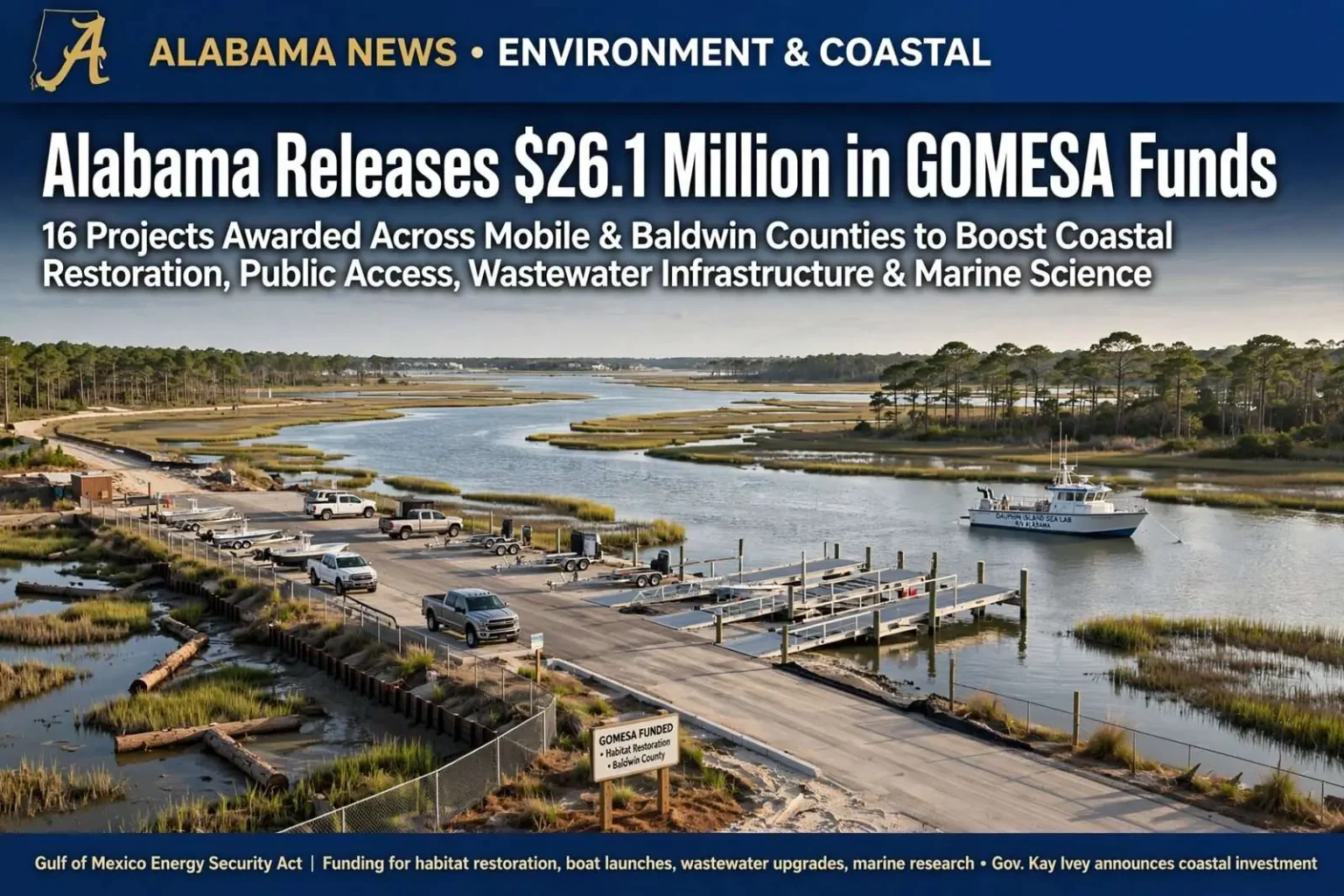
Sixteen environmental and recreational projects across Mobile and Baldwin counties are set to receive a combined $26.1 million after Gov. Kay Ivey approved the latest round of funding from the Gulf of Mexico Energy Security Act Program, known as GOMESA. GOMESA channels a share of federal oil and gas revenue back to the Gulf Coast states where that energy is produced.
Alabama has used its share to fund coastal restoration and public access projects, though the program has periodically faced pressure from lawmakers who wanted to redirect the money elsewhere in the state budget. In announcing this round of awards, Ivey said the funding reflects the state’s responsibility to protect the coastline that bears the brunt of the impact from Gulf energy production.
“Alabama’s Gulf Coast is a foundation for our state’s natural beauty, and it is imperative that we be good stewards to that area,” Ivey said in a statement. “The GOMESA funds made available to Alabama are providing aid to make various improvement and conservation projects possible. From research lab support to improving areas for Alabamians and our visitors to enjoy, these funds will go a long way in preserving this special place in our state.”
How the Money Flows
GOMESA, enacted by Congress in 2006, rewrote the arrangement under which the federal treasury shares offshore energy revenue with the producing states. Before its passage, Gulf states absorbed the environmental and infrastructure consequences of offshore drilling — hurricane response, coastal erosion, the marine science needed to manage its effects — while virtually all lease revenue flowed to Washington. The act dedicated a growing share of that revenue to Alabama, Mississippi, Louisiana and Texas, with a portion earmarked for the Land and Water Conservation Fund and the coastal states’ use restricted to conservation, coastal protection and public access purposes.
Those restrictions are the source of the periodic statehouse battles. Because GOMESA money cannot simply be dropped into the general fund, legislators facing budget shortfalls have regularly proposed redirecting it, and coastal legislators have just as regularly defended it as the region’s compensation for hosting the energy industry’s offshore footprint. Each award cycle therefore carries a significance beyond the projects themselves: it reaffirms that the money arrives for the coast and stays there.
The awards followed a call for project proposals issued in January 2020 by the Alabama Department of Conservation and Natural Resources. The agency received more than 60 suggestions from the public before narrowing the list down to the 16 selected projects.
The solicitation process put the selection in the hands of the people who use the coast. Municipalities, county commissions, universities and public agencies nominated specific needs — a boat ramp here, a wastewater fix there — and the department weighed them against the program’s allowable uses. The result spans four distinct categories: habitat restoration, boating and public access, wastewater infrastructure and marine science.
The Largest Grants
Some of the largest grants went to the Baldwin County Commission for a new boat launch on the Intracoastal Waterway, to ADCNR for habitat protection along the Perdido River, to the Dauphin Island Sea Lab for a new marine research vessel, to the Mobile County Water, Sewer and Fire Protection Authority for a septic-to-sewer conversion project, and to the Mobile County Commission to carry out a public access master plan.
The Intracoastal Waterway launch answers one of Baldwin County’s most persistent boating complaints. The Gulf Intracoastal Waterway carries a constant procession of commercial barges and recreational vessels along the county’s southern flank, but public launch sites able to handle trailer traffic on busy weekends remain scarce, and the county’s boat-owning population has grown with the subdivisions that surround it.
The Perdido River grant funds habitat protection along the waterway that forms the boundary between Alabama and Florida, a blackwater stream that ranks among the last relatively undeveloped rivers on the northern Gulf coast. Its sand-bottom runs, cypress sloughs and rare plant communities have made it a conservation priority for both states, and land protection along its corridor preserves water quality for the estuary it feeds at Perdido Bay.
The Sea Lab’s research vessel represents the science side of the ledger. The Dauphin Island Sea Lab serves as Alabama’s marine science consortium, educating students from universities across the state and operating the public Estuarium on the island’s east end. Research vessels are the working platform beneath that mission — ferrying classes into Mobile Bay, hauling sampling gear for the scientists who monitor fisheries and water quality, and supporting the emergency response work that follows spills and storms.
Baldwin County Projects
In Baldwin County, funding will go toward parking improvements at the Weeks Bay and Fish River boat ramp ($550,000), construction of public boating access along the Intracoastal Waterway ($2,601,500), an expansion of the city of Foley’s nature parks ($3,000,000), and ADCNR’s habitat protection work in the Perdido River watershed ($3,720,000).
The Weeks Bay and Fish River ramp serves one of the county’s most popular freshwater launches, drawing paddlers and anglers onto the river that feeds the Weeks Bay estuary. Parking at such sites is the binding constraint: a ramp is only as useful as the number of trailers it can stage, and the improvement targets exactly that bottleneck. Weeks Bay itself — a National Estuarine Research Reserve where the Fish and Magnolia rivers meet Mobile Bay — anchors the region’s network of protected waters, making public access to its tributaries a conservation investment as much as a recreational one.
Foley’s park expansion extends a different strand of Baldwin County’s growth. The city’s nature parks have become a regional draw in their own right, offering boardwalks, trails and playgrounds that serve both residents and the tourists who pass through on the way to the beaches. Expanding them converts GOMESA revenue — earned from offshore energy — into public open space a short drive from the Gulf, in a county whose residential boom has steadily consumed undeveloped land.
The Perdido watershed work, at $3.72 million the largest single Baldwin County award, funds the protection effort along the river and its tributaries, where conservation easements and land acquisitions shield the corridor from the development pressure radiating outward from the county’s population centers.
Mobile County Projects
Mobile County’s share of the funding includes public access enhancements at Chickasaw’s Brooks Landing ($274,990), public access improvements at the Steele Creek Lodge in Satsuma ($1,024,141), boating access improvements at the Little Billy Goat Hole on Dauphin Island ($450,000), a new marine science research vessel for the Dauphin Island Sea Lab ($3,250,000), a manatee sighting network also run by the Sea Lab ($149,838), exhibit and educational upgrades at GulfQuest ($76,800), a boat launch at Three Mile Creek through the Alabama State Port Authority ($150,000), an Auburn University oyster enhancement project in Little Dauphin Bay ($633,502), septic-to-sewer improvements in Bayou La Batre ($2,427,300), a second phase of septic-to-sewer work through the Mobile County Water, Sewer and Fire Protection Authority ($3,697,500), and implementation of the Mobile County Commission’s public access master plan ($3,500,000).
The two septic-to-sewer projects carry the list’s most direct public health significance. Aging septic systems around Mobile Bay leak nitrogen and bacteria into the groundwater and the bay itself, closing shellfish harvesting areas and feeding the dead zones that periodically plague the estuary. Bayou La Batre — a shrimping village whose seafood industry depends on clean water — and the unincorporated communities served by the water authority both face the same structural problem: homes built on small lots with soils ill-suited to septic absorption. Converting them to central sewer service removes the pollution at its source.
The Auburn University oyster project in Little Dauphin Bay continues Alabama’s sustained investment in restoring the oyster reefs that once filtered the bay’s waters and anchored its seafood economy. Oyster enhancement — placing cultch material and substrate where larval oysters can settle — rebuilds habitat that benefits everything from sport fish to the watermen who harvest the reefs commercially, and each restored reef improves the bay’s water clarity as the living filter grows.
The manatee sighting network reflects a quieter success story. West Indian manatees have appeared in increasing numbers in Alabama’s coastal waters in recent summers, wandering north from Florida as Gulf temperatures warm, and the Sea Lab’s network enlists the public in documenting the visitors. Sightings reported by boaters and anglers feed the research that determines how the state protects the species in its northern range.
Smaller awards round out the geography. Brooks Landing in Chickasaw and the Steele Creek Lodge in Satsuma improve public access to the waterways of Mobile County’s northern suburbs, where communities built on river industries have been reconnecting residents to the water. Little Billy Goat Hole is Dauphin Island’s working launch for anglers heading into the bay and the passes, and its improvements reach the island’s vital fishing tourism. The Three Mile Creek launch, funded through the Port Authority, opens paddling access on the urban creek that threads through west Mobile toward the river.
GulfQuest’s exhibit upgrades support the National Maritime Museum of the Gulf of Mexico on Mobile’s riverfront, an interactive museum that teaches the Gulf’s shipping, energy and ecological story to school groups and visitors. The award is small by the program’s standards but pointed: it funds the institution whose exhibits explain, to the next generation, exactly where GOMESA money comes from.
A Master Plan and a Shared Coast
The Mobile County Commission’s $3.5 million award funds implementation of the county’s public access master plan, the blueprint that identifies where boat launches, piers, trails and waterfront parks should be added or improved across the county. Rather than a single site, it is a program — the kind of award that multiplies the value of the individual projects around it by connecting them into a system.
Together, the 16 projects touch on habitat restoration, boating and public access, wastewater infrastructure and marine science, reflecting the range of needs identified by coastal Alabama communities during the public comment process.
The breadth was the point. A funding stream restricted to conservation and coastal access could have been spent on a handful of marquee acquisitions; instead, the process spread the money across two counties, a dozen institutions and every kind of coastal need, from the $76,800 museum upgrade to the $3.72 million river corridor. The smallest award and the largest sit on the same list because both emerged from the same answer to the same question — what does the coast need from the revenue its waters generate?
For the communities that will receive the funds, the awards also carry a deadline-free promise: the projects will be built as planning and permitting allow, converting a line in a state announcement into boat ramps, sewer lines, research platforms and protected land across the two counties where Alabama meets the Gulf.