Alabama Schools to Stay Closed Rest of Year, Mobile County Prepares At-Home Learning Plan
Gov. Kay Ivey announced Alabama's public schools will remain closed for the rest of the school year, with at-home learning to begin statewide April 6 as Mobile County Schools Superintendent Chresal Threadgill and other local leaders prepare their districts for the transition.
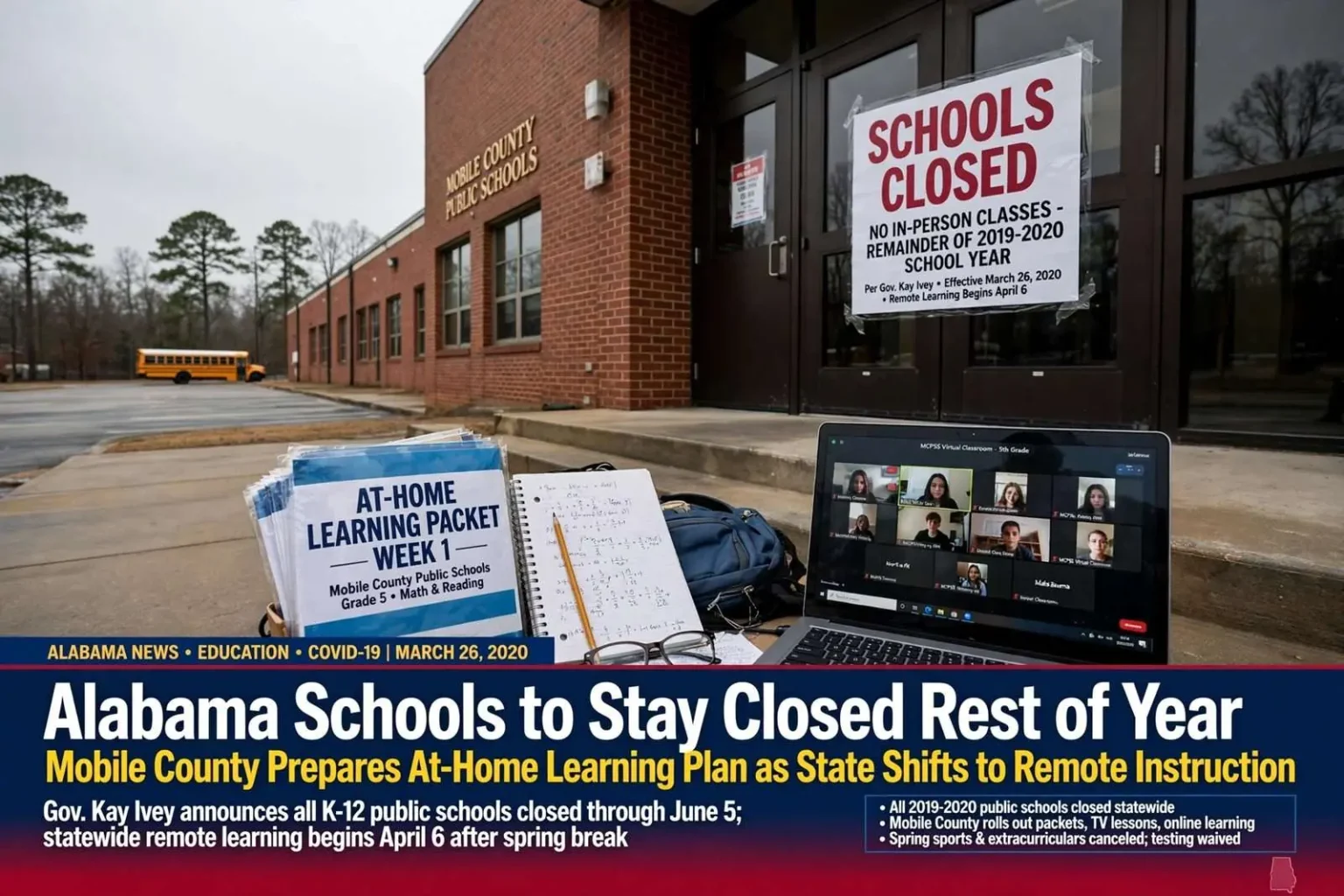
Alabama public schools will not reopen for the remainder of the 2019-2020 school year, Gov. Kay Ivey announced Thursday, as state officials scramble to build a statewide system for at-home instruction set to launch April 6. The decision affects every K-12 student in the state, including tens of thousands enrolled in Mobile County Public Schools, and marks one of the most sweeping disruptions to Alabama education in decades.
Ivey closed schools earlier in March for what was initially framed as a two-and-a-half-week pause meant to slow the spread of COVID-19, with the expectation that classrooms could reopen after the break. But with confirmed cases climbing across Alabama each day, Ivey said she and State Superintendent of Education Eric Mackey concluded that sending students and staff back into crowded classrooms was no longer a responsible option.
“Nothing can replace the interaction between a teacher and students in a classroom setting. However, access to high-quality instruction is crucial for our students to maintain their competitive edge academically,” Ivey said. “Certainly, we’ll be dealing with the fallout of COVID-19 in our health and economy, but the one thing we want to prevent is a slide in our students’ educational achievement.”
The closure makes Alabama the third state in the nation to shut down all public schools for the rest of the academic year, and officials acknowledge there is no modern precedent for a disruption of this scale. Mackey said the coronavirus outbreak has forced the state into uncharted territory, both medically and educationally.
One of the biggest hurdles facing the Alabama State Department of Education is unequal access to broadband internet, which Mackey said varies widely from county to county and household to household. While some school systems already operate virtual academies and have the infrastructure to shift seamlessly to online instruction, others have little to no digital learning capability in place.
To bridge that gap, Mackey said his department will spend the next week and a half working individually with superintendents across the state to build instructional plans tailored to each district’s resources. He said the goal is to make sure every school and every child at home, regardless of internet access, has a path to continued learning.
“We’re going to be able to offer online learning through our distance learning platform, but also take-home packets and some other resources as well,” Mackey said. He pointed to two resources already stepping up to help close the gap: the Alabama Public Library System, which has expanded the hours of its Homework Hotline and has more than 3,000 volunteers staffing phone lines to help students and parents, and Alabama Public Television, which plans to broadcast coursework at various times throughout the day to reach households without reliable internet service.
Federal education officials have also granted Alabama and other states a waiver excusing them from this spring’s required standardized testing, which typically takes place in April. Alabama had been preparing to roll out a newly developed state assessment next month after years of switching between different testing systems, and Mackey said that new exam remains on track to debut for the 2020-2021 school year as planned.
Until now, schoolwork assigned during the closure has been optional but encouraged. That will change on April 6, when local districts are required to begin their formal at-home instructional plans. In Mobile County, Superintendent Chresal Threadgill told teachers and parents Thursday afternoon that the coming week will still be treated as the district’s regularly scheduled spring break, and he asked teachers to hold off on assigning additional coursework or heavy classroom interaction until the new plan takes effect.
“By April 6, even though traditional classes will not be in session, we will have a plan to continue educating our students until we are able to return to the traditional classroom setting,” Threadgill said. “I continue to ask all of our MCPSS parents, students, faculty, staff and students to remain tough and remember that we can withstand all obstacles we face.”
Mackey said the 2019-2020 school year will not officially close until June 5, later than usual, giving teachers extra time to collect makeup work from students transitioning to remote instruction. That extension, however, comes with a difficult trade-off: all spring high school sports and extracurricular activities have been canceled statewide for the remainder of the year.
Mackey said he remains hopeful that some senior milestones, including graduation ceremonies and proms, can still be held later in the year once public health restrictions ease, even though they cannot take place before the June 5 end date. “Graduation ceremonies, proms and the like — we hope those can be done. Though they won’t be done between now and June 5, we hope many of our schools will be able to come back and have those ceremonies maybe later this summer,” he said. “I am truly sorry that these students are losing so many fun activities of their senior year that they’ve really counted on, but we have to do what is the most important, and that’s protecting the health and safety of our communities.”
Ivey used Thursday’s announcement to reiterate the seriousness of the outbreak and the importance of the public health measures already in place. “We must be serious about eliminating the threat of this virus. Public health orders are not suggestions, they’ve been put in place to save your life. This is for real, it’s a deadly situation and your attention is important,” she said, urging Alabamians to limit contact with people outside their households.
State Health Officer Scott Harris also provided an update on the Alabama Department of Public Health’s ongoing investigation into COVID-19 cases statewide. As of Thursday afternoon, ADPH had confirmed 524 cases across Alabama and one death, with additional reported deaths still under investigation. Harris said confirmed patients have ranged in age from under 1 year old to 97, with a median age around 47, and that roughly three-fourths of cases so far involve people between 19 and 64 years old.
“This is really a serious illness, and we plead with Alabamians to take this seriously and understand the benefits of social distancing,” Harris said. Despite the rising case count, Ivey said she is not yet ready to issue a statewide shelter-in-place order, even as 21 other states had done so by that point. “We’re not New York or California or Louisiana, and right now is not the time to order people to shelter in place,” she said. “We need to keep Alabamians working as much as we can. We’ve got to have our businesses operating to meet the needs of our teachers and medical professionals and provide food.”
Ivey said she would continue coordinating with Harris and other state health officials to reassess that decision as conditions evolve. For families in Mobile County and across south Alabama, the coming weeks will bring the first real test of how the state’s public schools adapt to teaching an entire student body from home.
About the Testing Waiver and the New Exam
The testing waivers were granted by the U.S. Department of Education. Federal law under the Every Student Succeeds Act normally requires states to test students each year in reading and math in grades 3 through 8 and once in high school.
The new state exam Mackey described, the Alabama Comprehensive Assessment Program, or ACAP, was given for the first time in spring 2021. Mobile County Public Schools is the largest public school system in Alabama.