Alabama senators introduce lottery bills that could reach 2020 ballot
Alabama senators Jim McClendon and Del Marsh introduced lottery bills that could put a state lottery before voters on the 2020 ballot.
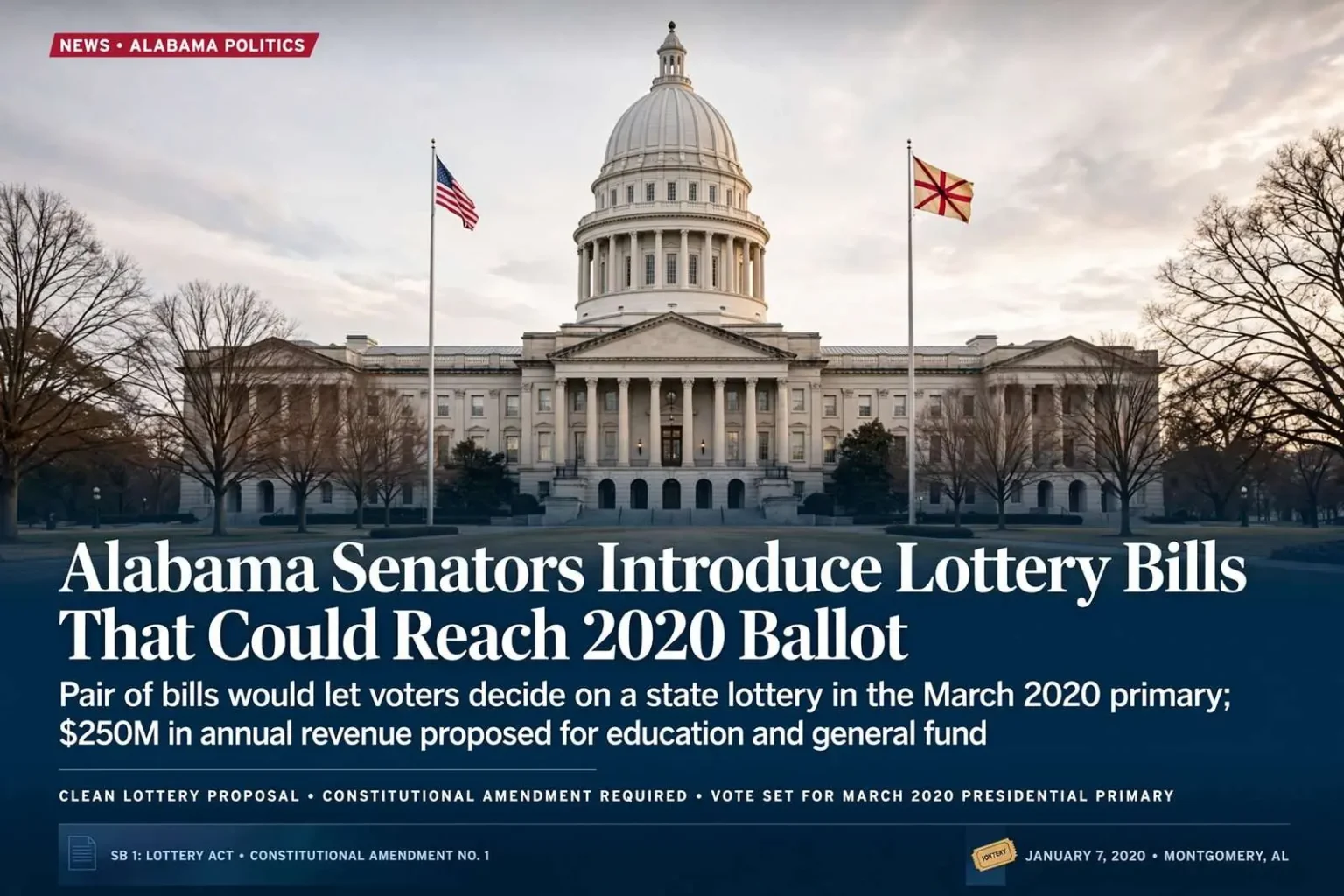
Two Alabama senators are pushing measures that could let voters decide whether the state joins the lottery era. Sen. Jim McClendon, R-St. Clair, introduced a pair of bills Tuesday — one creating a lottery and the other placing a constitutional amendment on the ballot — in a renewed attempt to end Alabama’s run as one of the few states in the nation without a state lottery.
McClendon described his proposal as a “clean” lottery bill that would not open the door to casinos, card games or other forms of gambling. That distinction is central to the political math in Montgomery, where lottery proposals have historically risen or fallen on whether they are perceived as a first step toward broader gambling expansion.
Under the proposal, McClendon estimates a lottery could generate about $250 million a year for the state, with the money split between education and general needs.
Senate President Pro Tem Del Marsh said he plans to introduce his own lottery measure soon, signaling that the question will be prominent in the Senate’s agenda. If approved by lawmakers, the question would go before voters on the 2020 presidential primary ballot next March.
Why a constitutional amendment is required
Alabama’s constitution prohibits lotteries, which means the Legislature cannot simply create one by statute. Any lottery must be authorized through a constitutional amendment, a process that requires approval by a supermajority of lawmakers before the question goes to voters in a statewide referendum. That structural requirement is why lottery proposals always arrive as paired legislation: one bill sets out how the lottery would operate, and the companion amendment puts the question on the ballot.
The two-bill structure also gives lawmakers a choice they can point to at home. A legislator can vote to let the people decide — a popular position in a state where polls have repeatedly shown majority support for a lottery vote — without necessarily endorsing the lottery itself. That distinction has shaped lottery politics in Montgomery for decades.
McClendon, a Republican from Springville who has carried lottery and gambling legislation in previous sessions, has argued that Alabamians are already spending lottery money — just in neighboring states. Georgia’s lottery-funded HOPE scholarship program and Florida’s lottery have operated for decades, and officials backing an Alabama lottery have long pointed to the estimated hundreds of millions of dollars that Alabama residents spend each year buying tickets across state lines.
The ‘clean lottery’ framing
The word “clean” carries a specific meaning in Alabama’s gambling debates. Past proposals have bundled a lottery with casino gambling, electronic bingo, and a statewide gaming commission, and each of those additions gave opponents a fresh line of attack. Churches and anti-gambling groups that might tolerate a state lottery have opposed expanded casino gambling, while casino interests have in turn resisted lottery-only bills that leave their projects out.
By stripping the proposal down to a lottery alone — no casinos, no card games, no other forms of gambling — McClendon’s bill attempts to remove the issues that have derailed previous packages. Supporters argue that a straightforward lottery is the only gambling question that can clear both the Legislature and a statewide vote in Alabama, and that broader gaming questions can be debated separately if voters ever want to take them up.
The framing also shapes how the money question is presented. A lottery-only bill generates dedicated ticket revenue without requiring the state to license, regulate, and police casino operations, keeping the administrative footprint small relative to a comprehensive gaming regime.
The $250 million question
McClendon’s estimate of roughly $250 million a year in lottery proceeds reflects the kind of revenue that a state of Alabama’s size might realistically expect, based on per-capita ticket sales in comparable states. How that money would be split between education and general state needs was part of the bill’s design, and the allocation question has historically been one of the most closely watched details in lottery legislation.
Georgia’s experience looms over that debate. The Georgia Lottery, created in the early 1990s, dedicates its proceeds to the HOPE scholarship program and pre-kindergarten, and the program’s popularity in Georgia has been cited for years by Alabama lottery advocates who want a similarly visible, education-branded benefit. An Alabama lottery whose proceeds visibly fund college scholarships or classroom spending, the argument goes, builds the public trust that keeps ticket sales — and revenue — growing.
Splitting proceeds between the Education Trust Fund and the General Fund, as McClendon’s proposal contemplates, answers a different political problem: lawmakers who represent districts where lottery support is softer can point to dollars reaching ordinary state functions rather than education alone. The split also avoids the criticism that the lottery amounts to an education tax on people least able to afford it.
Opponents raise the standard counterarguments. Lottery revenue, they note, is not new money in a strict sense — it arrives as Alabamians redirect spending — and ticket sales tend to be regressive, drawing disproportionately from lower-income households. Anti-gambling groups, including many churches influential in Alabama politics, have historically opposed lottery measures on principle, and their mobilization helped defeat the state’s last statewide lottery referendum.
Alabama’s lottery history
The most recent serious attempt came in 1999, when Gov. Don Siegelman campaigned on a lottery dedicated to college scholarships and brought the question to voters as a constitutional amendment. The referendum failed, and Alabama has remained one of a small handful of states without any state lottery or state-authorized casino gambling in the years since.
Since then, the issue has resurfaced in Montgomery session after session. Lottery and gambling bills have passed one chamber or stalled in committee, and comprehensive gaming packages have collapsed over disagreements about bingo casinos, tribal gaming compacts, and which regions of the state would host what. The recurring pattern has left Alabama surrounded by lottery states — Georgia, Florida, Tennessee, Mississippi with its casinos — capturing revenue from its residents’ tickets without collecting any of it.
McClendon’s bills attempt to break that cycle by narrowing the question to its simplest form. A clean lottery, put directly to voters on a ballot with high turnout, gives the proposal its best structural chance: no casino politics, no bingo disputes, and a single yes-or-no question Alabamians have told pollsters for years they want the chance to answer.
Del Marsh’s role
The involvement of Del Marsh, the Senate’s president pro tem and one of the most powerful figures in the Legislature, changes the arithmetic for any gambling bill. Legislation that reaches the floor without leadership backing typically dies in committee; legislation carried with the Senate’s top officer behind it has a path to debate. Marsh said he plans to introduce his own lottery measure soon, and his entry into the debate suggests Senate leadership intends the question to get a full hearing this session.
Marsh has previously sponsored his own lottery and gaming legislation, and his past proposals have ranged from a simple lottery to broader gaming packages. His announcement that a new measure is coming, alongside McClendon’s bills, gives lottery supporters multiple vehicles and gives the Senate a chance to consolidate behind the version most likely to pass.
For the House and Senate leadership alike, the timing carries appeal. A March 2020 presidential primary ballot guarantees high turnout, including the Democratic and Republican presidential primaries, and putting the question before the largest possible electorate serves both supporters and opponents of the measure.
What happens next
The path from introduction to ballot is demanding. The constitutional amendment must win approval by the required supermajority in both the Senate and the House of Representatives during the legislative session, and the enabling legislation must pass as well. If both clear the Legislature, the question goes to voters automatically — no petition or additional step required — on the March 2020 primary ballot.
If voters approve, the state would then stand up the lottery’s administrative structure: a commission or authority to oversee operations, contracts with vendors and game providers, and the startup period of establishing ticket sales, retailers, and the first draw games. State lotteries typically take months from authorization to first ticket sales, meaning an approval in March 2020 would put actual lottery revenue on a timeline reaching into the following fiscal years.
Legislative leaders have acknowledged that the political obstacles remain real even with a simplified bill. A supermajority vote in the Senate requires buy-in from senators whose districts split on gambling questions, and House passage brings its own coalition-building challenge. But for the first time in years, the question arrives with a clean-lottery design, a revenue estimate attached, and the Senate’s top leader signaling his own bill is on the way.
For Alabama voters, the immediate takeaway is that a lottery vote is closer to the ballot than it has been in years — and that the decision, if lawmakers agree, will be theirs to make in March 2020.
The date also gives both chambers a hard deadline. Legislative sessions run on fixed calendars, and any amendment intended for the March 2020 primary must pass in time for the secretary of state’s ballot certification requirements. That deadline has a way of forcing decisions on gambling legislation, which in past years has had a habit of drifting into end-of-session stalemates. Supporters of the McClendon and Marsh measures argue the pressure is a feature, not a bug: either the Legislature can agree to let the people vote on a clean lottery, or the question waits again — while Alabama’s lottery dollars keep crossing state lines.