Alabama State Parks Offer Virtual Programs and Outdoor Escapes During COVID-19 Restrictions
Alabama State Parks launched a Virtual Naturalist series and kept campgrounds, trails and fishing piers open as COVID-19 restrictions limited gatherings in.
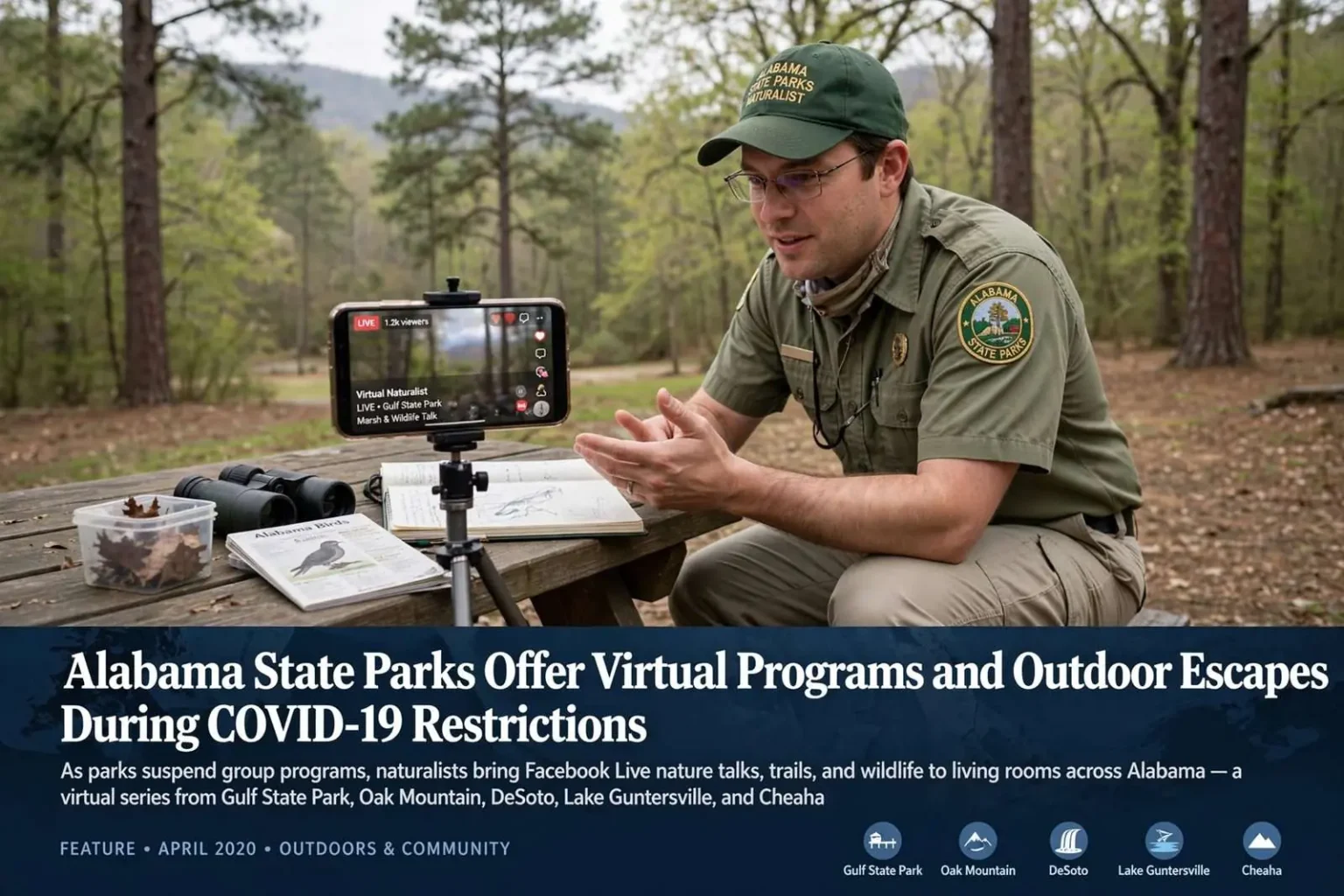
As Alabama moved to limit public gatherings and slow the spread of COVID-19 in the spring of 2020, the state’s 21 parks looked for ways to keep residents connected to the outdoors without crowding them together. The Alabama State Parks Naturalists rolled out a ‘Virtual Naturalist’ series on the Facebook pages of five parks — Gulf State Park, Oak Mountain, DeSoto, Lake Guntersville and Cheaha. The programming mixes Facebook Live videos, short clips, photographs, park stories and occasional challenges.
The move came as parks across the country suspended the group programming that normally fills their spring calendars — guided hikes, nature talks, school field trips and festival events all went on hold as public health guidance discouraged gatherings. Rather than going silent, the state’s naturalist staff turned the parks’ social media pages into their new amphitheater, delivering the same content that would have drawn a crowd to a picnic pavilion directly into living rooms instead.
The five parks chosen to anchor the series represent the breadth of Alabama’s system. Gulf State Park stretches across Gulf Shores and Orange Beach on the coast, with dunes, lakes and one of the region’s most-visited piers. Oak Mountain, near Birmingham, is the largest state park in Alabama. DeSoto sits atop Lookout Mountain near Fort Payne, home to the cascading DeSoto Falls. Lake Guntersville covers the shores of Alabama’s largest lake in the Tennessee Valley, and Cheaha — the state’s highest point — crowns the Talladega National Forest.
Virtual Programming in Place of Group Events
Each park’s page offered its own flavor of content under the shared series banner. Facebook Live sessions let viewers ask questions in real time while a naturalist handled an animal artifact, walked a trail or demonstrated a skill, while shorter clips and photo posts kept daily content flowing between the live events. Occasional challenges invited viewers to try activities at home or in their own neighborhoods, keeping children engaged while schools were closed.
Naturalists also launched a survey to learn which kinds of content viewers want most. The feedback loop mattered for an experiment launched on short notice: with no playbook for a pandemic spring, the parks team treated the virtual series as a live trial, adjusting topics, formats and posting schedules based on what audiences actually responded to rather than what a pre-pandemic program calendar assumed.
For the parks system, the series also served a quieter purpose — staying visible. State parks depend on visitation for much of their operating revenue, and a spring of closed facilities and canceled trips threatened budgets as well as programming. Regular online content kept the parks in front of the public during the lull, reminding Alabamians that the properties would still be there when restrictions eased.
Getting Outdoors at a Distance
For those able to get outside while keeping their distance, park officials encouraged self-guided activities such as camping, fishing, hiking, birding and biking, while warning that some facilities could be limited. The guidance reflected the state’s middle course in the pandemic’s early weeks: outdoor recreation with space between households remained a low-risk outlet, but amenities where people congregate — lodges, restaurants, playgrounds, swimming areas — were subject to closures that could change quickly.
The situation shifted on the coast within days of the series’ launch. On March 19, Gov. Kay Ivey announced that Alabama’s public and private beaches would close. That included the beaches at Gulf State Park, though the park’s fishing pier remained open, along with campgrounds, trails and other non-beach areas.
The closures rippled through a coastal economy built around spring break and the run-up to summer. Gulf State Park is one of the crown jewels of Alabama’s park system, drawing visitors from across the region to its two-and-a-half miles of beach, its inland trails and its 1,540-foot pier — among the longest on the Gulf of Mexico. With the sand off-limits, the pier became the park’s front door, giving anglers a place to fish the Gulf while the beach itself sat empty behind the dunes.
Hikers, campers and cyclists filled in some of the gap at parks across the state. Trails that normally share use with spring breakers saw steady local traffic as residents sought exercise and a change of scenery within driving distance of home, and campground reservations became an accessible form of vacation when hotels and attractions tightened their operations.
Red Snapper Season Amid Uncertainty
The Alabama Department of Conservation and Natural Resources’ Marine Resources Division said state and federal waters would open to private anglers for red snapper on May 22, but acknowledged the pandemic made the timing uncertain. Col. Scott Bannon, who directs the division, said planning that far out was difficult and that he hoped the state would be past the outbreak well before the season opened.
Red snapper season is a fixture of the Alabama summer calendar and a major economic driver for charter fleets, marinas and tackle shops from Dauphin Island to Orange Beach. Alabama’s artificial reef program, the largest of its kind in the country, concentrates snapper within reach of small boats, making the state one of the most productive private-angler fisheries on the Gulf. Planning a season launch in the middle of a pandemic — with questions about boat ramp operations, charter operations and boater safety — left officials cautious even as they kept the date on the calendar.
Conservation Leaders Urge Safety
Conservation Commissioner Chris Blankenship said the department was taking the health guidance seriously. ‘We know many Alabamians want to get outdoors during the spring and enjoy some recreational opportunities that can refresh in these challenging times,’ he said. ‘Just remember, we must do so safely.’
The message balanced two priorities that pulled in different directions. The department oversees everything from state parks to marine fisheries to wildlife management areas, and its normal mission is to connect people with the outdoors — a mission that had never mattered more than during a period of closed businesses, shuttered schools and stay-home guidance. At the same time, the agency was charged with enforcing the governor’s orders, including beach closures, and with keeping crowds from forming at boat launches, trailheads and piers.
The spring of 2020 tested outdoor institutions across the country in much the same way. National parks closed and partially reopened, state systems from coast to coast suspended programs, and wildlife agencies postponed seasons and meetings. Alabama’s approach — keep the trails and campgrounds open where possible, replace group programming with online content, and adapt dates like the snapper season opener as conditions evolved — aimed to preserve access without inviting the gatherings health officials were warning against.
A Different Kind of Spring in the Parks
For regular parks visitors, the season looked unlike any in memory. Favorite overlooks and picnic spots stood quiet, festival calendars emptied, and the sounds of school groups gave way to birdsong. What remained was the core of what the parks exist to protect: the dunes at Gulf State Park, the waterfalls at DeSoto, the ridgeline views from Cheaha’s Bunker Tower, the coves of Lake Guntersville, and the long trail system threading through Oak Mountain.
The Virtual Naturalist series filled part of the gap for those who could not make the drive at all — shut-in residents, families heeding early guidance to stay home, and out-of-state regulars whose trips had been called off. A live video of a naturalist at the edge of a marsh or beneath a mountain waterfall brought the parks to people who needed them, in however small a dose.
With traditional group programming on hold, the virtual series and open-air recreation gave Alabamians safer ways to experience the state’s natural wonders. The spring of 2020 became, in effect, an unplanned experiment in what the parks could be when the crowds stayed away — and a reminder, delivered through screens and empty trails alike, that the state’s outdoor heritage does not depend on a full calendar to remain worth protecting.
How the Parks System Adapted
Alabama’s state parks operate with a mix of state support and self-generated revenue from lodging, camping, golf and day-use fees, which made the pandemic spring more than a programming inconvenience. Every canceled event and closed lodge represented income the system could not replace, and the parks division, like its counterparts across the country, had to weigh opening amenities against the risk of drawing crowds that local health capacity could not absorb.
The naturalist staff’s pivot to video also changed who the parks could reach. A live program at Gulf State Park draws visitors already at the park; a Facebook Live session draws shut-ins, school classes meeting online, and former visitors wherever they live. Several viewers used the comment threads to ask questions they might have been too shy to ask in person, and the parks gained a written record of public interest they could build on after restrictions lifted.
The challenges embedded in the series gave families a structure for outdoor time close to home — scavenger-hunt style prompts, nature observation exercises and simple skills practice that required nothing more than a backyard or a neighborhood green space. With playgrounds closed and sports seasons suspended, parents had few turnkey options for keeping children active, and the parks’ content arrived as one of them.
By the time beaches reopened and the summer season arrived, the spring of 2020 had left a lasting mark on how the park system communicates. Virtual programming, first improvised as a stopgap, became a permanent layer alongside the traditional calendar — a reminder that the most durable outcome of an improvised spring was a wider front door to Alabama’s outdoors.