
Alabama Still Marks a State Holiday for Jefferson Davis — And Mobileans Remain Split on Whether It Should
Alabama is the last state with a Jefferson Davis holiday. A Confederate heritage leader and a Mobile pastor explain why they disagree.
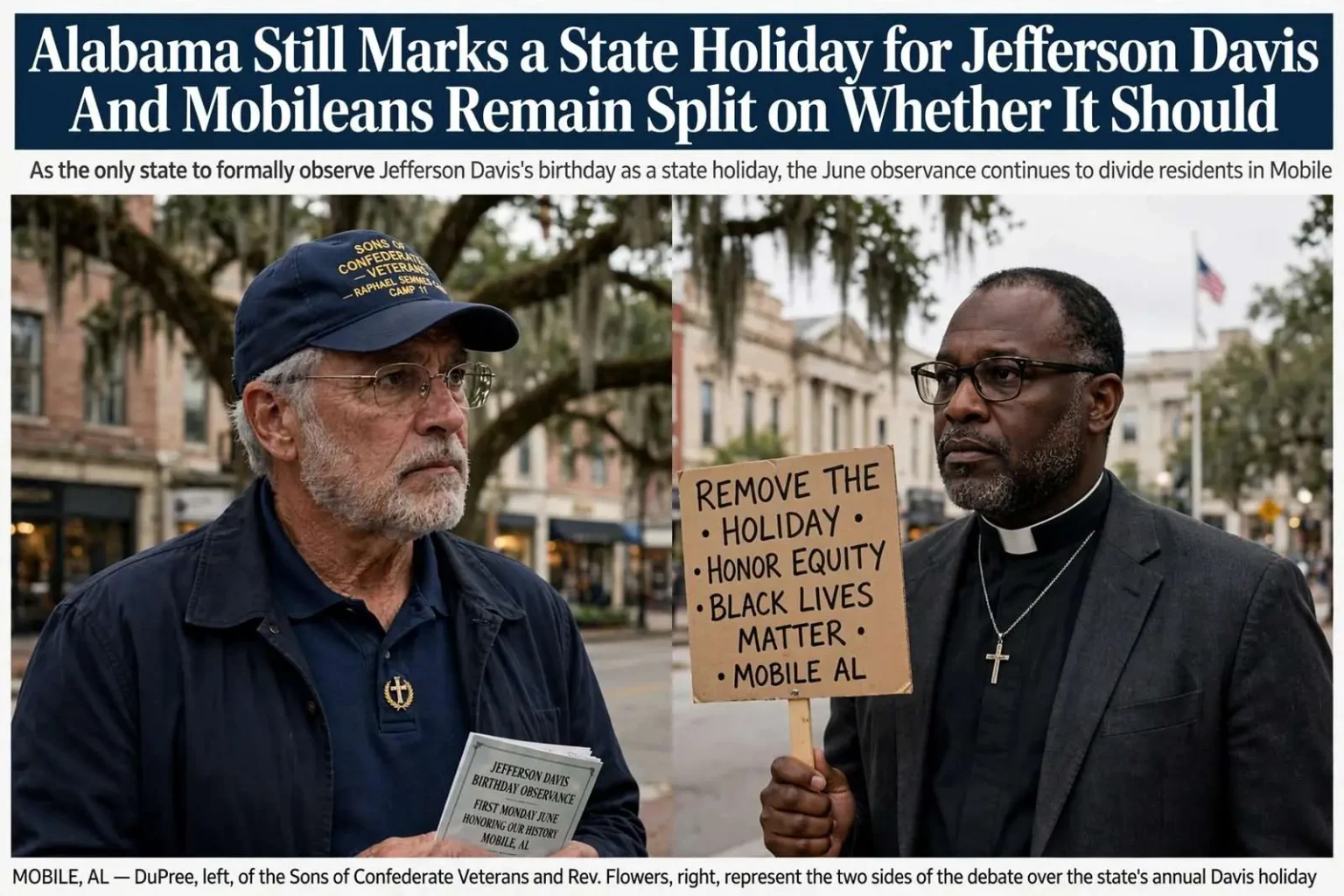
While state workers across Alabama enjoyed a day off, the occasion behind it remained one of the most divisive on the state calendar: Alabama stands alone as the only state in the nation that still observes a formal holiday honoring the birthday of Confederate President Jefferson Davis.
The holiday, observed on the first Monday in June, places Alabama in a category no other state shares. State offices close, and with them the ordinary machinery of government, in memory of the man who led the Confederacy through four years of war against the United States. That singularity has made the date an annual point of contention, and in Mobile — a city whose own history is deeply entangled with the Confederacy’s — residents line up on both sides of the question with equal conviction.
The debate over the holiday arrives amid a wider national argument about Confederate memory: which monuments belong in public space, what flags may fly over government buildings, and whether honors once given quietly should be reexamined in light of what they honor. Alabama’s holiday for Davis sits at the center of that argument because it is not a statue on a courthouse lawn or a plaque in a park — it is the state’s own calendar, speaking in the state’s own voice.
Two Views From Mobile
In Mobile, opinion on the holiday splits sharply. AJ DuPree, memorials chairman for the Raphael Semmes Camp 11 of the Sons of Confederate Veterans, points to Davis’s role in founding the Confederate States of America — inaugurated in Montgomery, the first Confederate capital — as an embodiment of Alabama’s motto, “We Dare Defend Our Rights.” DuPree argues Davis is an honorable historical figure whose record as a military veteran and political leader deserves commemoration.
DuPree’s organization takes its name from Admiral Raphael Semmes, the Confederate naval officer who commanded the raider CSS Alabama and who spent his postwar years in Mobile, where he is buried. For the Sons of Confederate Veterans camps across the state, the Davis holiday is part of a broader commitment to what members describe as heritage, not hate — the preservation of graves, monuments and historical memory for the men who served the Confederacy. In DuPree’s telling, Davis’s inauguration at Montgomery’s state capitol in 1861 ties the Confederacy’s founding directly to Alabama soil, and the state’s motto expresses a stance of defiance and self-determination that Davis’s career exemplified.
The Rev. Jim Flowers, rector of All Saints Episcopal Church in Mobile and a supporter of progressive causes including Black Lives Matter, sees it very differently. In his view, honoring a leader of the Confederacy means “honoring something that’s dishonorable,” and he calls the holiday an embarrassment to the state.
Flowers’ objection rests on what the Confederacy’s cause was: the preservation of slavery, stated openly in the secession documents of the states that formed the nation Davis led. From that premise, no amount of personal virtue or military biography can make the commemoration acceptable, because the office being honored — president of a nation founded to protect human bondage — is the thing itself. An annual state holiday, in this view, does not merely remember history; it confers the state’s ongoing endorsement on a chapter of it. To call the holiday an embarrassment is to say that Alabama, alone among the states, still tells the country something about itself every June that it should have stopped saying long ago.
The two positions barely share premises, which is why the debate repeats each year without converging. One side argues from heritage and the honor due to ancestors; the other argues from the moral weight of what those ancestors fought to preserve. Between them stands a calendar that only Alabama keeps.
A Broader Reckoning
The debate comes amid a broader reckoning with Confederate iconography. Over the past year, large Alabama cities including Mobile and Birmingham removed Confederate statues from public spaces.
Mobile’s own action was emblematic. The city removed the Confederate statue that had stood in its downtown for more than a century, part of a wave of relocations across the South after renewed national protest pushed the question of public monuments back onto local agendas. Birmingham removed its monument as well, and other Alabama cities weighed similar moves. Each removal followed the same contested process — petitions, council votes, legal questions over state monument-protection law — and each reflected the judgment of a city government that public space should no longer frame the Confederacy as an object of civic honor.
Yet the removals stopped at the city limits. Monuments can come down by municipal decision, but the state holiday is an act of the Legislature and the governor, and it survives the wave of monument relocations untouched. A statewide holiday requires statewide action to repeal, and no such action has been forthcoming — a reflection of the Legislature’s composition, in which rural and conservative districts hold the balance of power and heritage arguments carry weight that city councils do not feel.
No Change on the Calendar
Despite that shift, there appear to be no plans to alter the statewide holiday, leaving the dispute over what the day honors unresolved.
The result is a state that remembers the same man two ways at once. Its largest cities have pulled Confederate memorials out of their squares, while its state government continues to grant Davis a paid holiday that no other state recognizes. The disconnect between city and state — between the pace of change in Mobile and Birmingham and the immovable calendar in Montgomery — is itself a portrait of Alabama politics, where urban electorates and the Legislature routinely part company on questions of history and race.
For state workers, the day arrives each June as a day off, whatever they make of its meaning. For DuPree and the Semmes Camp, it is an honor still owed. For Flowers and those who share his view, it is an embarrassment still endured. The holiday’s persistence guarantees the argument will return every year, as regular as the date itself, until the Legislature decides otherwise — and so far, it has decided nothing at all.
What is not in dispute is the uniqueness. From Virginia to Texas, every other former Confederate state has abandoned or never held a formal holiday for the Confederate president. Alabama’s is the last. Whether that distinction is a mark of fidelity to heritage or a stain the state has not yet removed is precisely the question Mobile’s divided voices cannot settle — and the question the calendar itself keeps alive.
The holiday’s age helps explain its endurance. Alabama has marked Davis’s birthday for well over a century, a tradition that took root in the decades after the war when Confederate veterans’ organizations and their descendants shaped much of the South’s public commemoration. The state’s calendar grew around that heritage: Robert E. Lee’s birthday is observed in Alabama alongside Martin Luther King Jr. Day in January, and Confederate Memorial Day falls each April. Each of those observances has drawn criticism over the years, but the Davis holiday stands apart for its singularity — it is the only one no other state shares — and therefore draws the sharpest national attention whenever it rolls around.
The Sons of Confederate Veterans’ role in the debate reflects the broader architecture of Confederate memory in Alabama. Camps like Raphael Semmes Camp 11 maintain graves, mark historic sites and hold observances throughout the year, and the state holiday gives their commemorative work official standing. Members see themselves as caretakers of family history — many can name ancestors who served — and they view campaigns against monuments and holidays as attacks on that inheritance. Their opponents counter that public honors are not family heirlooms but statements by the government, subject to the same moral review as any other policy. The holiday sits exactly where those two ideas collide.
Whether the Legislature ever takes up the question may depend on generational change that has already reached the cities. Mobile and Birmingham acted when their councils concluded that downtown monuments no longer reflected the communities around them. The state calendar will change only when a similar conclusion reaches Montgomery with enough votes behind it. Until then, Alabama will keep a holiday no other state keeps, and each June the argument DuPree and Flowers represent will have its annual airing — one side defending an honor it believes is owed, the other pressing an embarrassment it believes is overdue for removal, with a day off for state workers as the occasion.
The geography of the dispute is worth noting as well. Davis’s connection to Alabama runs through Montgomery, where delegates from the seceded states gathered in the winter of 1861, formed the Confederate States of America and swore in Davis as its president on the capitol steps. A bronze star in the pavement marks the spot where he stood. That physical record gives Alabama a historical claim on Davis that other states lack, and it is part of why the holiday has proved durable here — the founding of the Confederacy happened on Alabama ground, and the commemoration grew from the same soil.


