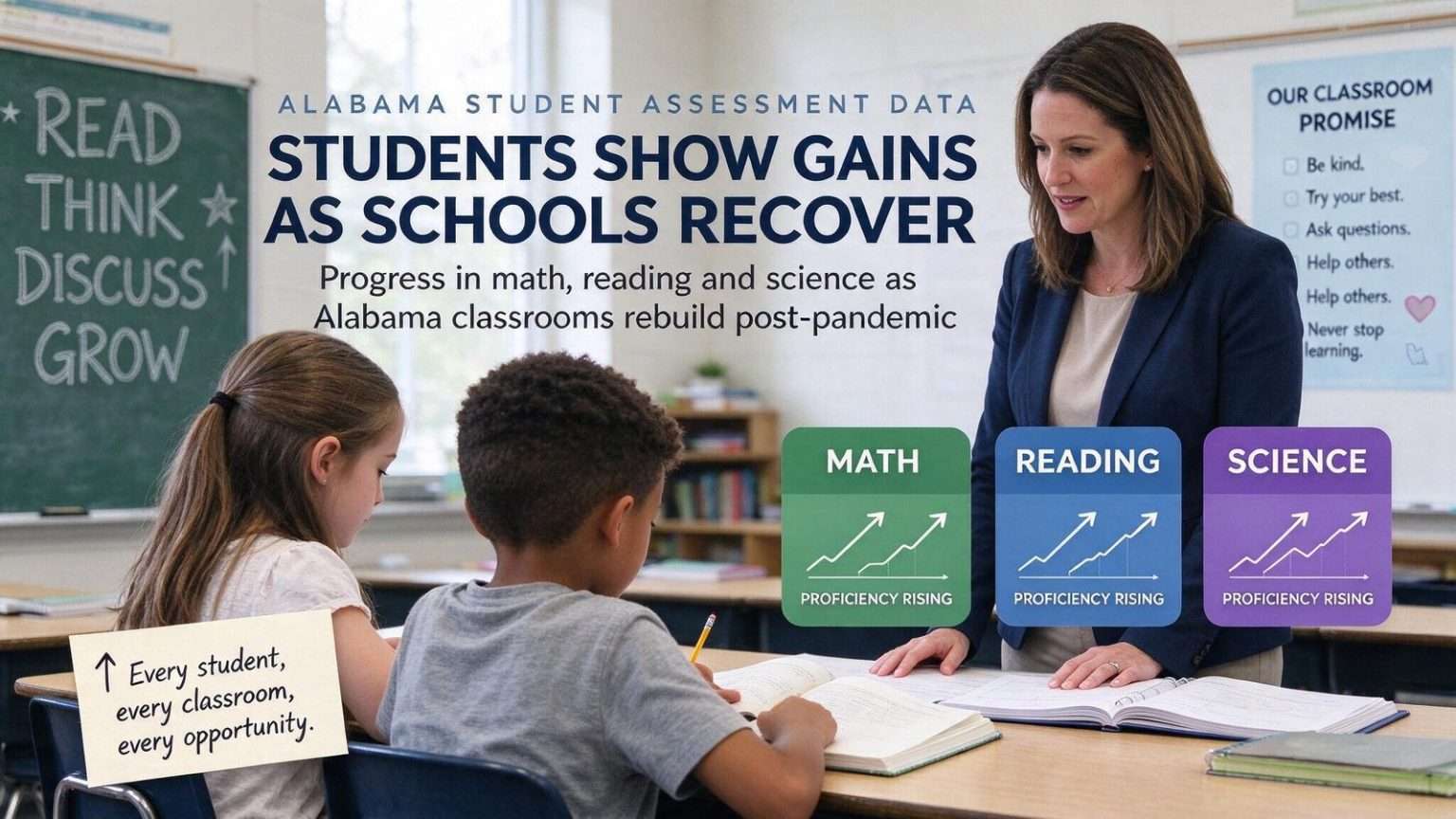
Alabama students are making progress on standardized tests, with scores rising in math, reading, and science across the state, according to newly released data from the Alabama Comprehensive Assessment Program. The results, drawn from the spring administration of the state’s annual accountability exam, offer the clearest sign yet that Alabama’s classrooms are climbing back from the steepest academic disruption in generations.
State Superintendent of Education Dr. Eric Mackey said the upward trend is encouraging. “We’re very encouraged because they are up in math and science and reading across the state. So our trajectory is definitely headed the right way,” Mackey said. For a department that spent two years managing shutdowns, remote instruction, and constant testing disruptions, a broad-based rise in all three tested subjects marked a turning point in the state’s pandemic recovery effort.
Mobile and Baldwin County Results
In Mobile County Schools, about 41% of students scored proficient in English Language Arts, a little more than 20% in math, and 33% in science. Baldwin County fared better, with 56% proficient in English Language Arts, 36% in math, and 49% in science. The gap between the two districts reflects differences in size and demographics as much as performance: Mobile County is the largest district in the state by enrollment, serving a student population spread across the city of Mobile, Prichard, Saraland-area communities, and rural stretches of the county, while Baldwin County’s fast-growing district covers a suburban and coastal corridor that has absorbed population growth for two decades.
The Alabama Comprehensive Assessment Program, the annual test given to students in grades two through eight, measures proficiency against the state’s academic standards in the three core subjects. Results feed into the state’s school accountability system, drive federal reporting requirements, and give districts school-level data for targeting interventions. A single year’s scores are a snapshot, but consistent movement across subjects and grades is the metric state officials watch most closely, and this year’s data showed that movement.
Education officials attribute much of the improvement to students returning to in-person classroom instruction after the disruptions caused by the COVID-19 pandemic. “There’s a clear correlation that the longer schools stayed closed down to in-person instruction, the lower the test scores were,” Mackey said. The correlation held nationally as well as in Alabama, and it shaped the state’s push to keep classrooms open, expand summer learning, and prioritize early grades where foundational reading skills develop.
Challenges Remain for Disadvantaged Students
Despite the gains, significant gaps persist. Just 15% of economically disadvantaged students statewide are considered proficient, a trend that mirrors national patterns. The figure is the soberest number in the release and the one officials say will define the next phase of the state’s recovery: overall averages can rise while the students who lost the most ground during closures remain far behind their peers.
Schools are working to close those gaps with after-school and summer programming, but officials say parental involvement is critical. “Schools have right now an unprecedented amount of resources in state funds to provide after-school and summer school programming. We’ve got to get parents to take advantage of that,” Mackey said. The state directed substantial federal pandemic relief into extended learning, tutoring, and summer enrichment, but participation in optional programs depends heavily on families signing up — and transportation, work schedules, and awareness all shape turnout.
Mobile County’s Response
Mobile County Public Schools said in a statement that the district has implemented targeted interventions at every level. Elementary teachers have been trained in multi-sensory programs to address learning gaps, and the district has adopted systematic approaches to identifying students who need support in foundational reading and math skills. The approach reflects the science-of-reading shift Alabama made in law with the Alabama Literacy Act, which requires early screening, intervention plans, and support for third graders who struggle with reading — a framework the district extended into math instruction as data revealed pandemic-era gaps there too.
The district also pointed to national recognition of its schools: Council Traditional School was ranked the top elementary school in Alabama by U.S. News and World Report, with Eichold-Mertz School of Math and Science at No. 3 and Old Shell Road School for Creative and Performing Arts at No. 11. The three magnets, all part of Mobile County’s long-standing magnet program, draw students from across the district into theme-based curricula and have historically posted some of the strongest academic results in the region.
The state plans to resume issuing school letter grades this November, a practice that was paused during the pandemic. The return of A-F ratings will put every school’s results in a single public framework, combining test proficiency, growth, and other measures, and will give parents their first full post-pandemic look at how their neighborhood schools compare. State officials expect the grades to add urgency to the recovery work already underway in districts like Mobile and Baldwin, where the newest scores show progress — and how far there still is to go.
What the ACAP Measures and Why It Matters
The Alabama Comprehensive Assessment Program has been the state’s primary accountability instrument since it replaced the older Scantron-based testing model, and it is designed to align tightly with what students are taught under Alabama’s course-of-study standards. Because questions are anchored to grade-level standards rather than national percentile curves, proficiency rates can look lower than parents expect: a student who passes a class with good grades may still fall short of the state’s definition of grade-level mastery. Education officials have spent years explaining that distinction, and it colors how this year’s gains should be read — a rise in proficiency means more students reaching genuine grade-level standards, not a loosened yardstick.
Science results, which improved alongside math and reading, carry particular weight along the Gulf Coast. South Alabama’s economy increasingly runs on aerospace, shipbuilding, engineering, and technical trades — from the aerospace corridor around Mobile’s Brookley Aeroplex to the shipyards and the chemical and industrial plants dotting Mobile Bay — and educators have pressed for years to build a pipeline of students ready for those careers. Proficiency in middle-grade science is one of the earliest predictors of whether students will take the advanced coursework those industries require, which is why districts track the subject as closely as reading.
The Pandemic’s Shadow and the Road Back
The scale of the recovery effort is easy to miss in a single year’s numbers. During the worst of the pandemic, districts cycled between remote, hybrid, and in-person schedules; thousands of students spent months with inconsistent internet access; and the state waived accountability consequences while teachers patched together instruction across formats. Absenteeism rose, particularly in early grades where attendance habits are formed, and districts across Alabama reported enrollment dips as families shifted to private schools, homeschooling, or simply disengaged. Every one of those disruptions showed up in the following year’s testing data.
The recovery strategies now running across the state grew directly out of that experience. High-dosage tutoring programs pair struggling students with trained instructors in small groups several times a week. Summer learning camps, funded with federal relief money, extend the school year for students who need it most. Districts hired interventionists — teachers whose sole job is pulling small groups for targeted instruction — and bought new curriculum materials aligned to the state’s standards. None of it works, officials caution, without attendance: a student who is not in school cannot be caught up, which is why attendance campaigns have accompanied the academic push.
The economically disadvantaged student proficiency figure of 15% underscores why the state’s remaining pandemic relief spending has been targeted so deliberately. Poverty shapes every part of the testing picture: students from low-income households are more likely to have experienced school closures in districts that stayed remote longer, more likely to lack quiet study space and reliable broadband, and more likely to have changed schools during the pandemic. Closing that gap is the central test of Alabama’s recovery, and officials have been explicit that the overall averages will not satisfy them while it persists.
A Blueprint in Mobile County’s Playbook
Mobile County’s multi-sensory teacher training reflects a broader statewide shift in how reading is taught. Multi-sensory instruction engages sight, sound, and movement together, an approach grounded in decades of research on how children decode language, and it has proven especially effective for students who struggled under the whole-language methods many schools used for years. Retraining a large elementary workforce is a multi-year undertaking, and the district’s investment signals that it intends to attack foundational skills rather than wait for students to age out of the problem.
The national rankings for Council Traditional, Eichold-Mertz, and Old Shell Road give the district showcase examples of what its schools can achieve, and they play a practical role in the recovery effort as well. Strong magnet programs attract families back to public schools, retain experienced teachers, and set benchmarks that other campuses can study. District leaders have framed the recognition as proof that Mobile County students can compete with any in the state — the task now is extending that performance beyond the magnets to every neighborhood school.
When letter grades return in November, they will merge this year’s proficiency data with growth measures, chronic absenteeism, and other indicators into a single rating for every school. For parents in Mobile and Baldwin counties, the grades will be the first comprehensive, easily comparable picture of post-pandemic performance in their communities. For educators, they are a deadline of sorts: the state’s trajectory is finally pointed the right way, and the letter grades will tell everyone how much of the lost ground has truly been recovered.