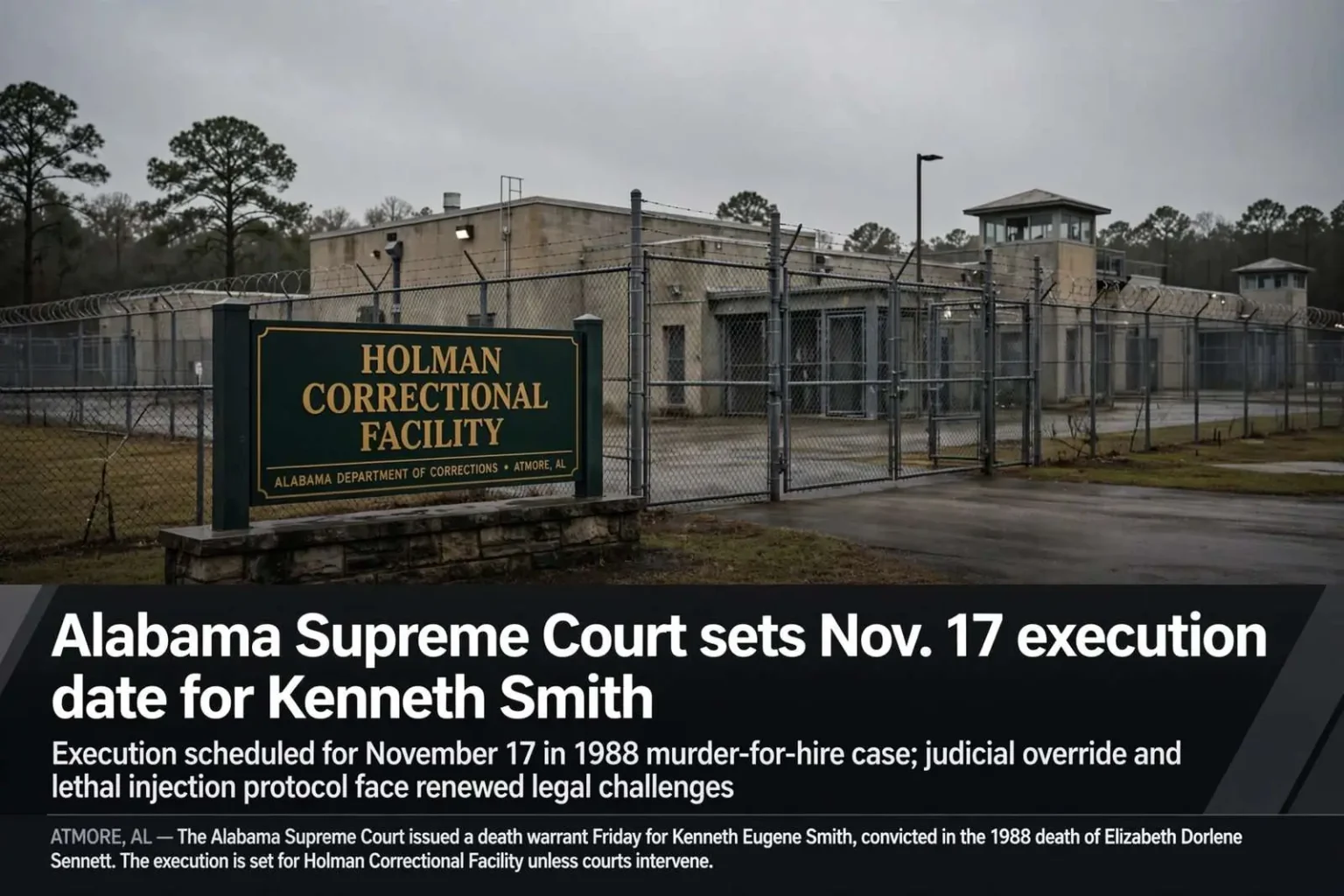
The Alabama Supreme Court has set an execution date of Nov. 17 for Kenneth Eugene Smith, according to a death warrant issued Friday. The execution would be carried out in the death chamber at Holman Correctional Facility in Atmore, unless a court intervenes.
The scheduling of an execution date is the final administrative step in a capital case that has already run for more than two decades, and it now starts a clock for the last round of appeals. Smith’s legal team can pursue challenges in state and federal courts between now and the November date, and death row inmates in Alabama routinely seek stays on grounds ranging from trial error to the constitutionality of the state’s execution methods. Until a court acts, however, the date set by the state’s highest court stands.
In 1996, Smith was convicted in a murder-for-hire plot that led to the 1988 death of Elizabeth Dorlene Sennett in her Colbert County home, court records show. A jury voted 11 to 1 to recommend life without parole, but a judge overrode that recommendation and sentenced Smith to death. A federal appeals court noted in 2021 that “if Smith’s trial had occurred today, he would not be eligible for execution” under later changes to state law limiting judicial override in capital cases.
The Case and the Judicial Override Question
Smith’s case has become one of the most frequently cited examples in the national debate over judicial override — the practice, once common in Alabama and Delaware, of allowing a trial judge to impose a death sentence even when the jury that heard the evidence voted for life. Alabama was the last state actively using the practice, and critics argued for years that it made the state an outlier and put Alabama sentences on shaky constitutional ground.
The Legislature ultimately acted, ending judicial override in capital cases in 2017, though the change did not apply retroactively to inmates already sentenced under the old system. That is why the federal appeals court observed that a trial conducted under today’s rules would produce a different outcome for Smith. Those changes came too late to affect his case, however, because his conviction and sentence predate them, leaving the courts to weigh whether the old procedure’s flaws justify intervention in his execution now.
The crime itself remains one of the more notorious in northwest Alabama’s history. Sennett, a pastor’s wife, was killed in her Colbert County home in a murder-for-hire arrangement, and the case shocked the Shoals region when it broke. Prosecutors built their case around the plot’s structure, and the trial that followed sent Smith to death row at Holman, near Atmore in south Alabama, where the state houses its male death row population and carries out executions.
Scrutiny of Alabama’s Execution Protocol
Smith’s is the latest in a series of Alabama executions. The state abandoned an attempt to execute another inmate, Alan Miller, earlier this month after staff could not establish intravenous access before the death warrant expired. Alabama’s last execution before that, in July, was the lethal injection of Joe Nathan James Jr. for the 1994 murder of Faith Hall; an independent autopsy later found prison staff used an outdated “cutdown” procedure to reach a vein. Hall’s family had publicly opposed James’ execution and asked that his life be spared.
Those back-to-back problems have put the Alabama Department of Corrections under intensifying scrutiny. Venous access — the ability to find a usable vein for the lethal injection line — has emerged as a recurring failure point, and the abandoned Miller attempt marked one of the occasions on which the state called off an execution after the process had already begun. Critics, including defense attorneys and advocacy groups, argue the pattern shows the state’s protocol is not being administered competently; state officials have maintained that the process works and that difficulties in individual cases do not amount to a systemic defect.
The independent autopsy finding in the James execution deepened the controversy. A “cutdown” — surgically incising tissue to reach a vein — is an older technique largely abandoned in modern medical practice, and its reported use in a lethal injection raised questions about the training and medical standards of the execution team. The disclosure drew national coverage and gave fresh ammunition to legal challenges arguing that Alabama’s lethal injection protocol creates a substantial risk of severe pain.
The state has carried out executions at Holman, near Atmore in south Alabama, under a protocol that has drawn scrutiny from courts and advocates over the past year. Holman is a familiar setting in this story: the prison’s death chamber is where all of Alabama’s executions take place, and it is where observers, media witnesses, and attorneys gather on execution nights. The facility’s remoteness — Atmore sits near the Florida line, more than an hour from Mobile and Pensacola — has not dulled the attention the protocol fights have attracted.
What Happens Between Now and November
In the weeks before a scheduled execution, a predictable legal sequence unfolds. The inmate’s attorneys typically file appeals raising newly developed claims — often focused on the execution method, the adequacy of past representation, or intellectual disability and mental health questions — while the state defends the conviction and the courts decide whether to grant stays. Federal courts may take up last-minute petitions, and requests for clemency can go to the governor and the Board of Pardons and Paroles. In cases like Smith’s, where the sentencing jury recommended life, clemency petitions typically argue that carrying out an override defeats the purpose of a jury trial.
Death penalty opponents have seized on the recent spate of problems to press for a pause on executions in Alabama, arguing that the state should not proceed while questions about its methods remain unresolved. Prosecutors and state officials, meanwhile, have defended the integrity of the sentences and pointed out that the condemned inmates in these cases were convicted of brutal murders. Smith’s November date will be the next test of that standoff.
For Sennett’s family, the setting of a date brings the case back into public view after decades of appeals. Colbert County residents remember the crime and the trial vividly, and execution dates routinely prompt relatives of victims to speak publicly about their losses and their views on the punishment finally being carried out. The weeks between the warrant and the execution often include such statements, along with vigils and petitions from abolition advocates.
The Nov. 17 date also lands amid a broader national conversation about capital punishment. States across the country have wrestled with drug shortages, litigation over lethal injection protocols, and declining public support for the death penalty, and Alabama has remained among the most active execution states in that landscape. The Smith case sits at the intersection of several of those threads: an old sentence built on a practice the state has since abandoned, a protocol under active legal challenge, and a corrections system whose recent failures are well documented.
Unless a court intervenes, Smith’s execution will proceed as scheduled at Holman. Between now and then, the case will move through the courts one more time, and the outcome will determine whether the state carries out the sentence a judge imposed over a jury’s objection in one of the last such cases of its kind — or whether the questions raised about that process and the state’s methods delay it further.
Holman and the History of Alabama’s Death Row
Holman Correctional Facility has been the center of Alabama’s capital punishment system for decades. The prison, opened in the late 1960s in Escambia County near the Florida state line, houses the male death row population in addition to its general inmate population, and its small execution chamber has been the site of every lethal injection the state has carried out. The facility’s isolation is deliberate — execution nights draw protesters and media to the gates of a prison surrounded by pine forest, far from any major population center.
The concentration of recent problems at Holman has made the facility itself part of the story. Execution protocols, staffing, and medical support are all administered there, so the vein-access failures and the reported cutdown procedure both trace back to the same operation. Defense attorneys challenging the protocol in federal court have focused their arguments on the totality of what has happened inside the Atmore death chamber, not just on any single incident.
A Case Watched Well Beyond Alabama
Because of the judicial override history, Smith’s case has drawn attention from national legal organizations and death penalty scholars, not only from Alabama observers. The federal appeals court’s observation that his trial, held under today’s law, would not make him eligible for execution has been quoted repeatedly in coverage of the case, and it frames the central question his attorneys are expected to press: whether executing someone under a sentencing practice the state itself has since repudiated satisfies constitutional requirements.
Alabama’s experience with override was unusual even among the states that permitted it. Judges in the state overrode jury recommendations at a far higher rate than in any other jurisdiction, and the overwhelming majority of those overrides — like the one in Smith’s case — imposed death over a jury’s vote for life. The Legislature’s decision to limit the practice acknowledged those concerns, but it did not provide a mechanism for revisiting sentences already imposed, leaving cases like Smith’s in a legal gray zone that the courts must now resolve.
The Nov. 17 execution date guarantees that this question, and the questions about the state’s lethal injection protocol, will be tested in court in the coming weeks. Whatever the outcome, the case will add to the record Alabama has accumulated over the past year — a record that has already made the state’s death penalty apparatus one of the most closely examined in the nation, and one whose next chapter will be written in the death chamber at Holman unless the courts say otherwise.