MOBILE, Ala. — A Foley man sentenced to 15 years in federal prison for methamphetamine trafficking and possessing firearms in furtherance of drug trafficking had been buying nearly pure meth in Pensacola and reselling it to customers in Baldwin County, according to federal court documents.
Christopher Charles Rogers, 51, was sentenced to 180 months in prison by U.S. District Judge Terry F. Moorer, U.S. Attorney Sean P. Costello of the Southern District of Alabama announced Thursday, Oct. 8. Judge Moorer also ordered Rogers to serve five years of supervised release after he leaves prison, during which he will be subject to drug testing and treatment.
Sales to an informant led investigators to Rogers
According to court documents, the case began with two sales of methamphetamine to a confidential informant at Rogers’ trailer in Foley in January and February 2025.
On Feb. 11, 2025, narcotics agents followed Rogers as he drove from Baldwin County to Pensacola, Florida, to buy a new supply of the drug, court documents state. Agents coordinated with Baldwin County sheriff’s deputies, who pulled over Rogers’ truck on the Foley Beach Express as he returned.
During the traffic stop, Rogers told deputies he had previously served time in federal prison for being a convicted felon in possession of a firearm. Deputies arrested him on warrants tied to the earlier sales to the informant.
Nearly pure meth found in truck’s console
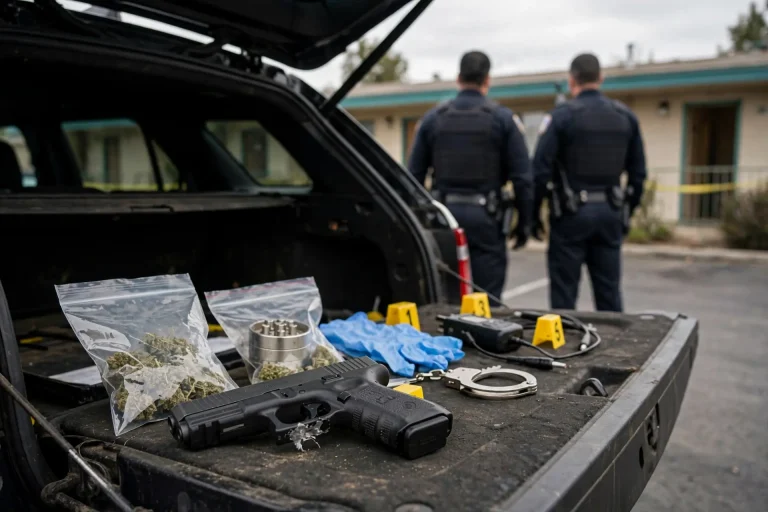
When deputies searched Rogers’ truck, they found 139.18 grams of methamphetamine in the center console, according to court documents. The drug was 99.4% pure, court documents state.
In an interview after his arrest, Rogers confirmed that he had bought the methamphetamine from a supplier in Pensacola for $875, and he described plans to resell it, citing a price of $175 per ounce, court documents state. He told investigators he never bought less than four ounces at a time and sometimes bought as much as eight ounces, which he regularly sold to various customers in smaller amounts. Rogers said he had customers waiting on him when deputies arrested him.
Rogers also admitted that he had several guns at his trailer and allowed deputies to search it. Inside, agents found additional baggies of methamphetamine and several loaded pistols and rifles, and Rogers admitted that he possessed the guns. In all, investigators seized 161.5 grams of methamphetamine from Rogers’ truck and trailer, a little more than a third of a pound.
Release revoked before sentencing
Rogers was free on conditions of release while awaiting sentencing in federal court. In August 2026, he admitted to using methamphetamine twice, and the court revoked his release, according to the U.S. Attorney’s Office.
Federal courts commonly set conditions for defendants released before trial or sentencing, such as drug testing, restrictions on travel and a requirement to avoid new criminal conduct. A violation can send a defendant back into custody to await the next step in the case.
The sentence
In addition to the 180-month prison term and five years of supervised release, Judge Moorer ordered Rogers to pay $200 in special assessments. The court did not impose a fine. Rogers’ firearms were forfeited to the United States.
There is no parole in the federal system, so defendants sentenced in federal court serve the bulk of their prison terms, with only limited credit available for good behavior. Supervised release begins after the prison term ends and works much like probation: a federal probation officer monitors the person, and violating the conditions can result in a return to prison.
Federal law treats firearms connected to drug trafficking seriously. Possessing a firearm in furtherance of a drug trafficking crime carries a mandatory minimum sentence of five years, which must be served consecutively to, or on top of, any sentence for the underlying drug offense. Federal law also generally bars people with felony convictions from possessing firearms or ammunition at all.
Agencies involved in the case
Homeland Security Investigations, the Drug Enforcement Administration and the Baldwin County Sheriff’s Office investigated the case. The Bureau of Alcohol, Tobacco, Firearms and Explosives and the U.S. Customs and Border Protection Laboratory in Long Beach, California, substantially assisted, according to the U.S. Attorney’s Office. Assistant U.S. Attorney Justin Roller prosecuted the case.
The prosecution was part of the Homeland Security Task Force initiative established under Executive Order 14159, titled “Protecting the American People Against Invasion.” According to the U.S. Attorney’s Office, the task force is a whole-of-government partnership aimed at dismantling criminal cartels, foreign gangs, transnational criminal organizations, and human smuggling and trafficking rings operating in the United States and abroad. The task force places special emphasis on crimes involving children, according to the office.
The Mobile task force includes agents and officers from Homeland Security Investigations, the FBI, the DEA and the ATF, among other agencies, with prosecutions led by the U.S. Attorney’s Office for the Southern District of Alabama. That office handles federal cases in Mobile, Baldwin, Escambia, Monroe and other counties in southwest Alabama.
Methamphetamine in south Alabama
The purity reported in the Rogers case reflects a broader pattern law enforcement agencies have described in recent years. Federal drug officials have reported that much of the methamphetamine reaching U.S. communities is now manufactured in large quantities by cartel-linked operations rather than in small home labs, and that the drug sold on the street is often extremely pure and comparatively inexpensive.
The Foley Beach Express, where Rogers was stopped, is a major north-south route linking Foley with Orange Beach and the rest of the Alabama coast. The route from Baldwin County to Pensacola is a short drive across the state line, and law enforcement agencies on both sides of the line frequently coordinate on drug investigations.
How to report drug activity
Residents who suspect drug trafficking in their neighborhoods can contact the Baldwin County Sheriff’s Office or their local police department. Tips about federal drug crimes can also be reported to the DEA, and anonymous tips about crimes in the Mobile area can be submitted through Mobile Area Crime Stoppers.
People struggling with methamphetamine or other substance use can reach the Substance Abuse and Mental Health Services Administration’s free, confidential National Helpline at 1-800-662-4357, available 24 hours a day.