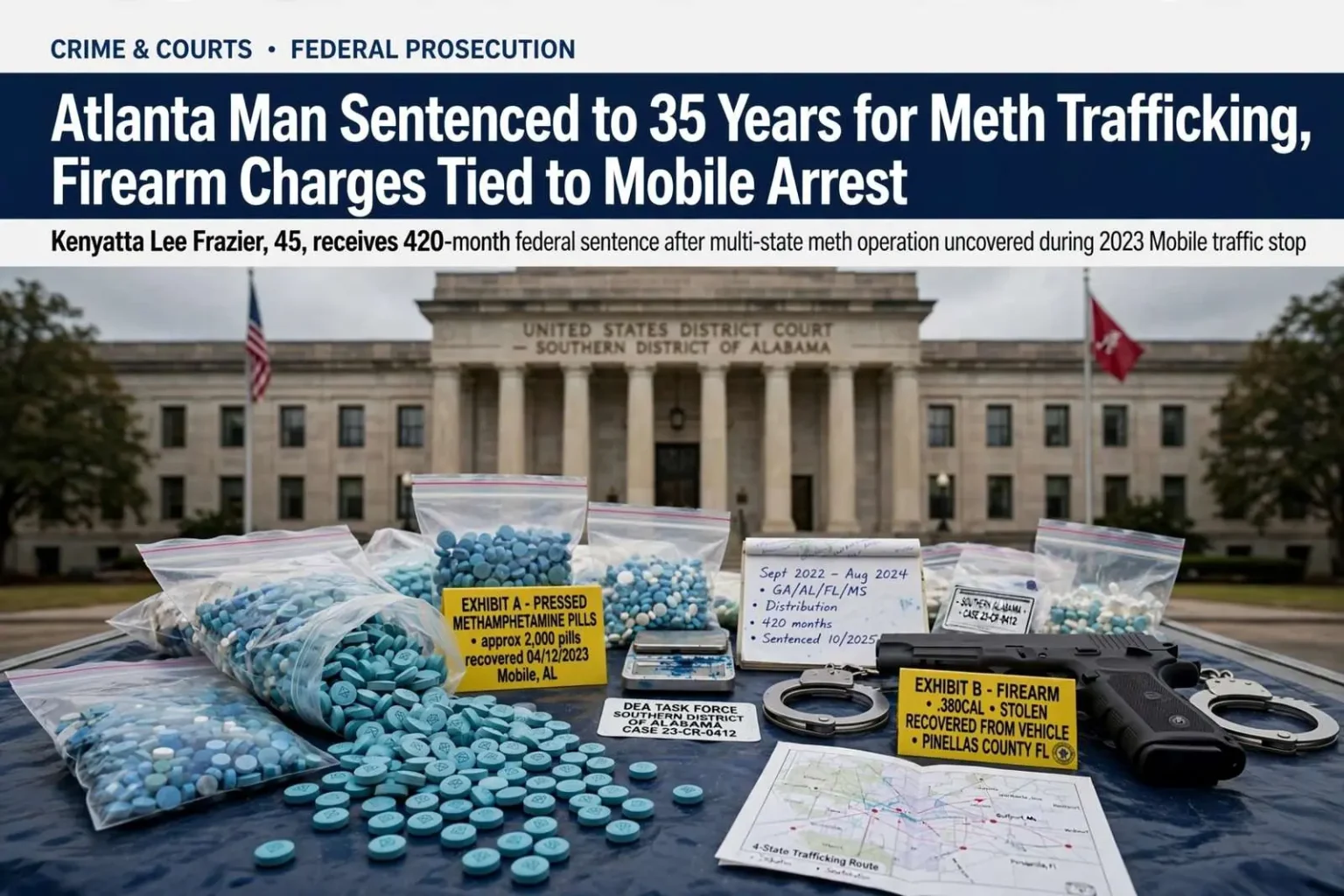
An Atlanta man will spend the next 35 years in federal prison for a methamphetamine trafficking operation that investigators say stretched across four states and was undone, in part, by a traffic stop in Mobile. Kenyatta Lee Frazier, 45, received a sentence of 420 months from Chief U.S. District Judge Jeffrey U. Beaverstock after a federal jury convicted him in October 2025 on drug trafficking and firearm charges, according to the U.S. Attorney’s Office for the Southern District of Alabama.
Evidence presented during the weeklong trial showed that Frazier manufactured and distributed tens of thousands of pressed methamphetamine pills throughout Alabama, Georgia, Florida and Mississippi between September 2022 and August 2024. Prosecutors told jurors that the pills were marketed to customers as ecstasy, a tactic that has become increasingly common among drug organizations attempting to disguise methamphetamine as a different substance in the eyes of buyers who might otherwise refuse it.
Among the most damaging pieces of evidence were photographs and videos taken by Frazier himself, which the jury reviewed during the trial. The images documented pills being produced with an illegal pill press, the kind of industrial equipment federal investigators regard as a hallmark of a large-scale manufacturing operation rather than personal use or low-level street dealing.
The April 2023 traffic stop in Mobile
The case reached a turning point in April 2023, when agents arrested Frazier and a co-conspirator during a traffic stop in Mobile. The stop came after the pair had delivered 2,000 pressed methamphetamine pills to a customer in Mississippi, according to court documents. A court-authorized recording device inside the vehicle had captured Frazier discussing drug deals and profits with co-conspirators, giving investigators and later jurors a direct window into how the operation was run and how its participants talked about the money moving through it.
During the stop, agents searching the vehicle found a loaded .380-caliber pistol concealed behind plastic molding in the floorboard, near where Frazier had been sitting. The firearm had previously been reported stolen out of Pinellas County, Florida, adding a stolen-firearm dimension to the drug counts Frazier already faced and making the gun evidence a central thread of the prosecution.
Prosecutors said the jury also heard a recorded jail call in which Frazier admitted hiding the gun so police would not find it. Text messages introduced at trial showed that he had tried to sell the same pistol, an effort prosecutors argued demonstrated that Frazier continued to deal with the weapon even after his arrest and while his case was pending.
A long criminal history
The firearm possession carried particular weight in the case because of Frazier’s history. At the time he possessed the .380-caliber pistol, he had already been convicted of at least eight prior felonies, including robbery, aggravated assault, firearms offenses, theft and drug crimes, according to prosecutors. Federal law prohibits anyone with a felony record from possessing a gun or ammunition, and sentencing guidelines call for escalating penalties for defendants whose criminal histories show repeated violence and repeated contact with the justice system.
In addition to the 35-year prison term, Judge Beaverstock ordered Frazier to serve a period of supervised release after he completes his sentence. Supervised release functions as a federal monitoring period during which a released defendant must report to a probation officer, obey all laws, and steer clear of firearms and controlled substances. Violations of supervised release conditions can send a defendant back to prison to serve additional time without a new trial.
The 420-month sentence falls at the serious end of the federal sentencing spectrum for drug trafficking cases, and it reflects the combination of factors prosecutors emphasized: the volume of methamphetamine involved, the four-state distribution footprint, the illegal pill press, the stolen firearm, and the defendant’s eight prior felony convictions.
How federal drug cases work in the Southern District of Alabama
The prosecution ran through the U.S. District Court for the Southern District of Alabama, the federal court district headquartered in Mobile that covers the southern band of the state, including Mobile, Baldwin and the other counties along the Gulf Coast. Cases of this kind typically begin when investigators working alongside federal prosecutors — in drug conspiracies, that often means DEA task force officers, FBI agents, and state and local narcotics units — develop evidence through surveillance, court-authorized recordings, controlled purchases and traffic stops, then present it to a federal grand jury for indictment.
Federal drug cases differ from state prosecutions in ways that matter for outcomes like this one. Sentences are driven largely by quantity calculations under federal sentencing guidelines, criminal history plays a major role, and defendants serve at least 85 percent of their sentence with no parole system to release them early. A 35-year federal sentence therefore means roughly three decades of actual confinement, a far different prospect than a state term of the same nominal length.
The multi-state footprint of the conspiracy also mattered. Operations that move product across state lines fall squarely within federal jurisdiction, and prosecutors can charge each delivery and each possession as part of a single continuing conspiracy. That is why evidence from a stop in Mobile, a delivery in Mississippi, and manufacturing activity tied to Georgia and Florida could all be presented to one jury in one weeklong trial.
Pressed meth pills sold as ecstasy
The marketing of methamphetamine as ecstasy has become a recurring theme in Gulf Coast drug prosecutions. Pressed pills can be stamped with logos and colors that mimic legitimate MDMA tablets, and buyers who think they are taking ecstasy may actually ingest a far more powerful stimulant. The distinction is not cosmetic: methamphetamine sold this way carries heightened risks of overdose, severe agitation and cardiovascular emergencies, particularly for users who have no tolerance for it and no idea what they are consuming.
An illegal pill press amplifies the danger. A single tableting machine can produce thousands of pills per hour, and the machines are themselves contraband when used this way. Federal investigators treat evidence of pill press activity as an indicator that an organization is operating at a wholesale scale, manufacturing its own product rather than simply reselling methamphetamine bought elsewhere. The photos and videos Frazier took of his own operation gave prosecutors exactly that proof.
Tens of thousands of pills manufactured over a two-year span and distributed across four states describes a supply chain rather than a sporadic dealing arrangement. Cases like this one typically involve coordinated handoffs, stash locations, couriers and customer networks — all of which take months of investigation to document, and all of which prosecutors point to when asking a judge for a sentence at the high end of the guideline range.
What it means for Mobile and the Gulf Coast
For residents of the Mobile area, the case is a reminder of the city’s role as a crossroads for Gulf Coast drug trafficking. Interstate 10, the Port of Mobile and the region’s highway connections make the area a natural waypoint for organizations moving product between Atlanta, the Florida peninsula, Mississippi and points beyond. Traffic stops by local and state officers regularly surface the evidence that later anchors federal prosecutions, and cooperation between patrol officers, county deputies and federal agents is often the mechanism by which a routine stop grows into a multi-state case.
It is also a reminder that firearms change the calculus of every drug case. The loaded, stolen pistol found behind the floorboard molding of Frazier’s vehicle converted a drug prosecution into a drug-and-gun prosecution, and the recorded jail call in which Frazier discussed hiding the weapon gave jurors insight into how he viewed the evidence against him. Armed defendants face guideline enhancements that can add years to a sentence, and prosecutors in the Southern District have consistently treated drug trafficking involving firearms as among the most serious conduct they charge.
The defendant’s own documentation of his work was unusual as well. Photos and videos recorded by a trafficker are comparatively rare in drug trials, and when they exist they tend to remove any doubt about what was happening inside an operation. Jurors in this case saw the pill press at work and heard the defendant’s own voice discussing deals and profits, evidence that left little room for argument about the scale or intent of the conspiracy.
With the verdict and Judge Beaverstock’s sentence now in place, the case stands as one of the more significant methamphetamine prosecutions in the district in recent years. It closes out an operation that federal authorities say supplied pressed meth pills marketed as ecstasy to customers across the central Gulf Coast for nearly two years, and it sends a message — in a sentence of 420 months — about how the federal system weighs methamphetamine manufacturing, four-state distribution and armed felony offenders together.