Mobile Police Investigate Fatal Shooting Near Carver Park
Mobile Police homicide detectives investigated after a 22-year-old man was found shot to death on Helveston Street near Carver Park.
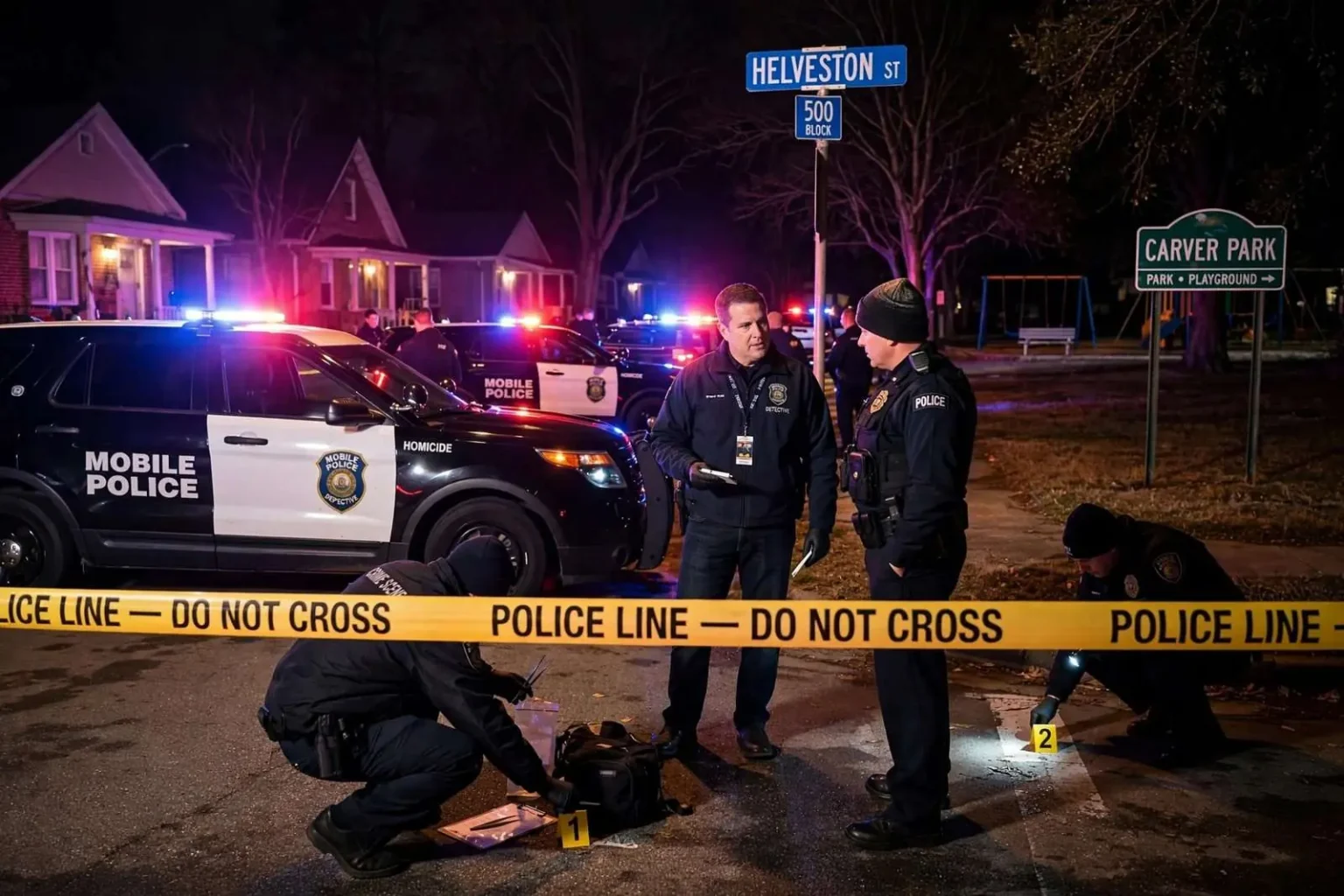
Mobile Police homicide detectives opened an investigation after a 22-year-old man was found dead of an apparent gunshot wound on Helveston Street near Carver Park in January 2015.
According to a Mobile Police Department spokeswoman, officers responded to reports of a shooting at approximately 9:55 p.m. on a Wednesday night. When officers arrived at the scene, in the 500 block of Helveston Street, they found the victim already dead. Homicide detectives took over the investigation from patrol officers, a standard procedure for cases involving a suspicious or violent death.
As is typical in early-stage homicide investigations, police did not immediately release details about a possible motive, suspect description or the circumstances that led up to the shooting. Investigators spent the hours after the shooting securing the scene, marking evidence and waiting on the arrival of the coroner before the victim’s body was removed for autopsy.
The scene near Carver Park
The Carver Park area, located in Mobile, has periodically seen violent crime that draws attention from both residents and city leaders concerned about public safety in the surrounding neighborhood. The streets around the park are residential blocks that sit within reach of downtown Mobile, and the neighborhood has long been among those city officials and community groups have targeted for investment and crime-prevention programs.
A late-night shooting in the 500 block of Helveston Street would have been heard by residents home on a Wednesday evening, and patrol officers canvassed nearby houses and porches for accounts of what they saw or heard. Detectives pay close attention to the seconds surrounding a gunshot in a residential area — vehicles that pulled away quickly, voices raised beforehand, or anyone seen leaving on foot — because such fragments often shape the early direction of a case.
The timing of the incident, in mid-evening rather than the overnight hours, meant more potential witnesses were awake and outside, and detectives urged anyone who had been in the area to come forward even if they were unsure what they had seen. Early tips, detectives noted, are often the most valuable because memories fade and residents’ willingness to talk diminishes as days pass.
How Mobile handles homicide cases
Homicide investigations in Mobile typically involve a combination of forensic evidence collection at the scene, witness interviews, and follow-up canvassing of the surrounding area in the days after a shooting. Technicians document shell casings, blood evidence and any physical items left behind, while detectives begin the process of building a timeline of the victim’s final hours — where he had been, who he had been with, and what disputes or associations might be relevant.
The Mobile Police Department’s homicide unit works cases in close coordination with the Mobile County District Attorney’s Office, which reviews evidence before any charges are presented to a grand jury. In cases where no arrest comes quickly, detectives keep files active, and older cases are periodically re-examined as new witnesses come forward or forensic techniques improve.
Investigators often rely heavily on tips from the public in the early stages of a case, particularly in neighborhoods where a shooting may have been witnessed by residents who are hesitant to come forward without an assurance of anonymity. Detectives say the difference between a case that is solved in weeks and one that lingers for years frequently comes down to whether even one person with information decides to make a call.
Mobile Police asked anyone with information about the case to come forward, offering several ways for tipsters to share what they knew. Residents were encouraged to call the Mobile Police Department directly, contact Crimestoppers, or send an anonymous tip by text message using a dedicated police intelligence line, a system designed to let witnesses share information without having to identify themselves to investigators directly.
Crimestoppers programs in Mobile County pay cash rewards for tips that lead to arrests, and the anonymity guarantee — tips are routed through a system that strips identifying information — has been credited locally with drawing out witnesses who would never walk into a precinct or speak with a detective face to face. The text-tip option extends the same protection to people who prefer to type rather than call, including younger witnesses more comfortable with messaging.
A violent start to 2015
The case added to the broader tally of violent crime that Mobile Police investigated in the opening weeks of 2015, underscoring concerns among city officials and neighborhood advocates about the pace of shootings in the early part of the year. City leaders had spent the preceding years promoting crime-reduction initiatives, including increased patrols in hot-spot areas, youth violence intervention programs and partnerships with churches and community organizations.
The department’s approach to shootings in residential areas pairs immediate investigative work with longer-term community engagement, and officers assigned to the neighborhoods around Carver Park have participated in foot patrols and community meetings designed to build the trust that makes witnesses more willing to talk. Advocates have long argued that clearance rates in cases like this one depend as much on those relationships as on forensic evidence.
In the days after the Helveston Street shooting, detectives worked to establish the victim’s background and last known movements, a process that includes reviewing social media, phone records obtained by warrant and interviews with family and friends. Police had not released the results of the autopsy, and officials cautioned that early findings — including whether the shooting was targeted or random — could change as evidence accumulated.
For residents of the streets around Carver Park, the January shooting was one more entry in a long-running conversation about public safety in the neighborhood, where community associations have repeatedly pressed the city for better lighting, faster removal of vacant structures and consistent police presence. City council members representing the area have historically echoed those requests, pointing to the link between blight, underinvestment and crime that studies across the country have documented.
The park itself and the streets around it are within a short drive of downtown Mobile’s growing waterfront and entertainment districts, a contrast often noted by residents who say the progress downtown has not reached their blocks. Local leaders have used cases like this one to renew arguments for directing redevelopment resources — housing rehabilitation, job programs, youth services — into the older neighborhoods just south and east of the central business district.
Mobile Police procedure in an open homicide is methodical by design: the scene is processed over the first day or two, evidence is submitted to the crime lab, and the case remains assigned to a detective who continues following leads as they develop. Even when no immediate arrest follows, detectives typically return to the neighborhood in the weeks after a shooting, re-interviewing potential witnesses once immediate fear has eased and once any early reluctance to get involved has had time to soften.
Family members of the 22-year-old victim, like families of homicide victims across Mobile County, were left to wait on answers while the investigation ran its course. Victim advocates with the district attorney’s office and the police department stay in contact with families of open-case victims, notifying them of significant developments and connecting them with support services.
Anyone with information was urged to contact Mobile police or to submit an anonymous tip through Crimestoppers or the department’s text line, and detectives said in the days after the shooting that even what seemed like an insignificant detail — a voice, a car, a direction of travel — could prove decisive in identifying who fired the shots that killed a 22-year-old on a Wednesday night near Carver Park.
January is historically one of the months when Mobile records an early spike in shootings, a pattern that police commanders have attributed in part to gatherings around the New Year and to disputes that carry over from the previous year. Department leadership reviews shooting data weekly, and the distribution of patrol resources across the city’s precincts shifts in response to where incidents cluster.
The 500 block of Helveston Street sits among blocks of modest homes and several multi-family properties, and like much of the area around Carver Park it has seen turnover in residents over the years. Longtime residents describe a neighborhood where most families keep to themselves but where a shooting at mid-evening touches everyone — the sound carries, porch lights come on, and the following morning the yellow tape and shell casings become the topic of every conversation on the block.
Detectives handling the case emphasized the standard appeal that accompanies nearly every Mobile homicide investigation: that residents treat the victim’s family as their neighbors first, and that keeping quiet about what they know ultimately leaves the person responsible free on the same streets. Police officials have repeatedly said that anonymous tips in past Mobile homicides have directly led to arrests, and they pointed to the reward money available through Crimestoppers as an added incentive.
The investigation remained active in the weeks after the shooting, with detectives awaiting lab results and continuing to interview those close to the victim. As with every open homicide in the city, the case file stays assigned until it is cleared by arrest or exceptional means, and Mobile police have historically reopened publicity on older unsolved cases around the anniversary dates of the crimes — a practice that has, in past years, prompted new witnesses to come forward.