Three Women Shot Following Altercation at Mobile Nightclub
Mobile police responded early Sunday after three women were shot during an altercation at a nightclub near Azalea Road and Airport Boulevard.
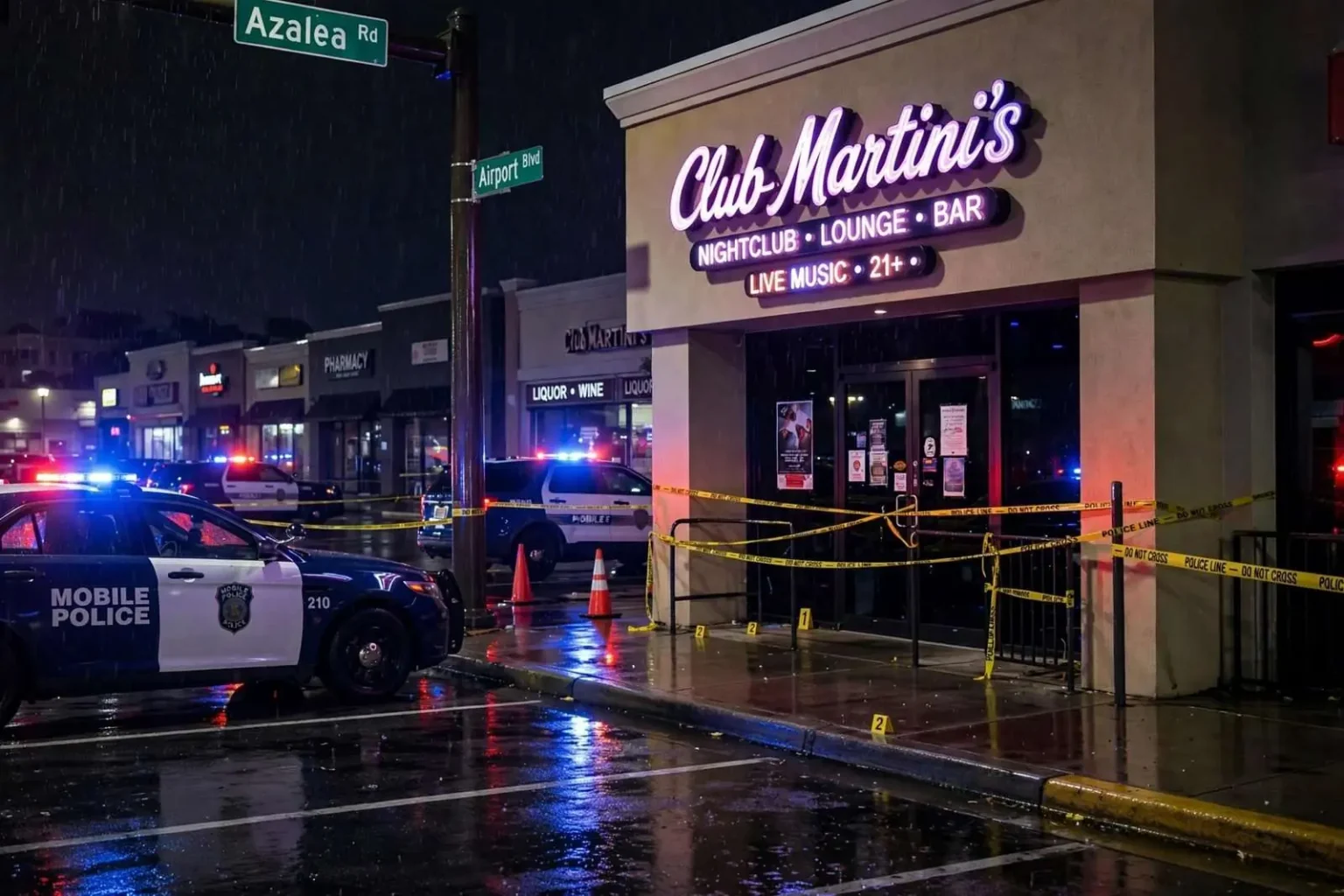
Three women were shot early one Sunday morning in January 2015 following an altercation at Club Martini’s, a nightclub located near the intersection of Azalea Road and Airport Boulevard in Mobile, according to the Mobile Police Department. The shooting added another entry to the recurring pattern of late-night violence that city police and west Mobile residents have wrestled with for years, and it unfolded during the overnight hours when area nightclubs draw their largest crowds.
Police said the shooting broke out after some kind of dispute inside or near the club. All three women were transported to a local hospital following the incident. A department spokesman said their conditions were not immediately known in the hours after the shooting, and authorities continued to gather details as the investigation got underway. The club itself did not immediately respond to requests for comment about the shooting or the circumstances that led up to it.
The early-Sunday-morning timing is significant for investigators, because it falls in the window when nightlife venues are emptying out — a period that combines large, lingering crowds, alcohol consumed over several hours, and parking lots and streets full of people deciding whether a conflict continues past the door. Disputes that begin inside over the course of a crowded night frequently move outside as patrons leave, which is why the perimeter of a club rather than the dance floor is where so many of these incidents end up.
The corridor where it happened
The Azalea Road corridor near Airport Boulevard is a commercial area of Mobile that includes a mix of retail, restaurants and nightlife venues, making it a frequent gathering spot on weekend nights. The stretch sits in the heart of west Mobile, a part of the city that grew rapidly in the second half of the twentieth century and whose commercial strips reflect that era: multitenant plazas, office parks, and entertainment businesses that serve neighborhoods stretching toward the Airport Boulevard thoroughfare, one of the busiest east-west roads in the city. On weekend nights, the concentration of venues within a short drive of each other means large numbers of people circulate among several spots before the night ends.
Shootings at or near entertainment venues in that stretch of the city periodically draw police attention and prompt broader conversations among city leaders and residents about security measures at establishments that serve alcohol late into the night. Those conversations tend to revisit the same questions: door policies and ID checks, the presence of uniformed or plainclothes security, surveillance coverage of parking areas, and how venues handle conflicts between patrons before they escalate. For the businesses around them, an incident at a nearby club carries economic consequences too, since weekend crowds are the lifeblood of the corridor’s restaurants and shops and violence gives patrons a reason to spend their evenings elsewhere.
A recurring category of weekend violence
Nightclub shootings tied to altercations are among the more common categories of weekend violence that Mobile police respond to, often stemming from disputes between patrons that escalate quickly in crowded venues, particularly in the overnight hours when clubs are busiest. Crowded rooms compress social friction — jostling, perceived slights, old grudges meeting in the same place — and the presence of alcohol lowers the threshold at which a verbal dispute becomes a physical one. When a firearm is introduced, the distance between an argument and a shooting collapses to seconds, which is the dynamic investigators almost always find themselves reconstructing in cases like this one.
Mobile police typically investigate club-related shootings by reviewing surveillance footage, interviewing witnesses and patrons who were present, and working to identify whether the shooting stemmed from a targeted dispute between specific individuals or a broader altercation that spilled outside the venue. That distinction shapes everything downstream. A targeted shooting sends investigators into the histories between the people involved; a shootout born of a chaotic brawl leaves them tracing shell casings, bullet paths and dozens of varying witness accounts. Either way, the first hours matter enormously, because nightclub witnesses scatter quickly and memories degrade fast once the night is over.
Charges in these types of cases can range from assault to more serious offenses depending on the extent of injuries and whether a weapon was used with clear intent to harm. When multiple people are wounded by the same act of gunfire, prosecutors evaluate each shooting separately, and the final charging decisions often wait on the victims’ medical outcomes — injuries that initially appear non-life-threatening can change the legal picture if a victim’s condition deteriorates. Venue liability can enter the picture as well, since establishments that serve alcohol late into the night operate under state licensing rules and face scrutiny over whether security measures matched the risks their operations presented.
What happens next
As is standard practice with active investigations, authorities held back most details in the immediate aftermath — the identities of those involved, the number of shooters, and the precise sequence of events all remained undeveloped while detectives worked. Residents and patrons with information about the shooting are typically encouraged to contact Mobile police directly or to use the department’s anonymous tip channels, which allow witnesses who fear involvement to pass along what they saw without identifying themselves. In nightclub shootings, anonymous tips are often decisive, since the people best positioned to know what started the dispute are frequently the same people reluctant to testify about it.
For the three women who were shot, the immediate concern was medical. The response to a multi-victim shooting in the Azalea Road area draws on the city’s emergency infrastructure, with police securing the scene first so that medics can reach the wounded, and victims distributed across the trauma and emergency resources available in the Mobile area. The condition updates that follow in the days after such an incident often determine how the case is ultimately charged, which is why police spokesmen characterize victim conditions cautiously in the early going.
The January 2015 shooting also landed during a period when Mobile’s leadership was pushing economic development and quality-of-life initiatives across the city, and incidents of this kind tend to sharpen the debate about the tradeoffs of a busy nightlife economy. Business districts benefit from the traffic that bars and clubs generate, but the overnight disorder that sometimes trails out of them — noise, crowds in parking areas, and in the worst cases violence — creates friction with the neighborhoods that surround those districts. The Azalea Road corridor is flanked by residential areas whose residents experience the after-hours activity directly.
Nationwide, cities have taken varied approaches to nightclub safety, from requirements that venues employ licensed security after certain hours to stricter enforcement of occupancy limits and earlier closing times for problem locations. Mobile’s own approach has generally leaned on police response and cooperation with venue owners rather than sweeping ordinance changes, which puts the burden on individual establishments to manage door traffic, monitor for brewing disputes and coordinate with police when events spill outside. Shootings like the one at Club Martini’s become reference points in those ongoing calculations.
What remains clear from the initial reports is the familiar shape of the incident: a crowded venue, a dispute that escalated beyond anyone’s control, and multiple innocent bystanders among the wounded. Women injured in a shooting that grew out of someone else’s altercation are the definition of collateral harm, and their cases are a reminder that gunfire in crowded spaces almost never stays confined to the people the shooter intended to reach. Detectives continued their work in the days that followed, and any developments in the case — arrests, charges, or updates on the victims’ conditions — were expected to come through the Mobile Police Department as the investigation progressed.
The geography of the Azalea Road and Airport Boulevard intersection is worth understanding for anyone trying to picture the response. Airport Boulevard runs the width of the city and ranks among Mobile’s most-traveled commercial corridors, and Azalea Road threads north-south through a dense cluster of shopping centers and office buildings just west of the Interstate 65 interchange. Venues in that pocket serve a wide catchment — patrons arrive from west Mobile neighborhoods, from across the I-65 bridge, and from across the bay — so an incident there touches a broader swath of the metro area than its address alone suggests. It also means police and fire units can reach the area quickly from multiple directions, something that matters in a multi-victim shooting.
Incidents at nightlife venues also tend to produce a second wave of work for investigators that the public rarely sees: warrants for surveillance video not just from the club but from surrounding businesses whose cameras cover the parking areas and approach roads, canvassing of patrons through social media, and coordination with hospital staff, both to monitor victims and to speak with anyone who accompanied them. Detectives piece together the night from those fragments, and in cases where a dispute built over the course of an evening, the video trail frequently shows escalation that patrons never noticed as it happened.
The inquiry into what happened at Club Martini’s followed that standard path, and like most cases of its kind, its resolution depended on the cooperation of the people who were there. Weekend crowds are made of witnesses — dozens of them — but converting a crowd into cooperation is the hardest part of a nightclub shooting investigation. Mobile police have long stressed that tips, even fragmentary ones, fill gaps that video and forensics cannot, and the department’s anonymous channels exist precisely for witnesses who want the shooting solved without becoming part of the case file themselves.