Mobile Police Honor Cpl. Julius Nettles as 2022 Officer of the Year at Recognition Banquet
The Mobile Police Department honored Cpl. Julius Nettles as its 2022 Officer of the Year at its annual Law Enforcement Recognition Banquet, capping off National Police Week amid a year the department was down 70 officers.
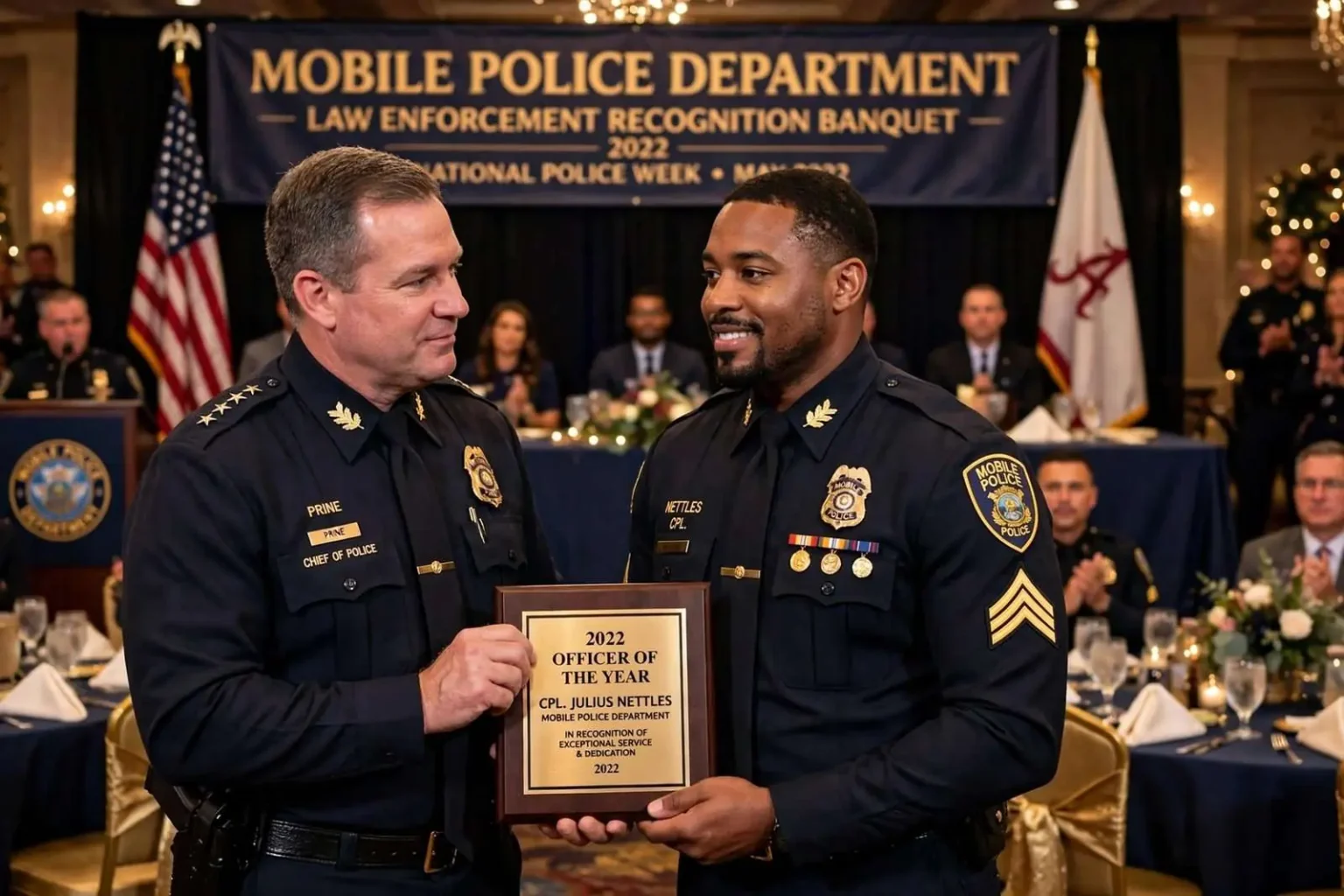
The Mobile Police Department capped off National Police Week by honoring its top performers from 2022 at its annual Law Enforcement Recognition Banquet, an event made especially meaningful this year given the staffing challenges the department worked through during that stretch. The ceremony, held amid National Police Week’s national observances, gave the department a rare moment to look past its vacancies and shortages and celebrate the work its officers had accomplished anyway.
A year of doing more with less
The banquet recognized achievements from calendar year 2022, a year in which the department was down roughly 70 officers. For a department responsible for patrolling Alabama’s fourth-largest city — from the historic downtown and the port district to the neighborhoods of Toulminville, Tillman’s Corner, and West Mobile — a shortfall of that size touches everything: response times, case loads, overtime budgets, and the sheer wear on the officers who remain. Departments across the country have faced similar shortfalls in recent years, and Mobile’s experience mirrored a national struggle to recruit and retain officers.
Despite that shortfall, the department honored double the number of recipients compared with the previous year’s ceremony. The contrast — fewer officers, more commendations — was the quiet theme of the evening, a reflection of how much the department’s smaller ranks had been asked to carry and how often individual officers had distinguished themselves under that strain. Honorees spanned the department’s work: investigations closed through persistence, lives saved under fire, and the unglamorous daily reliability that holds a city’s policing together.
Mobile Police Chief Paul Prine said the officers being recognized share something in common with why he entered law enforcement in the first place. “Why do they do it? — I would simply say it’s the same reason I got into law enforcement — is there is a sense of calling or purpose to do something greater than yourself,” Prine said. “And the fact that they do it for the low pay and the fact they do it for very low public recognition — really says a lot to that calling.”
Honoring the families behind the badge
The banquet also recognized the spouses and family members of officers for their support behind the scenes. Policing’s demands — rotating shifts, court dates that scatter a week, holidays spent on patrol, the constant undertone of risk — are borne in large part by households that absorb the stress without the badge. Departments have increasingly made family recognition part of formal ceremonies, acknowledging that retention begins at home: an officer with a stable, supported family is an officer who stays.
Lt. Col. Marcus Young, deputy commander of the 226th Maneuver Enhancement Brigade and this year’s keynote speaker, thanked families directly during the ceremony. The 226th, an Alabama Army National Guard brigade headquartered in Mobile with a long history of deployment support missions, has a institutional understanding of what service families endure — a parallel Young drew between military and law enforcement life. “To the family members — thank you for what you do for your officer — we cannot do it without you,” Young said. “They need your understanding — they need your nurture. Officers aren’t built and they’re not wired like a normal person.”
His message bridged the two worlds of service that Mobile knows well. The port city has deep military roots — from the historic bases and shipbuilding that shaped the region to the Guard and reserve units whose members serve as police officers, firefighters, and first responders in civilian life. A National Guard commander addressing a police banquet was, in Mobile, less a novelty than a family conversation.
The foundation behind the event
The event is held in partnership with the Mobile Law Enforcement Foundation, a nonprofit that raises money to support the department. Foundation President John Arendall said the group’s fundraising directly benefits officers and their families. “Every dollar we raise — goes straight to supporting the police department,” Arendall said. “Again whether it’s training or equipment, whether it’s supporting a family in need that are in the police — or like a night like tonight to celebrate them.”
Foundations of this kind have become essential partners for municipal departments, filling gaps that city budgets cannot: specialized equipment, advanced training, funeral and hardship assistance, and events like the recognition banquet itself. In Mobile, the foundation’s support carries extra weight during staffing crises, when overtime and equipment demands strain the department’s resources. Its board — drawn from the city’s business and civic leadership — represents the constituency Prine’s remarks alluded to: citizens who may never wear a badge but understand what the badge costs the people who do.
National Police Week, established by presidential proclamation in 1962 and observed each May, draws departments nationwide into remembrance and recognition — memorial services for the fallen, candlelight vigils, and ceremonies like Mobile’s that honor the living. For a department down 70 officers, the week’s blend of mourning and celebration landed with particular force: the names read at national memorials belong to departments no different from Mobile’s, and the officers at the banquet — the decorated and the quietly dependable alike — represent the department’s answer to a hard stretch of years. As the evening closed, the sentiment in the room matched the chief’s framing: whatever the staffing numbers say, the calling remains, and the people who answer it deserve a night when the city says so out loud.
Chief Prine’s first years at the helm
The banquet also served as a snapshot of Paul Prine’s leadership during a demanding period. A Mobile policing veteran who rose through the department’s ranks before assuming its top job, Prine inherited the staffing crisis that defined the 2022 calendar year and made recruitment a standing theme of his administration. His remarks at the banquet — framing police work as a calling rather than a job — doubled as a recruitment message aimed at the community watching: the department cannot compete with private-sector pay, but it can offer work that matters, and it wants people who hear that argument.
Chiefs across Alabama have made similar appeals as departments compete for a shrinking pool of certified officers, with sign-on bonuses, academy sponsorships, and lateral-transfer incentives becoming standard tools. Mobile’s size and its port, courthouse, and medical economy give it both the crime challenges of a big city and the civic resources to respond, and ceremonies like the recognition banquet are part of that response — visible evidence that the department honors its own, which matters to candidates weighing an offer.
What the 2022 commendations said
Doubling the number of honorees in a year of record vacancies told its own story about the department’s culture. Commendations at events like this typically recognize a spectrum of conduct: medal-ofvalor-type awards for officers who ran toward danger, lifesaving awards for CPR and overdose interventions, unit citations for investigations that cleared violent cases, and citizen commendations for residents who assisted officers. Each category represents a decision point where an officer could have done less and did more — the raw material of a department’s reputation.
The 2022 roster of honorees also reflected the department’s breadth. Mobile’s officers police a port that handles billions in trade, neighborhoods with generations-deep histories, a downtown experiencing renewed investment, and the sprawling commercial corridors along Airport Boulevard and Government Street. Recognition ceremonies necessarily generalize that variety into a single evening, but the honorees’ own assignments — patrol, investigations, traffic, specialty units — mapped the city’s policing geography in miniature.
Police Week and what it asks of a city
National Police Week’s origins trace to 1962, when Congress and the president dedicated May 15 as Peace Officers Memorial Day and the calendar week surrounding it as Police Week. What began as a national observance has grown into a tradition of local ceremonies where departments pair remembrance of fallen officers with recognition of living ones. Mobile’s banquet follows that pattern, and in a year of acute staffing strain, the pairing carried a practical logic: honoring the officers who stayed is among the most direct ways a department encourages the officers who remain — and the candidates it hopes to attract — to keep serving.
The evening’s structure — Prine’s reflections, Young’s keynote, Arendall’s assurance that every foundation dollar reaches the department, and the presentation of awards to officers and their families — composed a single argument: that policing in Mobile is a shared civic undertaking. The city provides the budget, the foundation provides the margin, the families provide the stability, and the officers provide the courage and consistency that none of the rest can substitute for.
As the department works through its staffing recovery — recruiting classes, retention efforts, and the slow arithmetic of hiring back toward full strength — the 2022 recognition banquet will stand as the record of what its smaller roster accomplished. Down roughly 70 officers, the department doubled its honors, filled its streets, and closed its cases. The 2023 banquet, whenever it convenes, will have a hard act to follow — and the officers in that ballroom earned the right to be a hard act to follow, one shift at a time, through a year when the city needed every one of them and they answered.