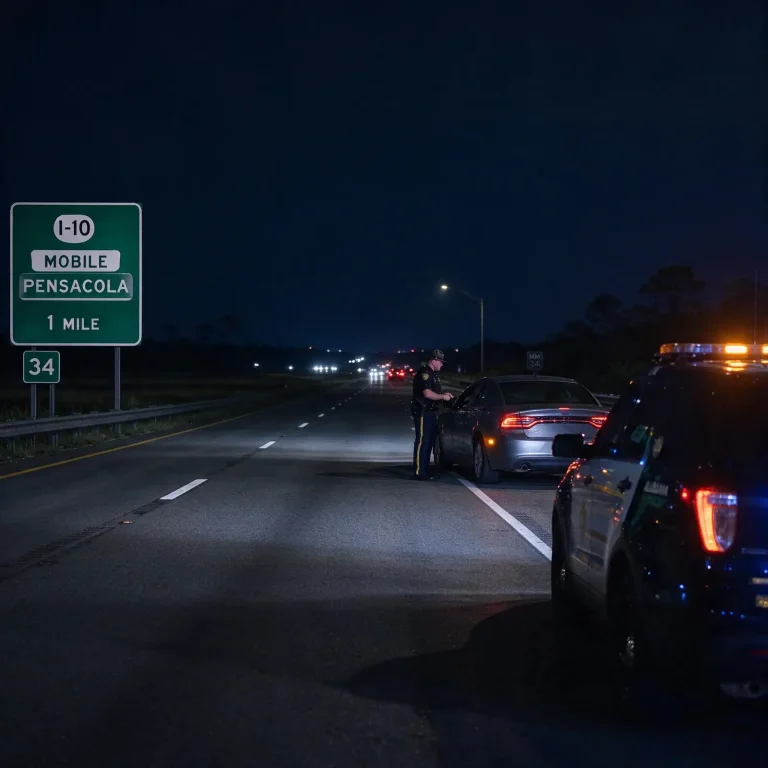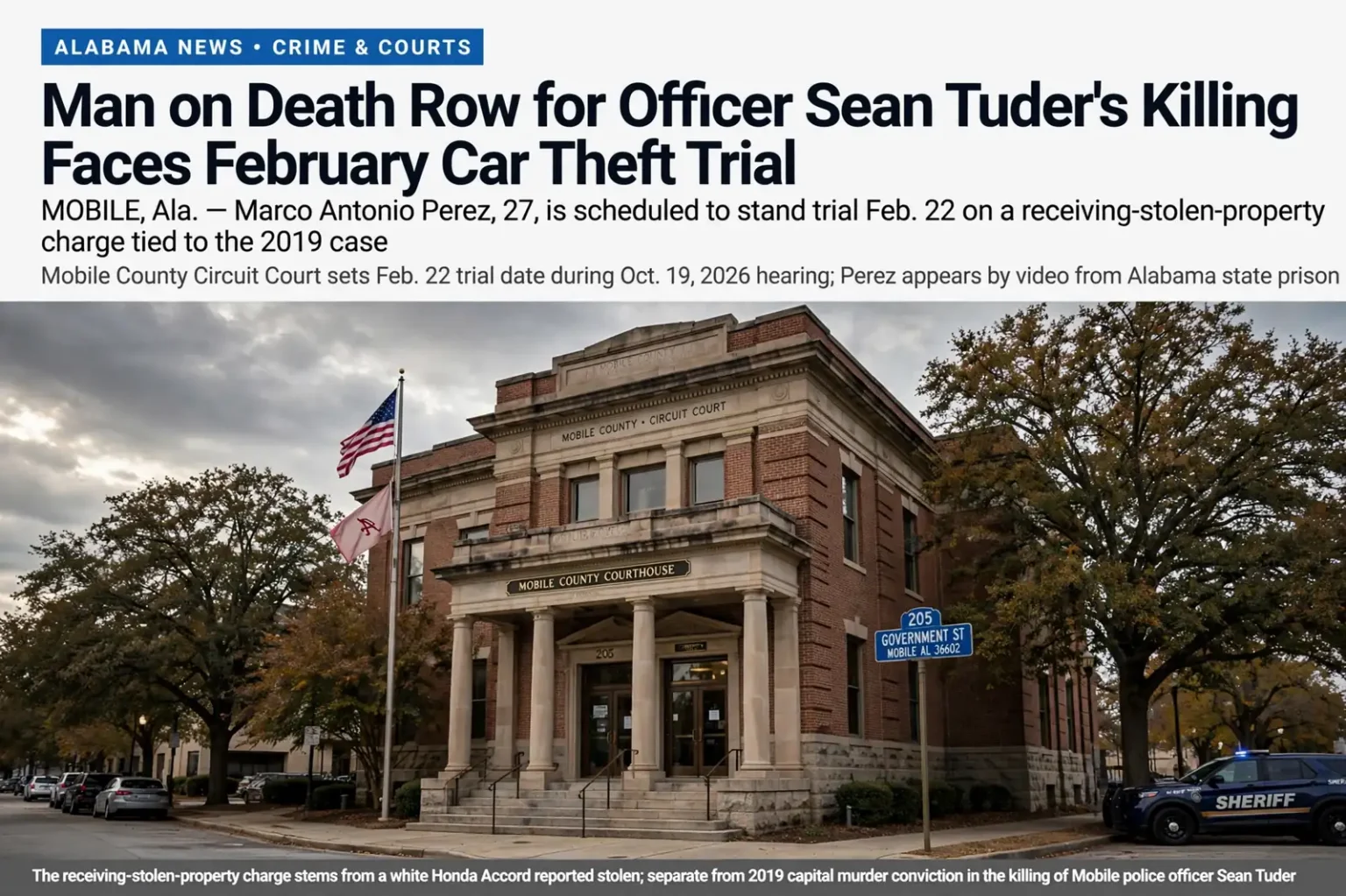
MOBILE, Ala. — Marco Antonio Perez, the man sentenced to death for the 2019 killing of Mobile police officer Sean Tuder, is scheduled to stand trial again in February, this time on a receiving-stolen-property charge tied to a car prosecutors say he was driving before the shooting.
Mobile County Circuit Judge Ben Brooks set the trial for Feb. 22 during a hearing Monday, Oct. 19, 2026. Perez, now 27, took part in the hearing by video from an Alabama state prison.
The new case carries far lower stakes than the capital murder trial that ended with Perez on death row. But it means the case connected to one of the most painful losses in the Mobile Police Department’s recent history will return to a Mobile County courtroom once more.
Charge Was Left Out of the Murder Trial
The receiving-stolen-property count was part of the original indictment against Perez but was not presented to the jury that heard the capital murder case. It concerns a white Honda Accord that had been reported stolen.
During the murder trial, prosecutors showed jurors surveillance video that they said showed Perez driving the Accord in a McDonald’s drive-through line. That video was introduced as part of the evidence in the capital case, but the stolen-vehicle allegation itself was set aside for a separate proceeding.
In Alabama, a person can be charged with receiving stolen property for knowingly receiving, keeping or disposing of property that was stolen, or doing so while having reason to believe it was stolen. The degree of the offense depends on the type and value of the property involved.
Perez has not been convicted on the stolen-property count. As with any criminal charge, he is presumed innocent of that allegation unless prosecutors prove it beyond a reasonable doubt.
The Killing of Officer Sean Tuder
Tuder was off duty on Jan. 20, 2019, when he received a tip that Perez was at the Peach Place Inn Apartments in west Mobile. At the time, police were searching for Perez, who was wanted on a federal gun charge. Perez, then 19, had been sought on a federal warrant after he failed to meet with his pretrial services officer in that gun case, according to evidence presented at his trial.
Tuder, who lived in Daphne, went to the apartment complex off Leroy Stevens Road to take Perez into custody, with other officers on the way as backup. According to the Alabama Attorney General’s Office, the two men struggled, Perez broke free, and he drew a stolen .40-caliber pistol and shot Tuder three times. The shooting was captured on surveillance video, prosecutors said.
The attorney general’s office has said Perez was violating the conditions of both state probation and federal pretrial release at the time, and that he had staged his own kidnapping before a roughly 10-day spree of property crimes that included vehicle thefts and the theft of the pistol used in the shooting.
Tuder joined the Mobile Police Department in 2016 and was named the department’s Officer of the Month in 2017. He was also a member of the Alabama National Guard.
Conviction, Death Sentence and Appeal
A Mobile County jury found Perez guilty of capital murder on Feb. 8, 2024, after a trial before Judge Brooks. The next day, jurors voted 11-1 to recommend a death sentence, and the jury unanimously found the aggravating circumstance that Perez killed the officer to avoid arrest. Under Alabama law, at least 10 of 12 jurors must agree before a death sentence can be imposed. Perez was formally sentenced to death in March 2024, according to the attorney general’s office. Alabama law lists the murder of a law enforcement officer while on duty, or because of an official or job-related act, among the offenses defined as capital murder, which can carry a sentence of death or life in prison without parole.
On May 1, 2026, the Alabama Court of Criminal Appeals affirmed both Perez’s capital murder conviction and his death sentence. The state’s side of that appeal was handled by the Alabama Attorney General’s Office. In Alabama, every death sentence is automatically reviewed by the Court of Criminal Appeals, which examines both the trial record and the sentence.
Capital cases typically do not end there. After the Court of Criminal Appeals rules, a defendant may ask that court to rehear the case and may then petition the Alabama Supreme Court for review. Further avenues can include a petition to the U.S. Supreme Court, state postconviction proceedings, and federal habeas corpus litigation. That process commonly takes many years.
What to Expect in February
The trial set for Feb. 22 will focus solely on the stolen-car allegation, not on the shooting itself or the murder conviction, which stands unless overturned on further appeal. Brooks, who presided over Monday’s hearing, will oversee the case in Mobile County Circuit Court.
Criminal trial dates can shift because of pretrial motions, scheduling conflicts or plea negotiations, so the February date could change before the case reaches a jury. The Mobile County District Attorney’s Office prosecutes felony cases in the county’s circuit court.
Because Perez is serving a death sentence in state custody, the outcome of the stolen-property case is unlikely to change where he is held. But a verdict would formally resolve a remaining count from the 2019 indictment that has been pending since the capital trial ended.