Trooper Stops Wrong-Way Driver on I-10 in Baldwin County Before Tragedy, Makes DUI Arrest
An ALEA trooper spotted and stopped a wrong-way driver on I-10 near mile marker 34 in Baldwin County late Sunday, Oct. 18, before a dispatcher had even finished broadcasting the alert. The driver was arrested on suspicion of impaired driving.
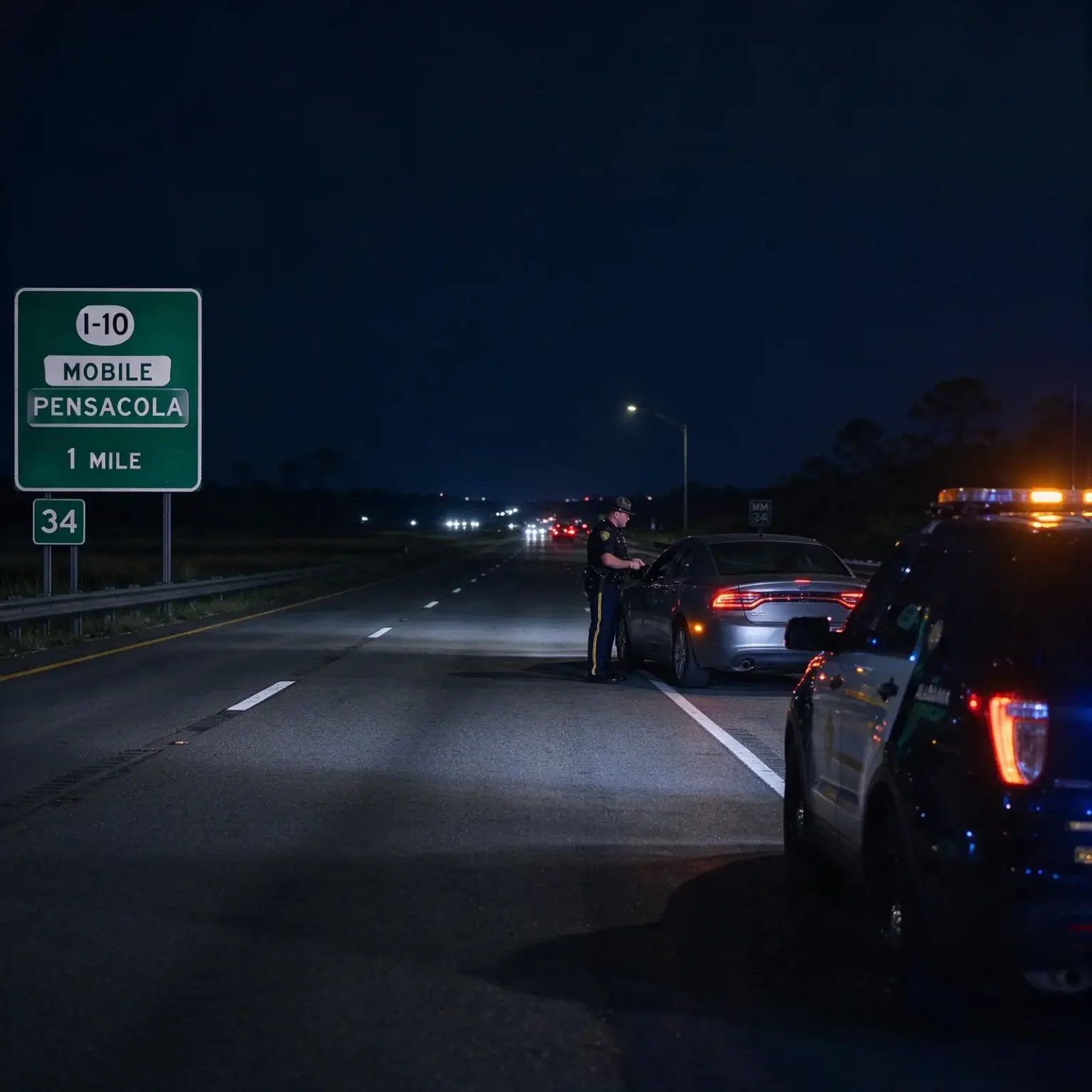
BALDWIN COUNTY, Ala. — A wrong-way driver on I-10 in Baldwin County was stopped by an Alabama state trooper Sunday night before anyone was hurt, and the driver was arrested after the trooper determined he was intoxicated, according to the Alabama Law Enforcement Agency.
The quick stop came at about 11 p.m. on Sunday, Oct. 18, after ALEA began receiving calls from motorists reporting a vehicle headed the wrong direction on Interstate 10 near mile marker 34. By the time a dispatcher was broadcasting a “Be On The Lookout” alert over the radio, a trooper had already spotted the vehicle and pulled it over.
A stop made in seconds
Law enforcement officers often say they cannot be everywhere at once. On Sunday night, a trooper happened to be in the right place at exactly the right time.
Calls from drivers who encountered the vehicle set the response in motion. As dispatchers relayed the description to units in the area, the trooper had already located the car and stopped it, ending a situation that could easily have turned deadly on one of the busiest highways on the Gulf Coast.
Following an investigation at the scene, the trooper determined the driver was intoxicated, according to ALEA. The man was arrested and booked into the Baldwin County Detention Center, and his vehicle was towed. His name and the specific charges he faces were not included in the initial information released about the arrest.
Like anyone arrested in Alabama, the driver is presumed innocent unless and until he is proven guilty in court.
There was no crash, no injuries and no property damage. Given the late hour, interstate speeds and the direction the vehicle was traveling, the trooper’s fast action very likely prevented a serious and possibly fatal head-on collision.
Where it happened
Mile marker 34 sits on the Baldwin County side of Mobile Bay, on the Eastern Shore section of Interstate 10 near the Daphne and Spanish Fort area. The stretch carries heavy traffic at nearly all hours, including commuters traveling between Baldwin and Mobile counties, commercial trucks moving along one of the nation’s major east-west freight corridors, and visitors heading to and from the beaches.
Interstate 10 runs across the full width of Baldwin County, from the Bayway over Mobile Bay to the Perdido River at the Florida state line. Divided highways like I-10 are designed so that traffic in opposite directions is separated, which is part of what makes a wrong-way driver so dangerous: oncoming motorists traveling at highway speed do not expect to meet a vehicle in their lane and have very little time to react.
Why wrong-way crashes are so deadly
Wrong-way collisions are relatively rare, but they are among the most lethal crashes on American roads because they are frequently head-on and the speeds of both vehicles combine at impact.
A 2021 study by the AAA Foundation for Traffic Safety found that 2,008 people were killed in wrong-way crashes on divided highways nationwide from 2015 through 2018, an average of about 500 deaths each year. That was a 34% increase over the average of 375 annual deaths recorded from 2010 to 2014.
The same research identified impairment as the most common factor. About 60% of wrong-way drivers in those crashes had a blood alcohol concentration at or above the legal limit of 0.08. The study also found that nearly 87% of wrong-way drivers were alone in their vehicles, and that drivers older than 70 were at higher risk of driving the wrong way than younger drivers.
Impaired driving in Alabama
In Alabama, it is illegal for adult drivers to operate a vehicle with a blood alcohol concentration of 0.08% or higher. Stricter limits apply to commercial drivers and to drivers under 21. Drivers can also be charged with driving under the influence of drugs or any other substance that impairs their ability to drive safely, regardless of a specific test number.
Impaired driving remains a leading cause of traffic deaths nationally. According to the U.S. Department of Transportation and the National Highway Traffic Safety Administration, alcohol-impaired driving crashes killed 11,904 people in 2024, accounting for about 30% of all traffic fatalities in the United States.
Law enforcement agencies across Baldwin County, including ALEA, frequently arrest impaired drivers, and state and federal grants help pay for extra patrols during holiday periods through national campaigns such as “Drive Sober or Get Pulled Over.” Still, as one of the fastest-growing counties in the country and a major tourist destination, Baldwin County presents a large territory for officers to cover.
What to do if you see a wrong-way driver
Sunday’s arrest began with motorists who took the time to report what they saw. Safety officials offer this advice if you encounter a vehicle going the wrong way:
- Get out of the way. Slow down and move toward the right shoulder if you can do so safely. Wrong-way drivers, especially impaired ones, often travel in the left lane because they believe it is the right lane.
- Call 911 as soon as it is safe. Give the direction of travel, the nearest mile marker or exit, and a description of the vehicle. In Alabama, drivers can also reach state troopers by dialing *HP (*47) from a cell phone.
- Do not try to stop the vehicle yourself. Leave that to law enforcement.
- Stay alert at night. Many wrong-way crashes happen late at night and in the early morning hours. Watching far down the road for unexpected headlights can buy precious seconds.
- Never drive impaired. Use a designated driver, a ride-hailing service or a taxi, and take the keys from friends who have had too much to drink.
A reminder from Sunday night
The outcome on Interstate 10 could have been very different. Instead of a crash scene, Sunday night ended with one arrest, one towed car and every driver on that stretch of highway making it home safely.
The case will proceed through the Baldwin County court system, where the driver will have the opportunity to respond to any charges filed against him.