Amended Lawsuit Names HSI Agent Kent Blacklidge, Who Faces Unrelated Felony Charges in Baldwin County
An amended federal complaint filed by Baldwin County U.S. citizen Leonardo Garcia Venegas now names Homeland Security Investigations agent Kent Blacklidge as a defendant. Blacklidge separately faces nine felony sex-crime charges in an unrelated Baldwin County case; he is presumed innocent.
MOBILE, Ala. — A federal lawsuit filed by a Baldwin County construction worker who says immigration officers detained him repeatedly despite his U.S. citizenship now identifies one of the agents involved by name. The first amended complaint names Homeland Security Investigations special agent Kent Blacklidge as an individual defendant, alleging he took part in the worker’s first detention at a Foley construction site in May 2025.
Blacklidge is also charged in an entirely separate Baldwin County criminal case. In September, he was charged with nine felony sex crimes involving a juvenile, according to the Alabama Attorney General’s Office. The criminal charges are accusations, not findings of guilt, and Blacklidge is presumed innocent unless and until proven guilty in court. The claims in the civil lawsuit are likewise allegations that have not been proven.
The detention described in the lawsuit
The plaintiff, Leonardo Garcia Venegas, is a U.S. citizen from Baldwin County. He filed suit after, according to his complaint, he was detained by immigration officers on more than one occasion even though he presented an Alabama STAR ID and told agents he was born in Florida.
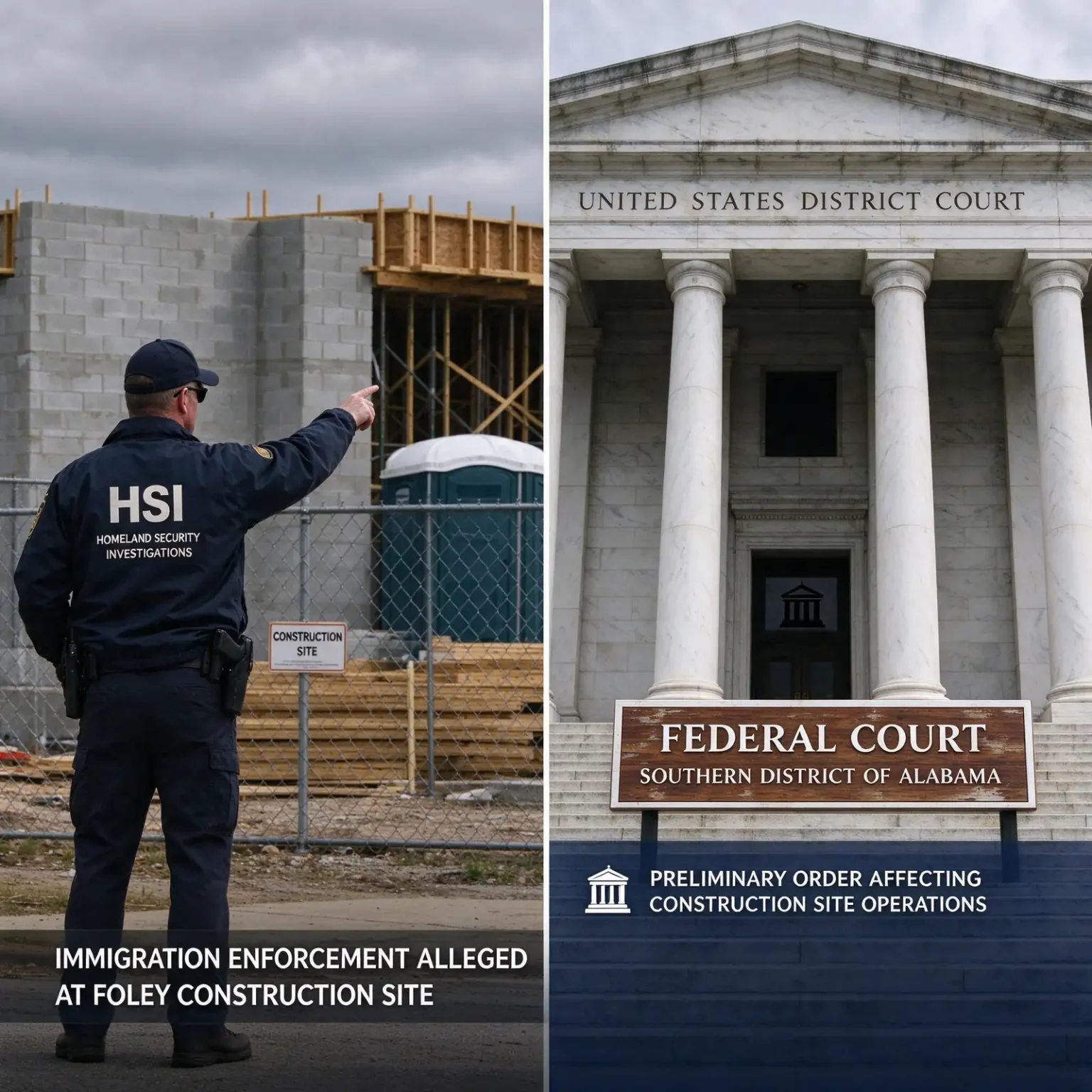
The amended complaint, filed this month, focuses in part on a May 21, 2025, immigration enforcement operation at a private construction site in Foley. According to the filing, Venegas was walking toward his brother, who was being detained by agents, and was recording the scene on his phone when Blacklidge stepped into his path.
The complaint alleges that Blacklidge, without first asking Venegas any questions, grabbed his arm, forced it behind his back and pushed him toward the ground. Venegas repeatedly told the agents he was a U.S. citizen and offered to show identification, the lawsuit says.
According to the complaint, agents searched Venegas’ pocket and found his Alabama STAR ID but continued to hold him for more than an hour.
The amended complaint further alleges that officers at the site singled out Latino workers for questioning and detention while passing by white and Black workers. Those claims remain allegations in a case that is still pending in federal court, and no court has made findings on whether they are true.
Who is named, and why it matters
According to the amended complaint, Blacklidge was working as a special agent with Homeland Security Investigations at the time of the May 2025 detention. HSI is the investigative arm of U.S. Immigration and Customs Enforcement, part of the U.S. Department of Homeland Security. While ICE’s Enforcement and Removal Operations division handles arrests and deportations, HSI agents investigate a wide range of cross-border crimes and also take part in worksite enforcement operations.
Lawsuits challenging government conduct often begin by naming agencies or unidentified officers, sometimes listed as “John Doe” defendants, when a plaintiff does not yet know who was involved. An amended complaint allows a plaintiff to update the claims, add facts or substitute the names of individual defendants once they are identified. Naming an officer individually means that person, and not only the agency, is a party to the case and must respond to the allegations.
Blacklidge has not been found liable for anything in the civil case, and the defendants will have the opportunity to respond to the amended complaint in court.
Court limits on construction site raids
The case has already had an effect beyond Venegas himself. A federal judge has issued a preliminary order restricting certain warrantless immigration raids and detentions at construction sites in Alabama while the lawsuit moves forward.
A preliminary order of this kind is not a final ruling on the merits. Courts may grant temporary relief when a party shows, among other things, a likelihood of success and a risk of harm if conduct continues while a case is pending. The order remains in place while the litigation continues unless the court modifies it or a higher court intervenes.
Alabama’s STAR ID, which Venegas carried, is the state’s federally compliant REAL ID credential, issued by the Alabama Law Enforcement Agency. Applicants must provide documents establishing their identity and lawful status in the country. Under the 14th Amendment, people born in the United States, including in Florida, are U.S. citizens at birth.
The legal backdrop for worksite stops
Venegas’ lawsuit challenges the lawfulness of how he was treated during his detentions. Cases like his test the boundaries between federal immigration authority and the constitutional protections that apply to everyone in the country.
The Fourth Amendment to the U.S. Constitution protects people against unreasonable searches and seizures. Federal immigration law gives officers authority, without a warrant, to question a person they believe to be a noncitizen about his or her right to be in the United States, and to make warrantless arrests in certain circumstances when they have reason to believe a person is in the country unlawfully and is likely to escape before a warrant can be obtained. Courts have long held, however, that those powers are subject to constitutional limits, and that brief stops generally require reasonable suspicion while arrests require probable cause.
Immigration detention authority applies only to noncitizens. A U.S. citizen cannot be held for deportation, which is why the question of how quickly officers confirm a person’s citizenship can become central in disputes over worksite operations.
Federal courts in recent years have heard a number of challenges to immigration enforcement tactics around the country. How the court rules in Venegas’ case could shape how such operations are carried out at job sites in Alabama, particularly in fast-growing Baldwin County, where construction is a major part of the local economy.
The separate criminal charges
The criminal case against Blacklidge is unrelated to the lawsuit. According to the Alabama Attorney General’s Office, Blacklidge was charged in Baldwin County in September with first-degree rape, second-degree rape, first-degree sodomy, second-degree sodomy, two counts of first-degree sexual abuse, two counts of second-degree sexual abuse, and incest. The charges involve a juvenile.
Prosecutors initially requested an Aniah’s Law hearing, which could have led a judge to order Blacklidge held without bond while the case is pending. Prosecutors later withdrew that request after saying the defense had subpoenaed the juvenile alleged victim to testify at the hearing.
Aniah’s Law is a 2022 amendment to the Alabama Constitution, approved by voters, that gives judges the authority to deny bail to defendants charged with certain serious violent felonies, including first-degree rape and first-degree sodomy, after a hearing. It is named for Aniah Blanchard, a 19-year-old college student who was abducted and killed in 2019. Before the amendment, the Alabama Constitution guaranteed bail in nearly all non-capital cases.
Blacklidge has not been convicted of any crime. In Alabama, felony cases are generally presented to a grand jury, which decides whether there is enough evidence to issue an indictment. If a case is indicted, a defendant is arraigned and enters a plea, and the matter proceeds toward possible plea negotiations or trial. At every stage, the burden is on the state to prove guilt beyond a reasonable doubt.
What happens next
The civil case will continue in federal court, where the newly named defendant is expected to respond to the amended complaint. Further proceedings could include motions to dismiss, the exchange of evidence and, eventually, either a settlement or a trial. The preliminary order affecting construction site operations remains part of the case as it proceeds.
The criminal case will proceed separately in Baldwin County. Court dates had not been publicly detailed in the information released so far.
People who believe they have been mistreated by a federal immigration officer can file a complaint with the Department of Homeland Security’s Office for Civil Rights and Civil Liberties or report misconduct to the DHS Office of Inspector General, which investigates allegations involving the department’s employees.
Anyone with information about a crime involving a child can contact local law enforcement, the Baldwin County Sheriff’s Office or the Alabama Department of Human Resources. In an emergency, call 911. Survivors of sexual abuse and their families can also reach the National Sexual Assault Hotline at 800-656-4673 for free, confidential support at any hour.
South Alabama News will continue to follow both cases as they move through the courts.