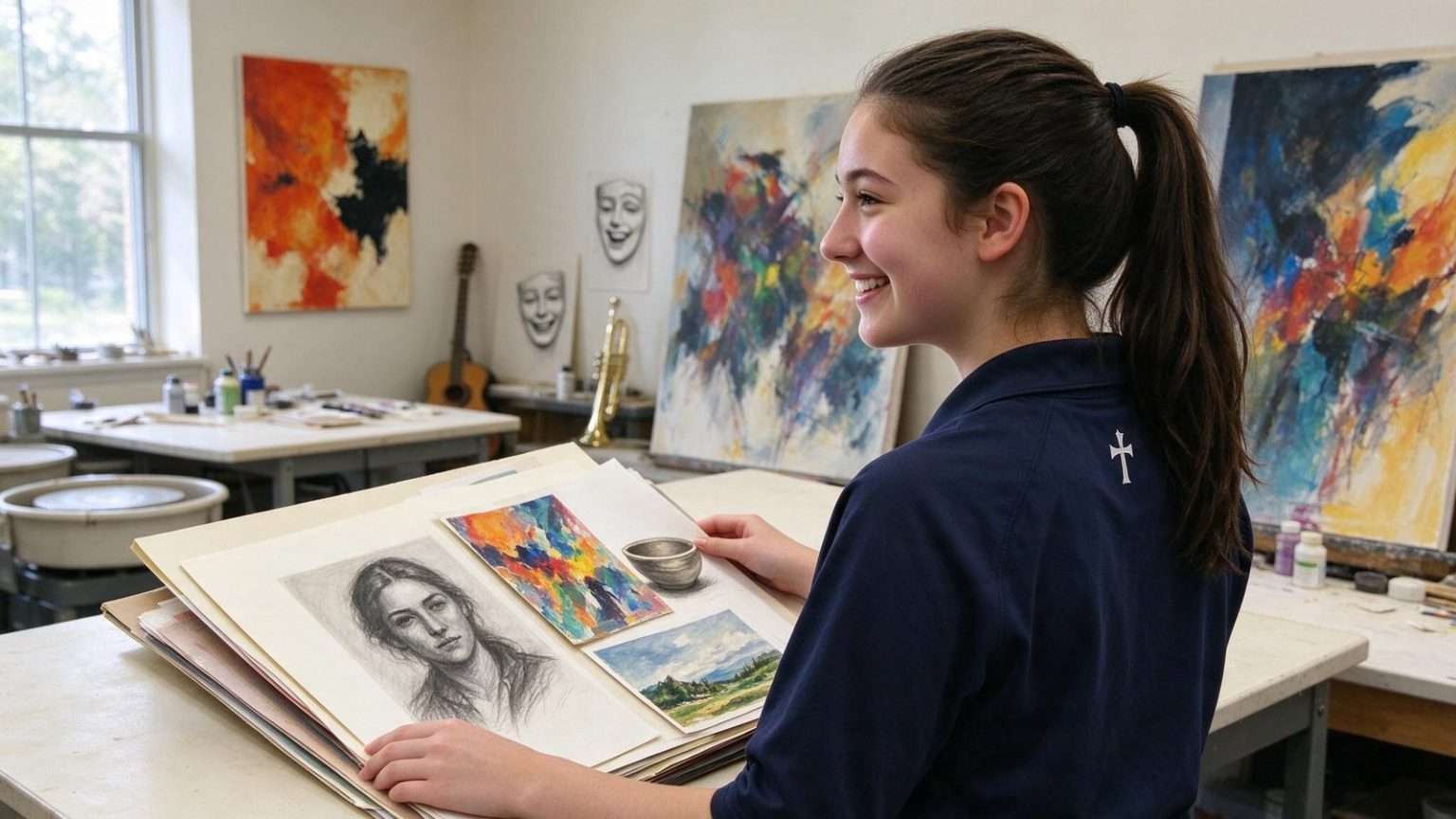
A student from St. Paul’s Episcopal School in Mobile has been selected for the inaugural statewide Youth Arts Collective, a new initiative that brings together young artists from across Alabama.
The selection places the Mobile student among a first-of-its-kind group of students chosen to represent their schools and regions in the collective, which is designed to give young artists a platform to develop their work, collaborate with peers across the state, and engage with Alabama’s broader arts community.
Arts education in the spotlight
Youth arts collectives of this kind typically connect participating students with mentors, workshops and exhibition or performance opportunities, helping students build portfolios and experience that can support future study and careers in the arts.
For St. Paul’s Episcopal School, a private school serving the Mobile area, the selection adds to a growing list of recognitions for its fine arts programs, which include visual arts, band, choir and theater offerings for students from lower school through high school.
Arts advocates across Alabama have pushed in recent years for greater investment in arts education, noting that participation in the arts is linked to stronger academic engagement and creative problem-solving skills. The launch of a statewide collective signals a renewed focus on elevating student voices in the state’s cultural life.
What comes next
Details about the collective’s first-year programming, including meeting schedules, showcases and exhibition plans, have not yet been fully announced. Participating students are expected to take part in collaborative projects and events that highlight work from communities across Alabama, from the Gulf Coast to North Alabama.
The St. Paul’s Episcopal community is expected to recognize the student’s selection as the inaugural cohort begins its work, and the school’s arts programs will be watching as the first statewide group of its kind takes shape.
Additional details about the student and the collective’s inaugural activities were not available at publication time. This story will be updated as more information becomes available.
How Statewide Youth Arts Collectives Typically Work
Programs organized around the “collective” model generally follow a similar structure regardless of the state or discipline involved: a cohort of students is selected through nomination or application, often with an eye toward representing different regions, school types and artistic disciplines, and then brought together over the course of a school year for workshops, mentorship sessions and at least one culminating showcase or exhibition. The goal is usually twofold — to give participating students direct exposure to working artists, curators or performers who can speak to what a career or continued study in the arts actually looks like, and to create a statewide network of young artists who might not otherwise cross paths, since students from a small-town public school and a private school in a metro area rarely share a classroom or studio.
For an inaugural cohort, much of the first year typically involves establishing the program’s format: settling on meeting cadence, choosing venues for workshops and showcases, and building the kind of institutional relationships with sponsoring arts organizations that later cohorts can rely on as a matter of course. That start-up period is one reason organizers of new collectives, in Alabama and elsewhere, often hold back detailed programming announcements until participating students and mentors have been confirmed and initial planning sessions have taken place.
The Alabama State Council on the Arts
Alabama’s primary state arts agency, the Alabama State Council on the Arts, has long played a central role in funding and coordinating arts programming across the state, distributing grants to schools, community arts organizations and individual artists, and administering the state’s partnership with the National Endowment for the Arts. The council’s mission includes expanding access to arts education, particularly for students in communities where school arts programs may be under-resourced, and it frequently partners with school systems, private schools and community arts councils to bring specialized programming — visiting-artist residencies, youth ensembles, statewide student showcases — to students who would not otherwise have access to them. A new statewide youth arts collective fits squarely within that broader mission of using centralized coordination to widen access to arts opportunities beyond what any single school district could offer on its own.
Why States Invest in Youth Arts Initiatives
Alabama is not alone in building statewide infrastructure specifically for young artists. Many states operate some version of a Governor’s School or summer arts academy that brings together top student artists, musicians and writers for intensive residential programs, while others have created honor ensembles, juried statewide exhibitions or recognition programs modeled on academic honor societies but focused on the arts. Alabama itself is home to the Alabama School of Fine Arts, a specialized public high school in Birmingham that draws students from across the state for intensive training in visual art, music, theater, dance, creative writing and math and science. A new, broader youth arts collective open to students statewide — rather than limited to those who relocate to attend a single specialized school — reflects a common next step states take once they have an anchor institution like ASFA: building lighter-weight programs that can reach talented students who remain enrolled in their home schools.
What the Research Says About Arts Education
Education researchers have documented a range of benefits associated with sustained participation in the arts, and those findings have increasingly shaped how school leaders and state arts agencies talk about the value of programs like a youth arts collective. Students involved in music, visual art, theater and dance programs are frequently found to show stronger engagement in school overall, better attendance, and gains in skills — pattern recognition, sustained focus, collaborative problem-solving — that carry over into other academic subjects. Arts advocates also point to the role creative disciplines play in building the kind of portfolio and presentation skills that matter well beyond the arts themselves, from public speaking to project management, making the case that arts investment pays dividends even for students who do not go on to pursue the arts professionally.
That research base is part of why arts advocacy groups in Alabama and nationally have pushed in recent years for more state-level investment in arts education, arguing that access to quality arts instruction should not depend entirely on which school district or which individual school a student happens to attend.
Fine Arts at St. Paul’s Episcopal School
St. Paul’s Episcopal School is one of the Mobile area’s longtime independent schools, serving students from the early grades through high school with a college-preparatory curriculum alongside a broad extracurricular program. Its fine arts offerings span visual art, instrumental and choral music, and theater, giving students multiple paths to develop as artists well before they might be considered for a selective statewide program. Independent schools with well-resourced arts departments, like St. Paul’s, are often positioned to produce standout candidates for competitive statewide or national arts recognitions, since students there typically have access to dedicated studio space, instructors trained in specific disciplines, and regular opportunities to perform or exhibit that build the kind of body of work a selection committee looks for.
What Recognition Like This Can Mean for a Student
For an individual student, selection to a first-of-its-kind statewide program carries benefits that extend well beyond a single school year. Participation typically strengthens a student’s portfolio or audition materials for college admissions and scholarship applications, particularly at arts-focused colleges and university fine arts programs that weigh demonstrated achievement and outside recognition alongside grades and test scores. It also offers early exposure to the kind of professional arts network — mentors, fellow young artists, sponsoring organizations — that can shape a student’s decisions about whether and how to pursue further study in the arts. Being part of an inaugural cohort carries its own distinction as well: the first group selected for a new statewide program often becomes closely associated with establishing its identity and reputation for the cohorts that follow.
Looking Ahead for Alabama’s Youth Arts Landscape
As the collective’s inaugural year unfolds, more details are expected about its full roster, its programming calendar and how organizers plan to showcase participating students’ work to the public. Programs of this kind often grow in scope and visibility after a successful first year, adding regional workshops, additional showcase opportunities or expanded partnerships with arts organizations, museums and performance venues across the state. For now, the selection of a St. Paul’s Episcopal student places Mobile among the communities represented in the collective’s founding class, a distinction the school and its arts programs are likely to highlight as the broader initiative takes shape over the coming year.
Mobile’s Broader Arts Community
Mobile has a long-standing cultural identity that extends well beyond its historical and culinary reputation, anchored by institutions such as the Mobile Symphony Orchestra, the Mobile Museum of Art and a network of community theaters and galleries that give young artists in the region places to perform and exhibit outside the classroom. Local schools, both public and independent, frequently partner with these institutions for masterclasses, gallery showings and joint performances, giving Mobile-area students exposure to working professional artists well before they might compete for a statewide honor. That existing infrastructure — a metro area with an active symphony, a full-service art museum and an established community theater scene — is often cited by arts educators as one reason Mobile-area students have historically performed well in statewide and regional arts competitions, since students there can supplement school-based instruction with community opportunities not available everywhere in Alabama.
A statewide collective drawing its inaugural cohort from across Alabama’s regions, including the Gulf Coast, gives organizers a chance to showcase exactly that kind of regional diversity, pairing Mobile’s coastal arts scene with the traditions and institutions of North Alabama, the Black Belt and other parts of the state in a single collaborative program.