SS United States Will Leave Mobile in November for Its Final Voyage to a Gulf Reef Site
Okaloosa County says the SS United States, docked in Mobile since March 2025, is scheduled to be deployed as an artificial reef in the Gulf during the second week of November, weather permitting.
Update, Nov. 2: Added details on the ship’s planned resting depth, its proposed location and Alabama’s artificial reef history below.
Update, Oct. 26: Dates are now set. The SS United States is scheduled to leave Mobile on Monday, Nov. 9, and will be sunk during a deployment ceremony at 10 a.m. Thursday, Nov. 12, about 22 nautical miles southwest of Destin-Fort Walton Beach. Okaloosa County will hold a public sendoff on Veterans Day, Nov. 11. Details are below.
Latest developments: Departure Nov. 9, deployment Nov. 12
The 990-foot ocean liner will depart Mobile on Nov. 9, ending a stay of about one year and eight months in the Port City. Willie Jones of Perdido Queen Dinner Cruises said the departure is expected around 10 a.m. that Monday, and the Perdido Queen plans to trail the ship as it leaves.
The final deployment, when the ship is sent to the Gulf floor to become the world’s largest artificial reef, will take place during a ceremony at 10 a.m. Nov. 12. Virtual and in-person viewing events are being planned for that day.
How to watch
- Sendoff celebration: Okaloosa County will host a public celebration of the ship’s history at 1:30 p.m. Wednesday, Nov. 11, Veterans Day, at the Destin-Fort Walton Beach Convention Center in Fort Walton Beach, Florida.
- Virtual viewing: A viewing link for the Nov. 12 deployment will be posted online before the event.
- Watch party: A live viewing party will be held at AJ’s Seafood and Oyster Bar in Destin beginning at 9 a.m. Nov. 12, with a live feed from the deployment site shown on a large outdoor screen.
Okaloosa County Board Chairman Trey Goodwin said this will be a historic day for Destin-Fort Walton Beach and for a ship with such a historic story. He said her story will continue to be told by thousands of people who visit her in tandem with the SS United States Conservancy’s land-based museum.
Visitors came from around the world
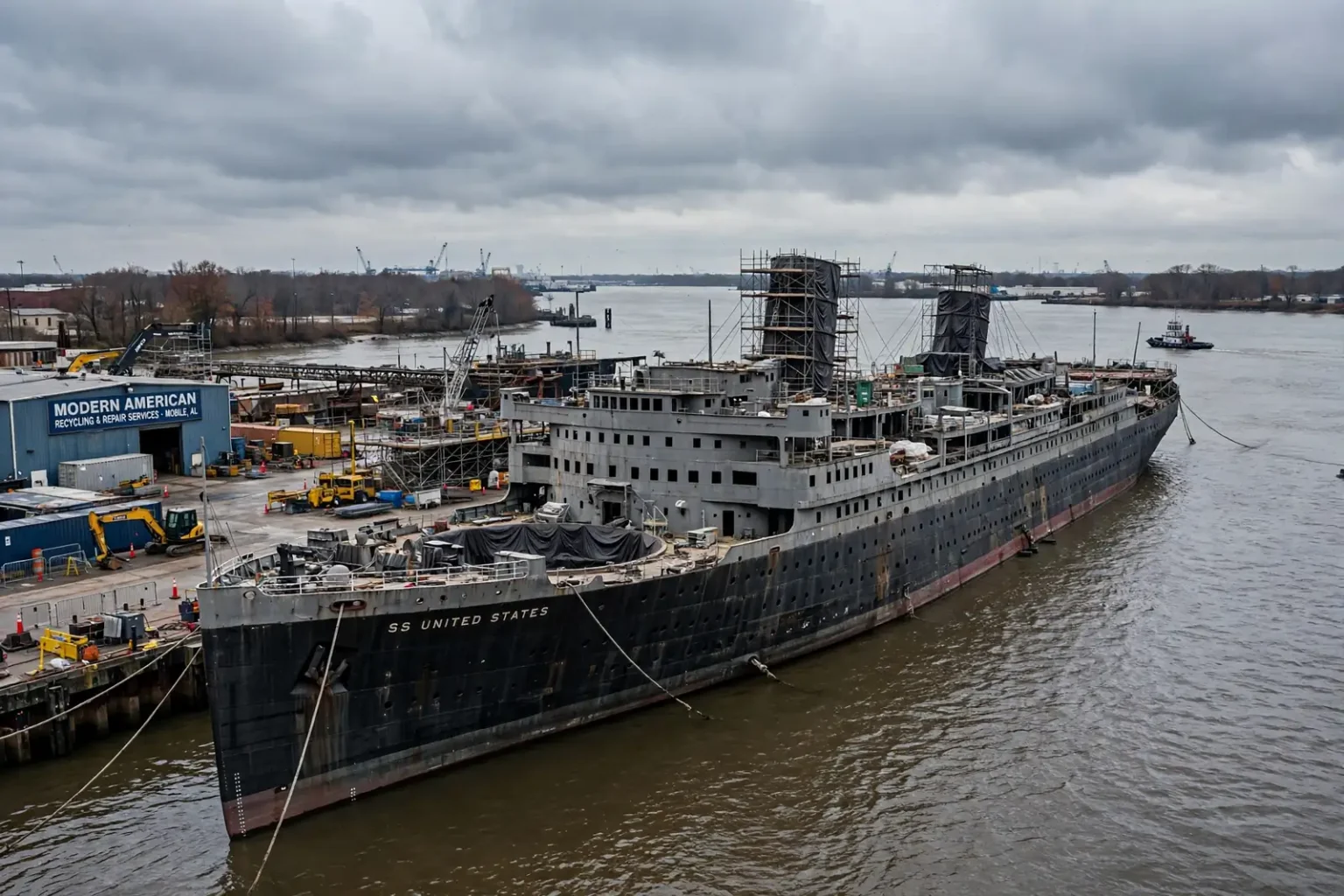
The ship, long known as “America’s flagship,” has drawn visitors throughout its stay at Modern American Recycling & Repair Services south of downtown Mobile, and cruise operators such as the Perdido Queen have offered trips past the ship.
Jones said it’s shocking how many people have flown in and taken the tour at 1 p.m. and then flown back to Boston, Detroit, or California. He said the commitment people have had is remarkable; they flew from New Zealand just to see the ship.
Smokestacks saved for the museum
Remediation work in Mobile included removing about 120 fuel tanks, all of the ship’s windows and large amounts of paint and other materials. The ship’s two iconic smokestacks, each about 65 feet tall and once among the largest ever installed on a passenger ship, were removed and will be preserved as centerpiece artifacts for the planned land-based museum in the Destin-Fort Walton Beach area. The museum’s location has not been finalized. Thinc Design, whose projects include the National September 11 Memorial Museum and the Empire State Building Observatory, is helping develop the museum and visitor center.
Built in 1951, the SS United States is the largest ocean liner built entirely in the United States and still holds the trans-Atlantic speed record for a passenger liner, set on its 1952 maiden voyage when it crossed in three days, 10 hours and 40 minutes at an average of more than 35 knots. Its passengers over the years included Walt Disney, Marilyn Monroe, Marlon Brando, Bob Hope, Judy Garland and John Wayne.
The earlier report follows.
After more than a year and a half in Mobile, the SS United States is about to make its last trip. Okaloosa County, Fla., officials announced that the historic ocean liner, which sailed from 1951 to 1969, is scheduled to leave Mobile in November and head into the Gulf, where it will be sunk to become what the county calls the World’s Largest Artificial Reef.
Nick Tomecek, a spokesperson for Okaloosa County, said the 990-foot ship is expected to be deployed during the second week of November, about 22 nautical miles southwest of Destin-Fort Walton Beach. The schedule depends on the weather and could change.
Update, Oct. 22: With the ship now days from leaving Mobile, the marine contractor hired to sink it says the tow to the reef site should take about a day, followed by a couple of days of preparation before the liner is sent to the bottom. An exact date still has not been announced. Capt. Tim Mullane of Coleen Marine said he expects to be the last person to step off the hull, and that the ship should settle on the Gulf floor roughly 45 minutes later. Details are below.
The announcement came in a press release Friday evening, Oct. 9, as Hurricane Isaias made landfall near Destin as a Category 2 storm with maximum sustained winds of 105 mph.
A milestone after months of preparation
The news marks a major step for a project that has kept the ship docked in Mobile since early 2025. Okaloosa County officials had been waiting on final approvals from the U.S. Army Corps of Engineers and the Environmental Protection Agency before moving ahead with the deployment.
Tomecek said the Okaloosa County Board of County Commissioners is working with safety and security partners for a safe and efficient deployment. He said this is an exciting move forward to create a one-of-a-kind resource for the environment and tourism industry.
County officials said additional details about the deployment are expected in the coming weeks.
Why the announcement came during a hurricane
The timing of the release raised eyebrows, arriving as Northwest Florida’s Emerald Coast was bracing for Hurricane Isaias. Tomecek said the overlap was purely coincidental.
He said they promised the public they would announce plans for the ship 30 days before deployment, so this day was always the plan to send it out; it just so happens they got blasted by a storm at the same time.
The deployment at a glance
- Ship: SS United States, a 990-foot ocean liner built in 1951.
- Current location: Modern American Recycling and Repair Services in Mobile, where it has been docked since March 3, 2025.
- Planned deployment: Second week of November 2026, weather permitting.
- Reef site: About 22 nautical miles southwest of Destin-Fort Walton Beach, roughly 22 miles south of the Okaloosa Pass toward Pensacola.
- Owner: Okaloosa County, Fla., which bought the ship for $1 million and spent about $10 million moving it from the East Coast.
- Federal approvals: The county had been awaiting final sign-off from the U.S. Army Corps of Engineers and the EPA.
Nineteen months on the Mobile River
The SS United States arrived in Mobile Bay on Lundi Gras, March 3, 2025, and has remained at Modern American Recycling and Repair Services ever since. The ship’s towering profile quickly became a familiar sight for people traveling along the Mobile River.
During its stay, crews carried out extensive work to prepare the vessel for its new life beneath the Gulf. Ships headed for artificial reef programs must be cleaned of fuel, oils and other materials that could harm marine life before they can be sunk, and the SS United States was no exception. The remediation work in Mobile included:
- Removing approximately 120 fuel tanks.
- Removing all of the ship’s windows.
- Stripping large amounts of paint and other materials.
- Removing the ship’s two iconic smokestacks.
The smokestacks were among the most dramatic changes. Each stood about 65 feet tall, the equivalent of roughly six stories, and they were once among the largest ever installed on a passenger ship. Their red, white and blue paint scheme made them the most recognizable feature of the liner for generations of travelers.
An unexpected tourist attraction in Mobile
The liner became an unplanned draw for visitors during its time in Mobile. Harbor cruises aboard the Perdido Queen and excursions operated through Blakeley State Park frequently sold out during the spring and summer of 2025 as people lined up for a close-up look at the historic ship.
For many Gulf Coast residents, the chance to see the SS United States up close was a once-in-a-lifetime opportunity, and its time in Mobile offered one of the last chances to see it above water before its final voyage.
Smokestacks headed for a museum
Both smokestacks will be preserved as centerpiece artifacts for a future land-based museum dedicated to the ship’s history. The museum’s location has not been finalized, but county officials said it will be somewhere in the Destin-Fort Walton Beach area.
Thinc Design, whose projects include the National September 11 Memorial Museum and the Empire State Building Observatory, is helping develop the museum and visitor center. The plan pairs an underwater attraction for divers with a land-based experience for visitors who never go beneath the surface, giving the ship’s story a home on shore as well as on the seafloor.
Why Okaloosa County wants a sunken ocean liner
Okaloosa County purchased the ship for $1 million and spent roughly $10 million transporting it from the East Coast to the Gulf. County leaders see the investment as a long-term boost for both the environment and the local tourism economy.
Artificial reefs are a well-established tool along the Gulf Coast. Sunken ships, concrete structures and other materials give corals, sponges and other marine growth a hard surface to attach to, which in turn attracts baitfish and the larger fish that feed on them. Over time, a large wreck can become a thriving habitat that draws recreational divers and anglers.
Northwest Florida already has experience with large artificial reefs. The aircraft carrier Oriskany was sunk off Pensacola in 2006 and has become one of the region’s best-known dive sites. At 990 feet, the SS United States would be an even larger structure on the Gulf floor.
For the Destin-Fort Walton Beach area, which depends heavily on tourism, the reef is meant to add a signature attraction that could bring divers, charter fishing customers and history enthusiasts to the area year-round.
America’s fastest ocean liner
The SS United States remains one of the most famous ships ever built in America. Constructed in 1951, it is the largest ocean liner built entirely in the United States, and it still holds the trans-Atlantic speed record for a passenger liner.
On its maiden voyage in 1952, the ship crossed the Atlantic in 3 days, 10 hours and 40 minutes, averaging more than 35 knots. That speed earned it the Blue Riband, the informal honor long awarded to the fastest passenger ship crossing the Atlantic.
Over the years, the liner carried a long list of famous passengers, including:
- Walt Disney
- Marilyn Monroe
- Marlon Brando
- Bob Hope
- Judy Garland
- John Wayne
The ship was retired from passenger service in 1969, as jet travel replaced ocean liners as the main way to cross the Atlantic. It spent the following decades out of service, much of that time docked in Philadelphia, as a series of owners and preservation groups searched for a new purpose for it. Okaloosa County’s purchase gave the vessel a final mission as a reef and diving destination.
Final days afloat: the man who will send her down
On Wednesday, Oct. 21, Visit Mobile and the crew of the Perdido Queen riverboat took visitors out on the river for a look at the liner in its last days afloat. Among the guests was Capt. Tim Mullane, whose company, Coleen Marine, will move the ship from the Mobile waterfront to the spot above its final resting place, about 22 nautical miles southwest of Destin, and then sink it.
Mullane said he expects the move itself to take about a day, with a couple of days of preparation once the ship is in position. If things go as he envisions, he will be the last man to step off the hull, and about 45 minutes later the SS United States will come to rest on the bottom.
He spoke of the ship with evident respect.
Mullane said you have to remember this ship is a storied vessel, with its history as the fastest passenger liner ever built, so they’re putting her to rest.
He said ships are born, live their life, and then go to die; most sadly go to scrapyards, but this ship is being prepared for deployment as beneficial marine habitat.
Mullane said the upper areas divers can reach have been specially prepared and the vessel extensively cleaned. Crews tried to keep the ship’s look and structure intact, avoiding major alterations other than removing the funnels, which he described as basically priceless pieces of art that belong in the planned museum.
He said invertebrates need a hard surface to grow on, and deploying the ship as a reef creates a whole new community, a city for sea life. He said divers are a big portion of this, but also just creating the habitat.
Coleen Marine specializes in this kind of work. Mullane, a Navy veteran who co-founded the company with his wife, Coleen O’Malley, estimated he has had a hand in about 160 ship sinkings. He said he never expects to handle one as large as the 990-foot United States again.
He said there will never be a ship this big made into an artificial reef; modern ships aren’t built to this degree, aircraft carriers are nuclear and will be scrapped, so this will probably be the last thousand-foot, 990-foot ship this big to be sunk as an artificial reef.
The preparation work in Mobile wrapped up in the spring, but permitting delays pushed back the ship’s departure until now.
30,000 riders and a lot of emotion
Willie Jones, who owns the Perdido Queen with his wife, Anna Jones, and is one of its captains, said the liner has been a boon for the riverboat.
He said in the almost two years it’s been there, they’ve carried north of 30,000 people to see it.
He said passengers have reacted with a range of emotions; some marvel at the size, calling it their own little Titanic, while others have a personal connection.
Jones said many people who came to see it traveled on it; many arrived in America on the ship to start new lives. He said one lady even wanted to read a poem to the ship.
The tours have also introduced many visitors to Mobile’s working waterfront, including the naval ships across the river, the container terminal and the coal terminal.
Jones said it’s shocking how many people say they didn’t even know Mobile was on the water; it’s a strange phenomenon, but it’s real that people don’t think of Mobile as an on-the-water city, but it very much is.
Anna Jones said the riverboat knew right away how much interest the ship would generate. The Perdido Queen had been part of Mardi Gras festivities and happened to be on the water on Lundi Gras 2025 when the liner was towed into port.
She said they have video footage of it coming in, and they immediately knew the impact because the footage reached over 100,000 views; they thought, oh gosh, this is huge.
Next up on the river: the former USS Enterprise
The liner’s departure may not leave the riverboat short on sightseeing material for long. The Navy has contracted to have the decommissioned aircraft carrier ex-USS Enterprise, the world’s first nuclear-powered aircraft carrier, dismantled in Mobile. In July 2026, Naval Sea Systems Command announced a roughly $418.5 million contract with NorthStar Maritime Dismantlement Services for the work, which is expected to be completed by September 2030. No arrival date for the carrier has been announced.
Anna Jones said they haven’t stopped SS United States tours and are going straight into Enterprise tours.
What the departure means for Mobile
The ship’s departure will close a memorable chapter on Mobile’s waterfront. The project brought work to Modern American Recycling and Repair Services and gave the city’s harbor tours and Blakeley State Park excursions a rare attraction. Once the SS United States leaves, the stretch of river where it has sat since Lundi Gras 2025 will look noticeably different.
Okaloosa County officials have not yet released details on how the ship will be moved from Mobile to the reef site or exactly when it will leave the city. Those details are expected in the coming weeks, along with any viewing information for people who hope to see it one last time.
A spring departure that slipped
November is not the timeline Okaloosa County originally had in mind. The ship had been expected to leave Mobile in May, but its departure was pushed back while several federal regulatory agencies reviewed the project.
Even with Friday’s announcement, the county has not set a precise date for the sinking. The county said in its statement that it is working with its safety and security partners on the deployment.
Environmental concerns and the county’s response
The project has also drawn criticism. In a February social media post, environmental activist Erin Brockovich alleged that the ship could contaminate the Gulf with hexavalent chromium if the cancer-causing chemical is not properly removed from the vessel’s surfaces. Brockovich became widely known for her role in a 1993 lawsuit over hexavalent chromium contamination of groundwater in Hinkley, Calif., a case later dramatized in the 2000 film “Erin Brockovich.”
Okaloosa County has maintained that the ship has been thoroughly cleaned and that every safety protocol has been followed in preparing it for sinking. Federal rules for ships used as artificial reefs require that fuels, oils and other potential pollutants be removed before a vessel can be scuttled, and the county had been waiting on sign-off from the U.S. Army Corps of Engineers and the EPA before announcing its plans.
What comes next
The deployment remains weather-dependent, and the timeline could change. The announcement came as Hurricane Isaias was hitting the region, and conditions in the Gulf will play a major role in when the ship can safely be towed and sunk.
Residents who want one more look at the liner should keep an eye out for announcements from Okaloosa County and local tour operators about the final weeks of the ship’s stay in Mobile.
Update: County won’t confirm departure timing, citing security
Okaloosa County’s Monday statement set the sinking for Thursday, Nov. 12, weather permitting, but the county is declining to confirm when the ship will be towed out of Mobile. County spokesman Nick Tomecek said the timing and route are being withheld for safety and security reasons.
Tomecek wrote that it will leave days in advance, and due to safety and security of the towing and deployment, they are not releasing all details of timing and route to the deployment site.
The Nov. 9 departure date reported above came from a local tour operator; the county itself has not publicly confirmed it.
Where the ship will rest
The 990-foot vessel, which broke the transatlantic speed record on its 1952 maiden voyage, is expected to rest in roughly 180 feet of water, with its upper decks about 55 to 60 feet below the surface, a depth meant to accommodate both recreational and technical divers. Okaloosa County lists the proposed deployment location as 30° 07.148′ N, 86° 46.755′ W. County officials said the project was fully funded by tourism revenue and partner contributions, and that it could draw hundreds of vessels. Boaters should follow directions from safety boats and Coast Guard personnel at the site.
A long history of Gulf reefs
The ship will join a region with deep experience in artificial reefs. Alabama, home to one of the world’s largest programs, began placing structures offshore in 1953, when 250 car bodies were deployed off Baldwin County. Because the natural seabed off Alabama is mostly sand and mud, materials such as culverts, bridge rubble, barges, retired M-60 tanks and even a sunken casino boat have been used to create habitat. As they are colonized by sponges, corals and other organisms, these structures provide food and shelter for species such as red snapper, grouper and amberjack, supporting charter fishing and diving along the coast.
Related coverage from South AL News
- Storied SS United States Docks in Mobile as Crews Prepare Historic Liner for New Life as Artificial Reef
- Mobile Bay's 3D-Printed Reef Project Expands After Successful Pilot
- Where to Get Free Sand on the Gulf Coast as Hurricane Isaias Approaches
- Two-Thirds of the Argosy VI's Roof Has Collapsed, and Tropical Storm Bertha Is the Likely Cause
Update, Oct. 30: Coast Guard sets Nov. 9 departure and a 100-yard safety zone
The U.S. Coast Guard has now put the Nov. 9 departure date in writing. A Marine Safety Information Bulletin posted Thursday, Oct. 29, by Coast Guard Station Panama City lists Monday, Nov. 9, as the anticipated date the SS United States will leave Mobile, subject to weather conditions or unforeseen delays. Okaloosa County officials had declined to confirm the tow date, citing security concerns.
According to the bulletin, the Coast Guard will enforce a 100-yard moving safety zone around the liner and every vessel officially involved in the dead-ship tow into the Gulf. The zone takes effect when the ship leaves Pier 4 at Modern American Recycling Services of Alabama on the Mobile River, where it has been docked since March 2025. Any updated enforcement dates will be issued through another Marine Safety Information Bulletin.
Boaters hoping for a last look should keep their distance. A violation of the 100-yard safety zone can bring a fine of up to $117,608, according to the Coast Guard.
The bulletin also asks that, once the ship reaches the sinking location, vessels not taking part in the operation stay at least one nautical mile away until the sinking is complete. The deployment is scheduled for Thursday, Nov. 12, about 22 nautical miles off Destin-Fort Walton Beach.