Two Theodore-Built Vessels Join ALEA Marine Patrol Fleet for Mobile Bay and Gulf Duty
Silver Ships of Theodore has delivered two new patrol vessels to the Alabama Law Enforcement Agency's Marine Patrol Division for patrol, enforcement and search and rescue on the Gulf Coast.
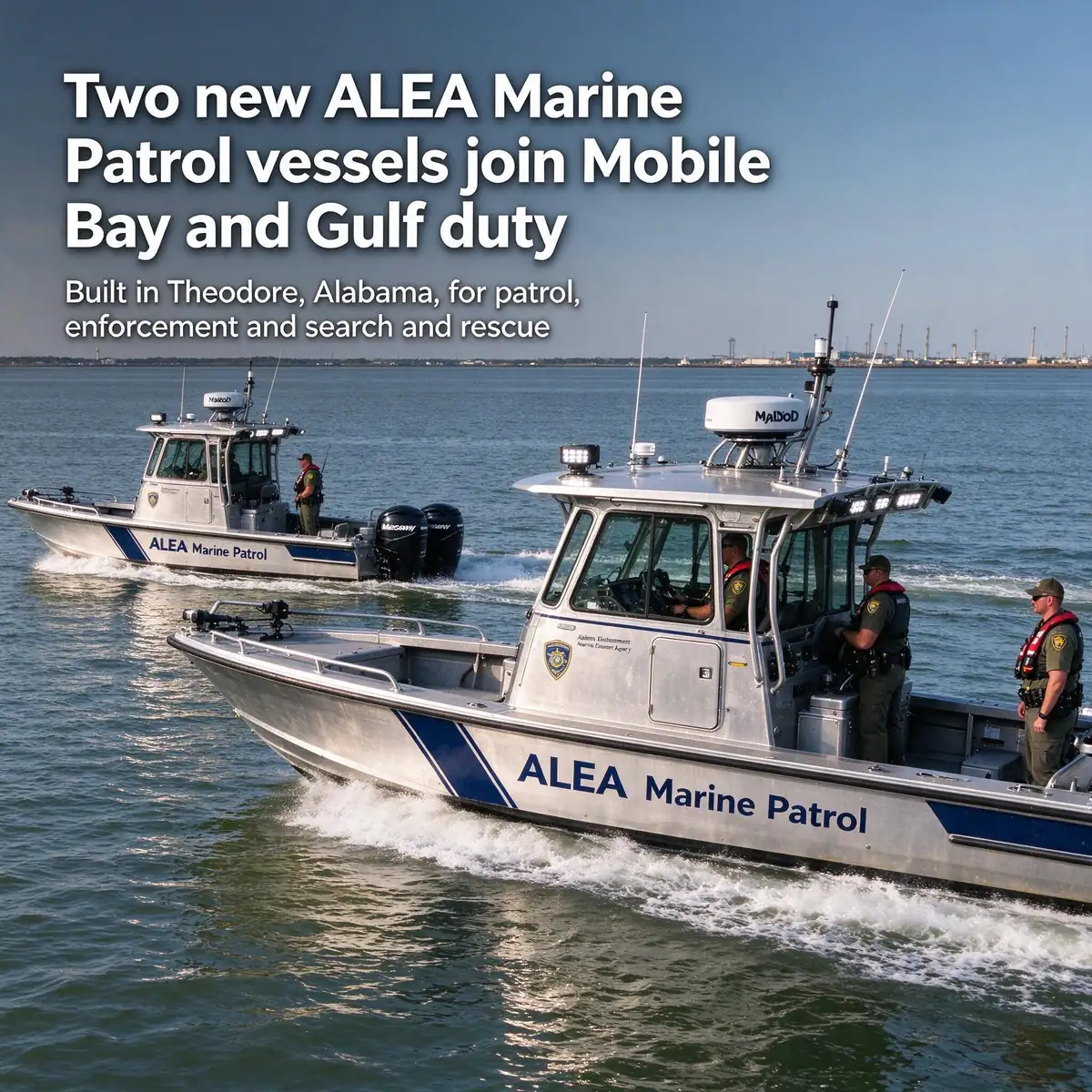
MOBILE, Ala. — The ALEA Marine Patrol has two new vessels for its work on Mobile Bay and the Gulf, built a short drive from where they will be stationed. Silver Ships, a boat builder based in Theodore, has delivered the pair to the Alabama Law Enforcement Agency’s Marine Patrol Division, and the boats are expected to enter service soon.
State troopers based in Mobile will operate both vessels. Their assignments will include routine patrol, law enforcement on the water, and search and rescue missions along Alabama’s Gulf Coast.
The Delivery at a Glance
- Builder: Silver Ships, Theodore, Alabama
- Customer: Alabama Law Enforcement Agency, Marine Patrol Division
- Number of vessels: Two
- Home base: Operated by troopers in Mobile
- Missions: Patrol, enforcement and search and rescue on the Gulf Coast
- Construction: All-welded aluminum
- Key equipment: Enclosed center console, Simrad HALO dome radar, DuraBrite LED floodlights and twin Mercury Verado outboard engines
Built for Night Work and Fast Response
Each of the new boats shares the same core layout and equipment package, and each piece was chosen with the demands of coastal law enforcement and rescue in mind. The builder said the outfitting is intended to give crews strong situational awareness, the ability to work at night and the speed to respond quickly to search and rescue calls on the Gulf Coast.
Enclosed center console
An enclosed center console places the helm inside a protective cabin in the middle of the boat. For troopers who may be on the water for long shifts in summer heat, winter wind or sudden rain, the enclosure offers shelter for the crew and protection for electronics, while the center position still allows movement around the deck for boarding, towing or pulling someone from the water.
Dome radar
The boats carry Simrad HALO dome radar. Marine radar lets a crew detect other vessels, shorelines, channel markers and other objects in darkness, fog or heavy rain, when visibility from the helm is limited. That capability is especially useful on busy waterways where commercial ships, fishing boats and recreational traffic share the same channels.
LED floodlights
DuraBrite LED floodlights give crews bright, focused light for nighttime searches, inspections and boardings. In a rescue, powerful lighting can be the difference in spotting a person in the water or a disabled boat after dark.
Twin outboards
Power comes from twin Mercury Verado outboard engines. A two-engine setup gives a patrol boat added speed and acceleration when a call comes in, and it also provides a measure of redundancy, since a vessel with two motors can often keep moving if one has a problem.
Welded aluminum hulls
The vessels use an all-welded aluminum design. Welded aluminum is widely used for patrol, fire and rescue boats because it combines strength with relatively light weight, and it holds up well to the bumps and wear that come with working alongside other vessels and docks.
A District That Covers Bay, River and Gulf
The new boats will serve the Marine Patrol Division’s Southern District, which covers eight counties in southwest Alabama and operates from an office in Orange Beach in Baldwin County. Within that district are three of the state’s most important bodies of water: Mobile Bay, the Mobile River and the Gulf of Mexico.
Each presents its own challenges. Mobile Bay is a broad, relatively shallow estuary where weather can change conditions quickly, and it is a heavily used area for fishing, sailing and pleasure boating. The Mobile River, formed north of the city where the Alabama and Tombigbee rivers come together, flows past downtown Mobile and the Port of Mobile, one of the busiest seaports on the Gulf, carrying large ocean-going vessels alongside smaller craft. Offshore, the Gulf draws charter fishing boats, recreational anglers and commercial traffic from the Alabama coast.
Stationing the boats with troopers in Mobile places them close to the upper bay, the river and the port area, while the district office in Orange Beach anchors operations on the eastern side of the coast near the Gulf beaches.
Working With the Coast Guard
ALEA does not patrol coastal waters alone. ALEA operates under a formal memorandum of agreement with the U.S. Coast Guard that covers search and rescue and other functions in waters where the two share jurisdiction. Agreements like this help federal and state crews coordinate responses, avoid duplicated effort and get help to people in trouble as quickly as possible.
For boaters, the practical result is that a call for help on coastal Alabama waters may be answered by a Coast Guard crew, a state trooper vessel or both, depending on the location and nature of the emergency.
What Marine Patrol Troopers Do
The Marine Patrol Division is part of ALEA, the state agency formed to consolidate many of Alabama’s law enforcement functions under one roof. Marine Patrol troopers are responsible for public safety on the state’s waterways, and their work generally includes:
- Enforcing state boating laws, including rules on vessel registration, required safety equipment and safe operation
- Watching for boaters operating under the influence of alcohol or drugs
- Responding to boating accidents and investigating serious incidents
- Conducting search and rescue operations for missing or stranded boaters and swimmers
- Supporting boater safety education across the state
- Providing a law enforcement presence at large on-the-water events and busy holiday weekends
New, well-equipped vessels help troopers carry out those duties over longer distances and in a wider range of weather and lighting conditions.
A Continuing Relationship With a Local Builder
This is not the first time ALEA has turned to the Theodore boat builder. In 2020, Silver Ships delivered seven patrol boats to the agency, including two that were sent to Weiss Lake, a reservoir on the Coosa River in Cherokee County in northeast Alabama.
The latest delivery means the boats protecting the waters of south Mobile County and the surrounding coast were built in the same community. Theodore, an unincorporated area in south Mobile County, sits near the western shore of Mobile Bay, and the region has a long history of shipbuilding and marine industry tied to its access to the bay, rivers and Gulf.
Safety Reminders for Coastal Boaters
The new patrol boats are designed to help when things go wrong, but boaters can do a great deal to avoid needing a rescue in the first place. Common boating safety guidance includes:
- Wear a life jacket. Make sure there is a properly fitting, Coast Guard-approved life jacket for every person on board, and have children wear theirs.
- Check the weather. Conditions on Mobile Bay and the Gulf can change quickly. Review marine forecasts before leaving and keep an eye on the sky.
- File a float plan. Tell someone on shore where you are going, who is with you and when you expect to return.
- Carry communication gear. A marine VHF radio is the standard way to call for help on the water. A charged phone in a waterproof case is a useful backup.
- Stay sober at the helm. Alcohol affects balance, judgment and reaction time, and those effects can be magnified by sun, wind and wave motion.
- Watch for large vessels. In shipping channels and near the port, commercial ships have limited ability to stop or turn. Give them plenty of room.
- Know your equipment. Check required safety gear, such as fire extinguishers, sound signals and navigation lights, before every trip.
Next Steps
With the delivery complete, the two vessels are expected to go into service with the Marine Patrol Division soon. Once operating, they will add to the state’s ability to patrol, enforce boating laws and respond to emergencies on Mobile Bay, the Mobile River and the Gulf of Mexico.