Health & Wellness Baldwin County
Baldwin County Mother of Child With Osteogenesis Imperfecta Offers Thanksgiving Prayer for Supporters
A Baldwin County mother whose daughter has osteogenesis imperfecta type III shared a Thanksgiving prayer for the people who have supported her family and for anyone facing a difficult holiday.
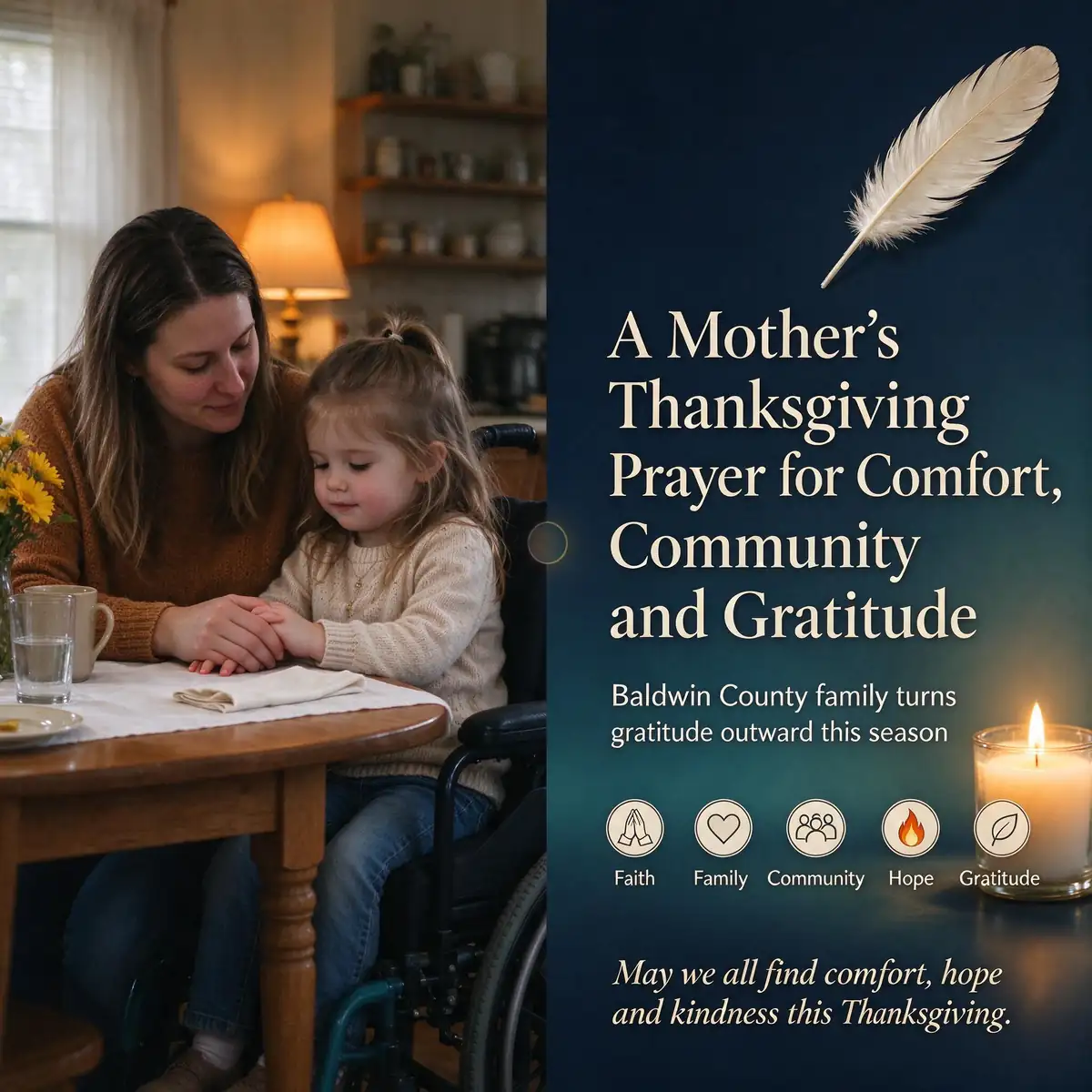
BALDWIN COUNTY, Ala. — A Baldwin County mother whose young daughter lives with osteogenesis imperfecta type III used the Thanksgiving holiday to turn the focus away from her own family and toward the many people who have cheered her child on. In a prayer she shared publicly, the mother asked for comfort and provision for others who may be struggling this season, and she expressed gratitude for the encouragement her family has received from people around the country.
The family’s story has drawn a wide following. The mother has regularly posted updates online as her daughter has undergone surgeries and treatments aimed at helping the child live as full a life as possible with the rare genetic condition. Over time, those updates have connected the family with supporters well beyond south Alabama.
A Holiday Message Turned Outward
The mother said she is thankful for the prayers that have been offered for her daughter, and that this Thanksgiving she wanted to return the gesture by praying for those who have followed the child’s progress. She said she hoped her words would help people who are going through difficult circumstances realize that others care about them and that they do not have to carry their burdens by themselves. She added that she hoped the prayer would bring some comfort to anyone facing a hard stretch in life.
Rather than centering on her daughter’s medical needs, the prayer focused largely on the private struggles that many people bring with them to the holiday table. Its main themes included:
- Grief: those who will notice an empty chair this year because a loved one has died, and who may feel both thankful and sorrowful at the same time
- Loneliness: people spending the holiday alone, those who feel isolated even among others, and those whose family relationships are complicated
- Financial strain: parents worried about how to afford Christmas, as well as households struggling with groceries, housing costs, medical expenses and utility bills
- Illness and caregiving: patients spending the holidays in the hospital, people awaiting test results or living with hidden health battles, and the worn-out caregivers who look after them
- Spiritual struggle: those who feel angry, hurt or distant from God, with an invitation to approach faith honestly and without pretense
- Gratitude: thanks for the people who have supported her family and shared their own stories with her, along with a hope that their kindness would be returned to them
The prayer also encouraged families gathering in happy homes to slow down, savor small moments and watch for people who may need a little extra kindness during the season.
Understanding Osteogenesis Imperfecta
Osteogenesis imperfecta, often called OI or brittle bone disease, is a genetic disorder that affects the body’s connective tissue and causes bones to break easily, sometimes with little or no apparent cause. The condition is present from birth and lasts throughout a person’s life.
In most cases, OI results from changes in genes responsible for producing type I collagen, a protein that acts as a kind of framework for bone and is also found in skin, tendons, ligaments, teeth and other tissues. When the body produces too little collagen, or collagen with a faulty structure, bones lack the strength and flexibility they need. The two genes most commonly involved are known as COL1A1 and COL1A2, although researchers have identified a number of other genes linked to less common forms of the disorder.
OI is considered rare. It is estimated to affect roughly 1 in 15,000 to 20,000 births, and medical sources estimate that somewhere in the range of 25,000 to 50,000 people in the United States live with the condition. It occurs in people of all races and ethnic backgrounds and affects boys and girls alike.
The Many Forms of OI
Doctors have traditionally grouped OI into numbered types based on how the condition presents. Type I is the most common and generally the mildest form, with people often experiencing fractures mainly in childhood and having relatively normal height. Type II is the most severe and is frequently fatal around the time of birth. Type IV falls in the moderate range. As genetic understanding has grown, additional types have been described, many of them tied to less common gene changes.
What Sets Type III Apart
Type III is regarded as the most severe form of OI among children who survive the newborn period. It is often described as progressively deforming, meaning bones not only fracture frequently but may also bend and change shape over time. Babies with type III may be born with fractures already present.
Common features of type III can include:
- Very frequent fractures, sometimes numbering in the dozens or more over childhood
- Significantly short stature
- Bowing of the arms and legs and other skeletal deformities
- Curvature of the spine, such as scoliosis
- A barrel-shaped rib cage, which can contribute to breathing difficulties
- A relatively large head and triangular-shaped face
- Fragile or discolored teeth, a condition called dentinogenesis imperfecta
- Loose joints and weak muscles
- A blue, purple or gray tint to the whites of the eyes in some individuals
- Possible hearing loss, which in OI often develops later in life
Many people with type III use mobility aids such as wheelchairs or walkers, though abilities vary widely from person to person. Importantly, OI does not affect intelligence, and many people with even severe forms of the condition attend school, build careers and lead active, fulfilling lives.
How OI Is Treated
There is currently no cure for osteogenesis imperfecta, but a range of treatments can reduce fractures, improve function and support quality of life. Care is typically coordinated by a team that may include orthopedic surgeons, endocrinologists, geneticists, physical and occupational therapists, pulmonologists, dentists and audiologists.
Medication
Bisphosphonates, a class of drugs that slow the breakdown of bone, are widely used in children with moderate to severe OI. Medications such as pamidronate and zoledronic acid are often given intravenously on a periodic schedule. Studies have shown these drugs can increase bone density and may reduce fracture rates and bone pain in many children, although they do not correct the underlying collagen problem. Researchers continue to study other medications that may strengthen bone.
Rodding Surgery
One of the most common surgical treatments for OI is rodding, in which a surgeon places a metal rod inside the long bones of the arms or legs. The rods help straighten bowed bones, support them and reduce the risk of repeated fractures. In growing children, surgeons often use telescoping rods designed to lengthen as the bone grows, which can reduce the number of operations needed over time. Spinal surgery may also be considered for some people with significant scoliosis.
Therapy and Daily Care
Physical therapy and occupational therapy play a central role in OI care. Gentle, carefully supervised exercise can build muscle strength, protect joints and improve mobility, while water-based therapy is often recommended because it allows movement with less stress on the bones. Occupational therapists help families adapt routines, equipment and home environments to support independence.
Families of young children with OI also learn specialized handling techniques. Caregivers are typically taught to support a child’s whole body when lifting and to avoid pulling on arms or legs. Other aspects of care can include good nutrition, adequate calcium and vitamin D under medical guidance, safe and appropriately padded seating, regular dental care and monitoring of hearing and breathing.
Support for Families
Raising a child with a rare and complex medical condition can involve frequent appointments, hospital stays, surgeries and long recoveries, often requiring travel to specialized centers. Many families describe the emotional and financial demands as considerable, and online communities have become an important source of encouragement, practical tips and connection with others who understand the experience.
The Osteogenesis Imperfecta Foundation, a national nonprofit organization based in the United States, is a leading resource for people with OI and their families. The foundation offers educational materials, information about medical care and research, guidance on finding knowledgeable clinicians and opportunities to connect with others in the OI community. Families seeking information about the condition may find it helpful to begin there and to speak with their child’s medical team.
A Season of Gratitude in Baldwin County
For this Baldwin County family, the support that has poured in from across the nation has been a source of strength through medical procedures and recoveries. This Thanksgiving, the mother chose to share that strength with others, offering a prayer that named the hidden burdens many people carry during the holidays and asking that those who have encouraged her family receive the same kind of care in return.
Her message arrived at a time of year when many people are balancing celebration with grief, financial worry, illness or isolation. By focusing her words on those experiences, she reminded the community that a family facing its own serious challenges can still look outward and offer comfort to others.
Anyone in Baldwin County or elsewhere in Alabama who is struggling during the holiday season can reach out to local churches, community organizations or the 211 information and referral line, which connects callers with resources for food, housing, utilities, health care and other needs. People experiencing emotional distress can call or text 988 to reach the 988 Suicide and Crisis Lifeline at any time.