Alabama Weatherization Grants Top $3.8 Million, With Aid Headed to Mobile and Baldwin Homes
Thirteen grants worth more than $3.8 million will pay for energy audits, insulation and air sealing for qualifying low-income households statewide, including in Mobile, Baldwin and surrounding counties.
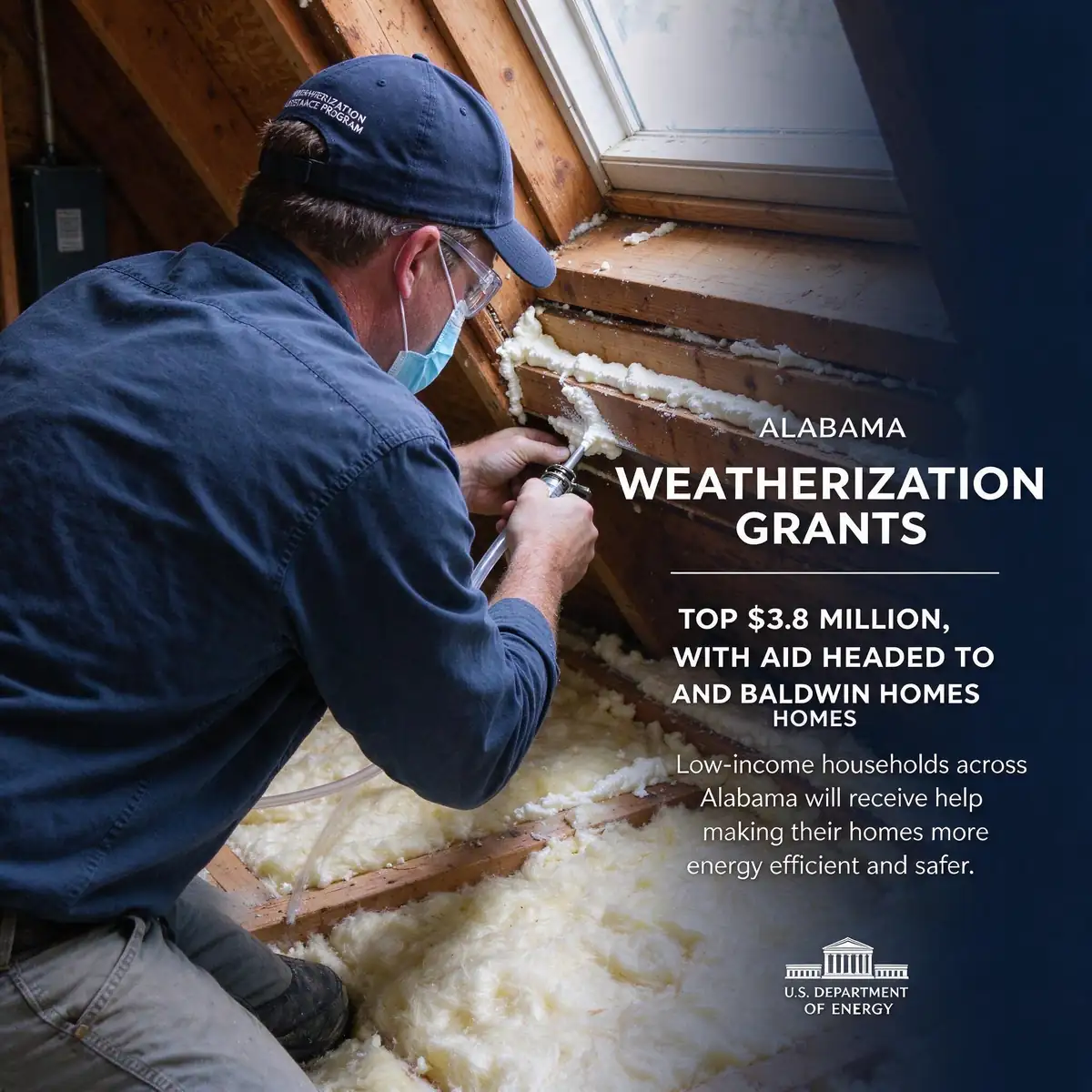
MONTGOMERY, Ala. — Low-income households in Mobile, Baldwin and more than a dozen other south Alabama counties are among those who could see smaller utility bills thanks to a new round of Alabama weatherization grants. Gov. Kay Ivey on Wednesday awarded 13 grants totaling more than $3.8 million to community action agencies and partner organizations that make homes more energy efficient and safer for families who qualify.
The money flows through the Weatherization Assistance Program, a federally funded effort supported by the U.S. Department of Energy. The Alabama Department of Economic and Community Affairs, known as ADECA, is administering the grants. Together, the 13 awards add up to $3,844,785 and cover all 67 Alabama counties through a network of local agencies.
In south Alabama, Mobile Community Action Inc. received $349,812 to serve Choctaw, Mobile and Washington counties, and the Community Action Agency of South Alabama received $250,491 to serve Baldwin, Clarke, Conecuh, Escambia, Marengo, Monroe and Wilcox counties.
Key Facts About the Awards
- Total awarded: $3,844,785 in 13 grants.
- Funding source: U.S. Department of Energy, with grants administered by ADECA.
- Recipients: Community action agencies and other partner organizations across Alabama.
- Purpose: Energy-efficiency and safety improvements to homes selected for help.
- Priority households: Low-income households that include older residents, people with disabilities or children.
- How to apply: Through the local agency serving your county, which sets its own application period.
- Largest award: $900,417 to the Community Action Agency of Northeast Alabama Inc.
- Smallest award: $70,307 to the Community Action Committee Inc. of Chambers-Tallapoosa-Coosa.
Why Energy Costs Hit Some Families Harder
For households living on tight budgets, a high power or gas bill can force painful trade-offs. State officials said low-income families often find themselves deciding between keeping their homes adequately heated or cooled and paying for other necessities such as groceries and medication. The grants, the governor’s office said, will allow those households to make worthwhile upgrades capable of cutting their energy costs considerably.
That concern is especially relevant in Alabama, where long, humid summers keep air conditioners running for months and occasional winter cold snaps drive up heating demand. Older homes, mobile homes and houses with little or no insulation tend to lose cooled or heated air quickly, which means families in those homes often pay more to stay comfortable.
The program gives priority to households with members who are elderly or living with disabilities, along with low-income families raising children. Those groups can be particularly vulnerable to extreme indoor temperatures, which can pose health risks in addition to financial strain.
How Weatherization Works
Weatherization is not a bill-payment program. Instead, it pays for physical improvements meant to lower a home’s energy use over the long term.
Step One: An Energy Audit
Each qualifying home first undergoes an energy audit. During the audit, trained staff examine the house to find where energy is being wasted and to decide which improvements will deliver the most benefit for the money spent.
Step Two: Targeted Improvements
Based on the audit, crews carry out the most effective and efficient measures for that particular house. Examples include adding insulation in the attic and sealing gaps that let air leak in or out around doors and windows. Depending on the home, the work is meant to improve both energy efficiency and safety.
Step Three: Lasting Savings
Because the upgrades are built into the home, the savings continue month after month. An ADECA official said the program reaches some of the most vulnerable people in communities across Alabama and that the agency was glad to join the governor in supporting grants that will make durable improvements helping families lower the cost of heating and cooling their homes.
A Program With Deep Roots
The Weatherization Assistance Program was created by Congress in 1976 and is managed nationally by the Department of Energy, which distributes funding to states. States, in turn, contract with local organizations to deliver the services. In Alabama, ADECA handles that role and channels money to agencies that know their communities.
Many of those local partners are community action agencies, a type of organization that traces its origins to the federal Economic Opportunity Act of 1964 and the War on Poverty. Community action agencies typically operate a range of services for low-income residents, so a family that contacts one about weatherization may also learn about other forms of assistance available in its area.
Weatherization is separate from the Low Income Home Energy Assistance Program, or LIHEAP, a federal program that helps eligible households pay heating and cooling bills. In many Alabama communities, the same local agencies handle both programs, which can make it easier for residents to ask about each at once.
How to Apply
Residents interested in weatherization help should contact the agency that serves their county, listed below, to find out whether they qualify and to submit an application. A few points to keep in mind:
- Timing varies: Each local agency sets its own application period, so dates will differ from county to county.
- Funding may not be available right away: The allocations announced Wednesday may not yet be open for applications at the local level.
- Eligibility is determined locally: Federal rules generally base eligibility on household income, and the local agency will explain which documents, such as proof of income and residence, it needs.
- Renters can ask too: Renters interested in the program should ask the local agency whether services are available for rental housing, since work on a rented home typically requires the property owner’s permission.
- Ask about other help: While on the phone, it can be worthwhile to ask about energy bill assistance or other services the agency offers.
Because demand for weatherization services often exceeds available funding, agencies may keep waiting lists, and applicants are usually served as money becomes available. Calling early and keeping contact information up to date with the agency can help ensure a household does not miss its turn.
Grant Recipients by Region
The awards are grouped below by region, beginning with the agencies serving south Alabama. Find your county in the first column to identify the agency to call. Note that the Central Alabama Regional Planning and Development Commission administers both its own multi-county award and the separate grant for Montgomery County, so both share the same phone number.
South Alabama and the Gulf Coast
| Counties served | Agency | Phone | Grant |
|---|---|---|---|
| Choctaw, Mobile, Washington | Mobile Community Action Inc. | 251-457-5700 | $349,812 |
| Baldwin, Clarke, Conecuh, Escambia, Marengo, Monroe, Wilcox | Community Action Agency of South Alabama | 251-626-2646 | $250,491 |
Southeast Alabama and the Wiregrass
| Counties served | Agency | Phone | Grant |
|---|---|---|---|
| Barbour, Bullock, Butler, Coffee, Covington, Crenshaw, Dale, Geneva, Henry, Houston, Lowndes, Pike | Organized Community Action Program Inc. | 334-566-1712 | $365,857 |
Central and East Alabama
| Counties served | Agency | Phone | Grant |
|---|---|---|---|
| Montgomery | Montgomery County Commission c/o Central Alabama Regional Planning and Development Commission | 334-262-4300 | $199,719 |
| Autauga, Chilton, Dallas, Elmore, Macon, Perry, Russell, Shelby | Central Alabama Regional Planning and Development Commission | 334-262-4300 | $357,388 |
| Lee | Alabama Council on Human Relations Inc. | 334-821-8336 | $157,545 |
| Chambers, Coosa, Tallapoosa | Community Action Committee Inc. of Chambers-Tallapoosa-Coosa | 256-825-4287 | $70,307 |
West Alabama
| Counties served | Agency | Phone | Grant |
|---|---|---|---|
| Bibb, Fayette, Greene, Hale, Lamar, Pickens, Sumter, Tuscaloosa | Community Service Programs of West Alabama Inc. | 205-469-0397 | $307,394 |
North and Northeast Alabama
| Counties served | Agency | Phone | Grant |
|---|---|---|---|
| Blount, Cherokee, DeKalb, Etowah, Jackson, Jefferson, Marshall, St. Clair | Community Action Agency of Northeast Alabama Inc. | 256-638-4430 | $900,417 |
| Cullman, Lawrence, Marion, Morgan, Walker, Winston | Community Action Partnership of North Alabama Inc. | 256-355-7843 | $266,249 |
| Limestone, Madison | Community Action Partnership Huntsville/Madison and Limestone Counties Inc. | 256-851-9800 | $256,285 |
| Calhoun, Clay, Cleburne, Randolph, Talladega | Community Action Agency of Talladega, Clay, Randolph, Calhoun and Cleburne Counties Inc. | 256-362-6611 | $219,211 |
| Colbert, Franklin, Lauderdale | Community Action Agency of Northwest Alabama Inc. | 256-383-3832 | $144,110 |
Simple Steps While You Wait
Because local application periods vary and not every applicant can be served at once, households may want to take some low-cost steps on their own in the meantime. Common energy-saving practices include:
- Applying weatherstripping or caulk around drafty doors and windows.
- Replacing or cleaning heating and air conditioning filters regularly.
- Closing curtains and blinds on hot afternoons and opening them on sunny winter days.
- Setting thermostats a few degrees higher in summer and lower in winter when comfortable and safe to do so.
- Using ceiling fans to help circulate air.
Residents who rely on space heaters during cold weather should follow the manufacturer’s safety instructions, keep heaters away from anything that can burn and never leave them running unattended.
What This Means for South Alabama
Together, the two south Alabama agencies received $600,303 of the statewide total, covering 10 counties that stretch from the Mississippi line and Mobile Bay to the Florida state line and north into the Black Belt. In the Wiregrass and southeast, the Organized Community Action Program Inc. received $365,857 to serve 12 counties, including Houston County.
For homeowners and renters in those areas, the most important step is to call the local agency, ask whether applications are being accepted and get on the list as soon as the local period opens. Improvements such as better insulation and sealed air leaks can make homes more comfortable through both the summer heat and the winter chill while lowering what families pay to keep the lights on and the temperature steady.