Alabama House Republican Urges Lawmakers to Weigh Addiction Risk Before Any Gambling Expansion
A Republican member of the Alabama House is urging colleagues to consider addiction and the size of government before backing any lottery or casino plan in the next session.
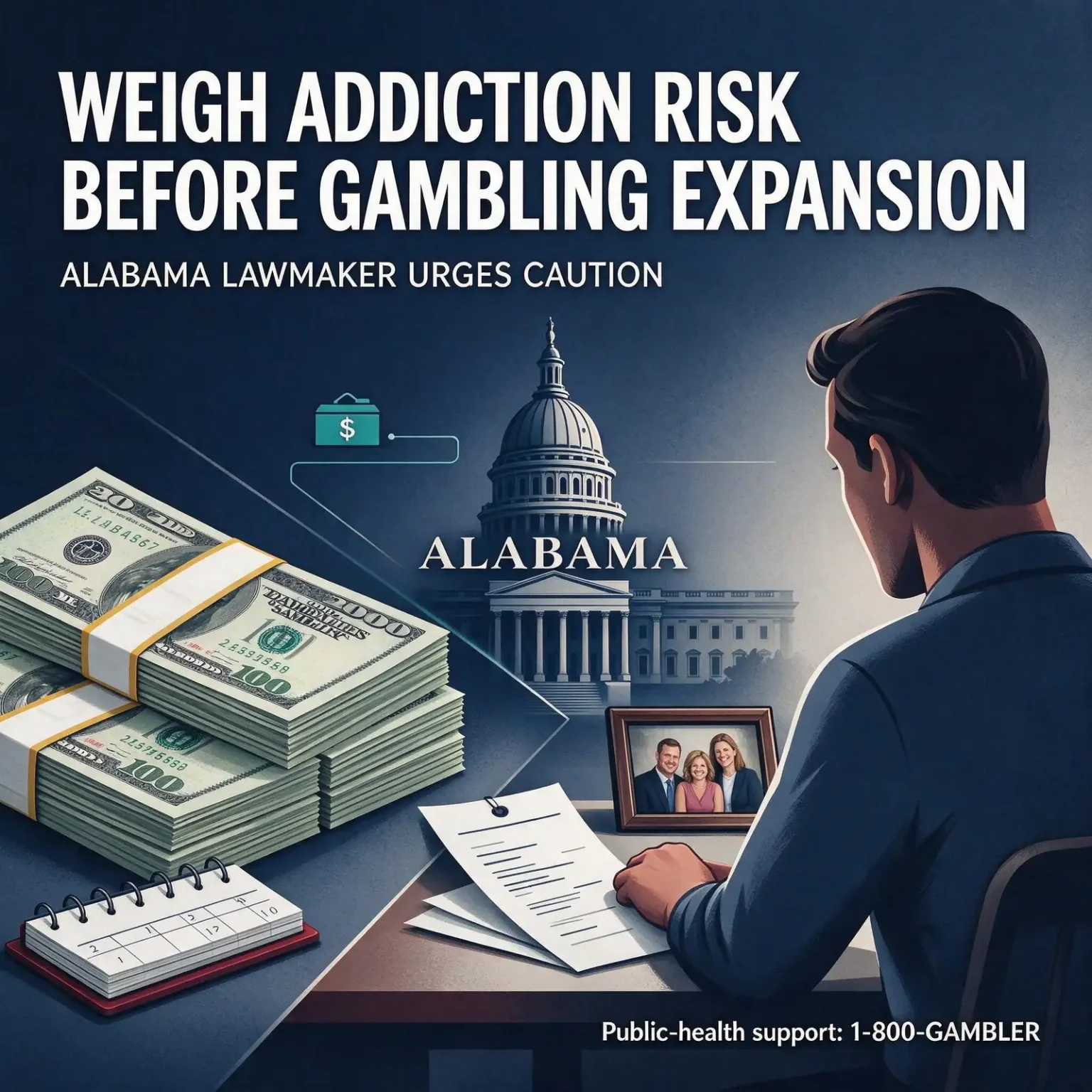
MOBILE, Ala. — With Alabama lawmakers expected to face another round of proposals on lotteries, casinos and sports wagering when the Legislature returns for its next regular session, one Republican member of the Alabama House of Representatives is urging colleagues to weigh the human cost before voting on any gambling expansion. Speaking on Monday, Nov. 23, the lawmaker argued that the potential for addiction outweighs the revenue that a legal gambling market could bring to the state.
The remarks add to a long-running debate in Montgomery over whether Alabama, one of only a handful of states without a state lottery, should change its constitution to allow more forms of legal betting. Supporters of expansion have pointed to new money for public needs and to dollars that Alabamians already spend across state lines. Opponents, including this lawmaker, have focused on problem gambling, family hardship and the size of government.
Addiction at the center of the lawmaker’s objection
The lawmaker’s chief concern is compulsive gambling. Citing the gambling policy report produced for the governor, the House member said that roughly 5% of people who begin gambling go on to become addicted. Whatever the Legislature ultimately decides, the lawmaker said, Alabama should put its name on something that benefits residents rather than knowingly offering a product that a share of the public will be unable to control.
The lawmaker described the consequences of that addiction in personal terms, saying that people caught in compulsive gambling can lose their homes and their families, and that the lawmaker personally knows people who have gone through that experience. The House member called on fellow legislators to search for whatever approach would be best for the state as a whole.
The Republican also made clear that the objection is rooted in personal moral conviction. The lawmaker said that, as a matter of conscience, gambling expansion is not something the lawmaker can support, and repeated a dislike for any policy that would lead people into addiction and damage their lives.
How the lawmaker views the money involved
Much of the push for expansion in recent years has centered on revenue, and the lawmaker addressed that argument directly. The House member went so far as to describe state-sanctioned gambling as a scam, explaining the label by pointing to how the money would flow. Under the kind of system being discussed, the lawmaker said, the state would keep a significant share of what players put into machines, which the House member put at about 30%, and would use that money to fund government.
The lawmaker outlined how portions of that money might be divided, mentioning possible uses such as roads, bridges, education and the general budget, with other slices going toward expanding government itself. The House member noted that revenue estimates presented to lawmakers had topped $1 billion, then posed a question to colleagues: with that much money on the table, what would the costs be?
The lawmaker also raised a philosophical objection, arguing that a new gambling structure would almost certainly enlarge state government, something the House member said they do not favor. The lawmaker asked whether such a plan is truly the best the state can do for its residents, and whether there is a way to address the issue without making government bigger.
National figures on gambling revenue and losses
To illustrate the scale of the industry, the personal finance company WalletHub has estimated that the gambling industry took in about $78.7 billion in revenue nationwide last year. The same analysis put total consumer gambling losses across the United States at more than $100 billion per year. Those figures are national and do not represent projections for any specific Alabama proposal.
Where Alabama stands now
Alabama’s constitution has long prohibited lotteries, which is why any statewide lottery or broad casino plan requires a constitutional amendment rather than an ordinary bill. Under the state’s amendment process, a proposed amendment must win the support of three-fifths of the members of both the House and the Senate before it can go to voters, who then decide the question at the ballot box. That supermajority requirement is one reason gambling proposals have repeatedly stalled even when they enjoyed broad support in one chamber.
Today, Alabama is among a small group of states, along with Alaska, Hawaii, Nevada and Utah, that do not operate a state lottery. Neighboring states take a different approach. Florida, Georgia and Tennessee all run lotteries, and Mississippi launched its own lottery in 2019 in addition to the casinos that operate on the Mississippi Gulf Coast and elsewhere in that state. For many residents of Mobile and Baldwin counties, lottery tickets and casino floors are a short drive away across the state line.
Within Alabama, the most visible form of casino-style gaming is offered by the Poarch Band of Creek Indians, which operates Wind Creek properties in Atmore, Wetumpka and Montgomery. Those facilities operate under federal tribal gaming law and offer electronic bingo-style machines rather than the full range of games found in Mississippi casinos. Separately, the state has seen years of legal fights over electronic bingo halls operating in various counties.
A history of close calls
The question has come before Alabama voters and lawmakers several times. In 1999, voters rejected a proposed education lottery in a statewide referendum. Since then, lottery and casino proposals have surfaced in the Legislature on a regular basis.
In late 2020, a study group appointed by Gov. Kay Ivey released a report on gambling policy that examined the potential revenue from a lottery, casino gaming and sports betting, along with the social costs associated with gambling, including problem gambling. That report has been a reference point for both sides of the debate ever since, and it is the document the House member cited when discussing addiction rates.
In 2021, the Alabama Senate approved a broad gambling proposal, but the measure did not advance in the House. In 2024, the dynamic reversed: the House passed a comprehensive package that would have authorized a lottery, a limited number of casinos and sports wagering. The Senate approved a narrower version, and a compromise worked out by negotiators from both chambers fell a single vote short of the three-fifths threshold needed in the Senate. That near miss is one reason the issue continues to come up as lawmakers plan for future sessions.
The arguments on each side
Supporters of expansion have generally made several points. They have argued that a lottery and regulated gaming could generate hundreds of millions of dollars a year for priorities such as education, and that Alabama residents already spend money on lotteries and casinos in neighboring states, sending tax revenue elsewhere. Some backers have also said that a regulated system with a state commission could bring oversight to gaming that currently operates in legal gray areas, and that residents deserve the chance to vote on the question themselves.
Opponents have raised a different set of concerns. Some, like the House member, point to the risk of addiction and the financial and family harm that can follow. Others question whether projected revenues would materialize as promised, how the money would be divided, and whether a new regulatory agency would expand state government. Moral and religious objections have also played a significant role in Alabama’s gambling debates over the years.
Both sides generally agree that any change of this size would ultimately go before voters, given the constitutional requirements, which means that a proposal approved by the Legislature would still need to win a statewide referendum.
Understanding problem gambling
Public health organizations describe gambling disorder as a recognized behavioral addiction. Warning signs commonly cited by treatment groups include needing to bet larger amounts to feel the same excitement, repeated failed attempts to cut back, chasing losses, lying to family members about gambling, borrowing money to cover debts, and gambling as a way to escape stress or other problems.
Anyone in Alabama who is worried about their own gambling, or that of a loved one, can call the national problem gambling helpline at 1-800-GAMBLER, which offers confidential support around the clock. Many treatment providers also recommend that families facing gambling-related debt seek help from a reputable nonprofit credit counseling agency before taking on new loans.
What comes next
Gambling legislation in Alabama typically starts as two linked bills: a proposed constitutional amendment that voters would decide, and an accompanying enabling bill that spells out how a lottery or gaming system would be regulated and how revenue would be distributed. Each must clear committees and floor votes in both chambers. Lawmakers often spend the months before a session discussing possible frameworks, and the details of any new proposal, including which games would be allowed, where they would be located and how proceeds would be spent, would shape how individual legislators vote.
For now, the House member’s remarks signal that at least some Republicans in the chamber intend to press questions about addiction, social costs and government growth whenever a new plan surfaces. Supporters, for their part, are expected to continue making the case for revenue and voter choice. Residents who want to share their views on the issue can contact their own state representative and state senator, whose contact information is available through the Alabama Legislature’s official website.
Once specific bills are filed, their text, sponsors and committee assignments will be posted publicly by the Legislature, giving residents on both sides of the issue a chance to review exactly what is being proposed before any vote takes place.