Aniah’s Law Dispute: Lawmaker Fires Back After Circuit Judge Calls Bail Measure Unconstitutional
A Republican lawmaker defended Aniah's Law and questioned a circuit judge's ethics after the judge criticized the pretrial detention law on social media as a violation of constitutional rights.
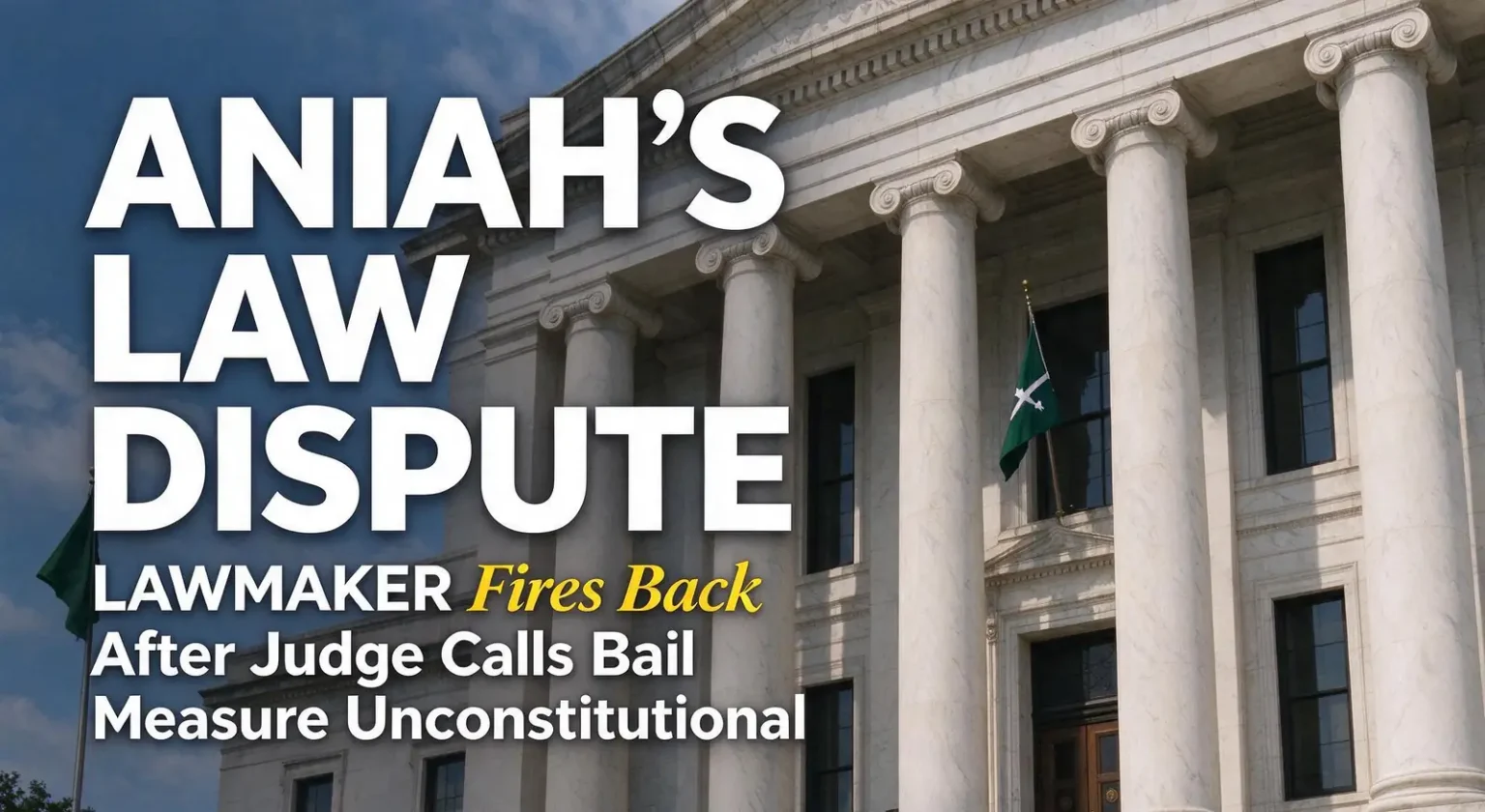
MOBILE, Ala. — A public clash between a sitting Alabama circuit judge and one of the Republican lawmakers who wrote Aniah’s Law has reopened debate over the state’s expanded power to hold violent-crime defendants without bail. After the judge criticized the law on social media as an attack on constitutional rights, the legislator went on the radio to defend it, argue that the judge misunderstands how it works and question whether a judge should be publicly attacking a law he is sworn to apply.
The Two Positions in Brief
| Issue | The judge’s view | The lawmaker’s view |
|---|---|---|
| Constitutionality | The law is a direct attack on individual rights protected by the Constitution and conflicts with the Eighth Amendment. | Lawmakers designed it carefully to comply with the Eighth Amendment, and it has not faced a legal challenge since taking effect. |
| Effect on defendants | It undermines rights guaranteed to the accused. | It does not change the presumption of innocence and does not require any judge to deny bail. |
How an Aniah’s Law Hearing Works
Much of the disagreement turns on how the law operates in a courtroom, and the legislator walked through the process step by step during his radio appearance.
- An arrest for a serious violent felony. The process applies only to people charged with violent Class A felonies, which include the state’s most serious violent offenses.
- A prosecutor’s request. If a prosecutor believes that releasing the defendant could endanger the community, the prosecutor may ask the court for an Aniah’s Law hearing.
- Judicial discretion. The judge may decline to hold the hearing. Even if a hearing takes place, the judge can still decide to set bond.
- Evidence at the hearing. The prosecutor presents evidence to support holding the defendant. None of that evidence can be used later at the defendant’s trial.
- A legal threshold. To keep a defendant jailed without bail, the prosecution must show at least one of three things: the defendant presents an immediate danger to others, presents a danger to himself or herself, or is likely to flee.
The lawmaker said the law gives judges and prosecutors one more option in their toolbox but leaves the presumption of innocence untouched. He said the law does not mandate that anyone be denied bail; it gives judges the opportunity to restrict defendants who are likely to pose a danger to the community or to themselves, or who are likely to flee.
The Constitutional Argument
The judge’s central claim is that Aniah’s Law runs afoul of the Eighth Amendment to the U.S. Constitution. That provision forbids bail and fines that are excessive, along with punishments that are cruel and unusual.
The legislator disputed that claim directly. He said he believes the judge may not have read the law closely and that the judge’s description of it is far off the mark. During the drafting process, the lawmaker said, he listened to judges, prosecutors and the families of crime victims, and the authors deliberately worked to make sure the law would stand on firm ground under the Eighth Amendment. He noted that the Constitution bars unreasonable bail, and he said he believes the law satisfies that standard, pointing out that no one has challenged it in court since it was put into effect and that voters approved it at the ballot box.
Questions About Judicial Conduct
The lawmaker went beyond the legal debate to criticize the judge personally. He questioned how a sitting circuit judge publicly attacking laws he is responsible for upholding could be consistent with the canons of judicial ethics, and he suggested that the judge could face complaints over his conduct. He also accused the judge of posting provocative statements online and claimed the judge has freed defendants who were later accused of violent offenses.
He closed with a pointed observation: in his view, the judge is exactly the kind of judge who ought to understand the law and put it to use.
Those statements are the lawmaker’s own assertions and opinions about the judge’s record and conduct.
How complaints about judges are handled in Alabama
Alabama judges are bound by the state’s Canons of Judicial Ethics, which govern conduct both on and off the bench. Complaints about a judge’s conduct are reviewed by the Judicial Inquiry Commission, which investigates and can bring formal charges before the Court of the Judiciary, the body that decides whether discipline is warranted. The Alabama State Bar handles discipline for attorneys in general.
Questions about how freely judges may comment on legislation are not new. Judges retain some rights of expression, but ethics rules generally caution them against public statements that could cast doubt on their impartiality or on how they would rule in cases that come before them. Where that line falls in a given situation is often a matter of debate.
Background: The Case Behind the Law
Aniah’s Law is named for Aniah Blanchard, a 19-year-old college student who disappeared from Auburn in October 2019 and was later found dead. The man charged in her abduction and killing had been free on bond at the time while awaiting trial on other violent charges, which prompted calls to give Alabama courts more authority to hold dangerous defendants before trial.
Before the change, the Alabama Constitution generally allowed judges to deny bail outright only in capital cases. The amendment known as Aniah’s Law, approved by Alabama voters in a statewide election, expanded that authority to a list of serious violent felonies, subject to a hearing and the standards described above.
Key Terms
Bail and bond: Bail is the set of conditions, often including a sum of money, that allows an arrested person to be released while the case is pending. A bond is the financial guarantee posted to secure that release. Most defendants in Alabama are entitled to bail, and Aniah’s Law carves out a limited exception for certain violent felonies after a hearing.
Class A felony: The most serious category of felony in Alabama short of capital offenses. A conviction can bring a sentence ranging from 10 years to 99 years or life in prison.
Presumption of innocence: The principle that a person charged with a crime is considered innocent until the prosecution proves guilt beyond a reasonable doubt at trial. Supporters of Aniah’s Law say a detention hearing does not affect that presumption because it decides only whether a defendant stays in custody before trial, not whether the defendant is guilty.
Eighth Amendment: The part of the Bill of Rights that prohibits excessive bail, excessive fines and cruel and unusual punishment. Courts have long held that the government may, in some circumstances, detain defendants before trial if the process includes proper safeguards.
A Broader Debate Over Pretrial Detention
The dispute reflects a national argument that has played out in courtrooms and legislatures for years. Supporters of expanded pretrial detention argue that it protects victims and communities from defendants who are likely to commit new violent crimes while awaiting trial. Critics, including some judges and defense attorneys, argue that holding people who have not been convicted strains the presumption of innocence and can be applied unevenly.
In Alabama, the issue carries particular weight in the Mobile area, where violent crime cases regularly come before circuit judges and where prosecutors have used Aniah’s Law hearings to seek detention in serious cases.
What Happens Now
The exchange is, for now, a war of words rather than a legal proceeding. Aniah’s Law remains in effect, and prosecutors can continue to request detention hearings in qualifying cases. Whether the judge’s constitutional objections lead to a formal court challenge, or whether the lawmaker’s ethics concerns lead to any complaint, remains to be seen.
What is clear is that the debate over how Alabama balances public safety with the rights of the accused is far from settled, and the next legislative session, which begins Feb. 2, 2027, could bring renewed attention to how the law is working.