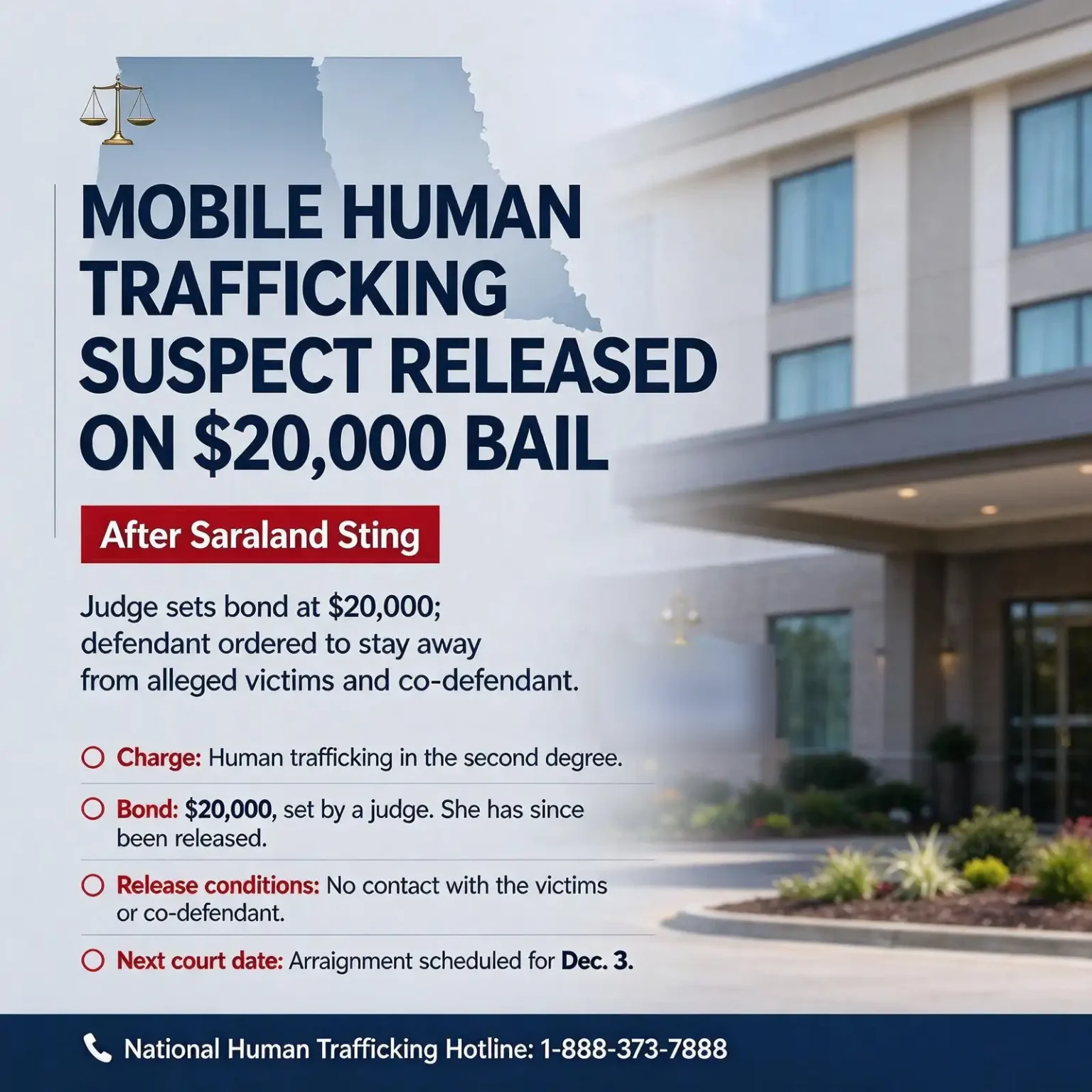
MOBILE, Ala. — A Mobile woman accused of second-degree human trafficking is out of custody after a judge set her bond at $20,000 and ordered her to stay away from both the alleged victims and the man charged alongside her. The Mobile human trafficking case grew out of an undercover operation at a Saraland hotel in October and an earlier arrest of a man police describe as the head of the operation.
Her arraignment is scheduled for Dec. 3. Her co-defendant is due in court a week later, on Dec. 10, for a preliminary hearing. Neither defendant has been convicted, and this article does not name them.
Update: Investigators Describe the Ring’s Alleged Structure
A search warrant affidavit filed in the case offers more detail about how investigators say the operation worked. During the Oct. 21 undercover meeting at the Saraland hotel, investigators said the man now accused of leading the ring gave the woman a ride to the hotel. When officers spoke with him, he maintained that he had only given her a ride and was unaware of what she did for money, according to court filings.
The woman later gave investigators a different picture. According to the affidavit, she said the man managed the online advertisements and served as the point of contact with customers for both her and another woman, and that he took nearly all of the money earned from their appointments. Officers also took eight smartphones out of the car he had been driving, investigators said.
Court records show the man faces a first-degree human trafficking charge, the more serious of the two degrees under Alabama law, while the Mobile woman faces the second-degree count. Police said the investigation remains open. The case is one of numerous anti-trafficking operations Alabama law enforcement agencies have carried out over the past two years, many of them built around undercover stings that have led to dozens of arrests statewide.
Key Facts at a Glance
- Charge: Human trafficking in the second degree.
- Bond: $20,000, set by a judge. She has since been released.
- Release conditions: No contact with the victims or with her co-defendant.
- Her next court date: Arraignment on Dec. 3.
- Co-defendant: A man police identified as the person suspected of running the operation; preliminary hearing set for Dec. 10.
- Undercover operation: Oct. 21, at a hotel in Saraland.
How Investigators Reached Her
Police said the case did not begin with her. Investigators first focused on the man they now accuse of running the ring. After speaking with several victims, officers said they identified him as its alleged leader.
Part of that work involved an undercover investigator. Police said the investigator answered an advertisement posted online and set up a meeting with a woman at a hotel in Saraland on Oct. 21. Investigators have not publicly detailed everything that happened at that meeting.
Once the man was arrested, police said, information gathered in connection with his arrest pointed them toward the Mobile woman, which led to the second-degree trafficking charge against her. Authorities have not publicly described what specific role they believe she played.
What Second-Degree Human Trafficking Means
Alabama divides human trafficking into two degrees. First-degree human trafficking generally covers knowingly subjecting a person to labor servitude or sexual servitude, or doing so with a minor, and it is a Class A felony, the most serious category short of a capital offense.
Second-degree human trafficking is broader. It generally applies to a person who knowingly benefits, financially or by receiving something of value, from taking part in a venture that has engaged in trafficking, or who knowingly recruits, transports, harbors, provides or obtains another person for the purpose of labor or sexual servitude. It is classified as a Class B felony, which in Alabama carries a possible prison sentence of two to 20 years upon conviction.
The difference in degree helps explain why the two defendants in this case are at different points. Prosecutors often charge people they view as organizers differently from those accused of supporting roles, though the final charges in any case can change as evidence is reviewed.
Understanding the Bond Decision
The Alabama Constitution generally guarantees the right to bail before trial, with exceptions. In 2022, voters approved Aniah’s Law, which allows judges to deny bail for a list of the most serious violent offenses, including first-degree human trafficking. The charge in this case is second-degree, which is not on that list, so the question before the judge was how much bond to require and what conditions to attach.
Bond is not a penalty. Its purpose is to make sure a defendant returns to court and to protect the public and any victims while the case is pending. Conditions like the no-contact order in this case are a common tool. If a defendant violates those terms, a judge can revoke bond and order the person back to jail.
In Alabama, a defendant can usually satisfy a bond in one of a few ways: by posting the full amount in cash, by pledging property, or by hiring a licensed bail bonding company, which typically charges a nonrefundable fee and guarantees the full amount to the court. A cash bond is generally returned at the end of the case if the defendant makes every required court appearance. Release on bond does not resolve or weaken the charge; the case continues on its normal schedule.
Barring contact with a co-defendant is also routine in multi-defendant cases. It is intended to prevent the people charged from coordinating their accounts or pressuring witnesses before the case is heard.
The Road Ahead in Court
The two defendants are scheduled for different types of hearings, each with its own purpose:
- Arraignment (Dec. 3): At an arraignment, a defendant is formally told of the charges and enters a plea. It is typically a brief hearing.
- Preliminary hearing (Dec. 10): At a preliminary hearing in district court, a judge hears evidence to decide whether there is probable cause to believe a crime occurred and that the defendant committed it. If so, the case can be sent to a grand jury.
- Grand jury: A Mobile County grand jury reviews felony cases and decides whether to return an indictment, which moves a case to circuit court for trial or other resolution.
Both defendants are presumed innocent unless proven guilty beyond a reasonable doubt.
Human Trafficking on the Gulf Coast
Human trafficking investigations frequently involve online advertising, which is why undercover responses to ads are a common investigative technique. Law enforcement agencies across Alabama have worked to build cases against trafficking networks, and the state operates an Alabama Human Trafficking Task Force that brings together law enforcement, prosecutors, service providers and advocates.
Advocates note that trafficking victims often do not see themselves as victims at first, may fear law enforcement or may be controlled through threats, debt or dependency. That is part of why investigators in these cases emphasize speaking directly with the people involved, as police said they did here.
Saraland, where the undercover meeting took place, is a city in northern Mobile County along Interstate 65 and part of the greater Mobile area.
How to Get Help or Report a Tip
Anyone who believes they or someone they know is being trafficked can contact the National Human Trafficking Hotline at 1-888-373-7888, or text 233733. The hotline is confidential and available around the clock, and it can connect callers with local services. Anyone in immediate danger should call 911.
Common warning signs that advocates encourage the public to watch for include a person who appears to be controlled by someone else, does not hold their own identification documents, seems fearful or coached when speaking, or shows signs of physical abuse.
The Bottom Line
A Mobile woman charged with second-degree human trafficking has been released on a $20,000 bond with orders to avoid the alleged victims and her co-defendant. Investigators say they found her through information tied to the arrest of a man they accuse of leading the ring, a case that included an undercover meeting at a Saraland hotel on Oct. 21. She returns to court for arraignment Dec. 3, and the man is set for a preliminary hearing Dec. 10.