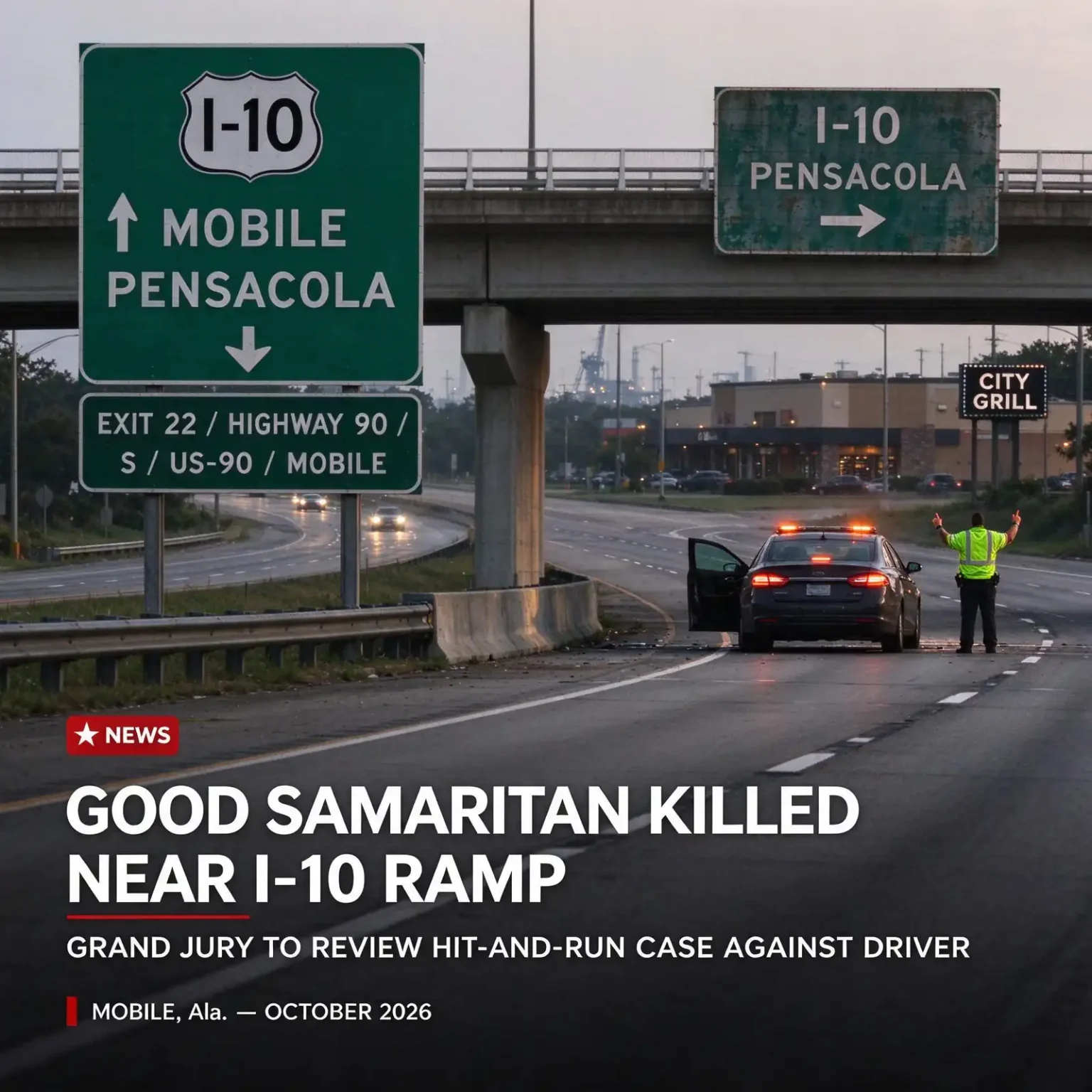
MOBILE, Ala. — The driver accused of fleeing after a deadly crash that killed a Good Samaritan near the Interstate 10 and Highway 90 interchange will have the case weighed by a Mobile County grand jury. A judge ruled that prosecutors presented enough evidence for the deadly hit-and-run case to move forward, sending it to the panel that will decide whether to formally indict.
The defendant faces two felony charges connected to leaving the scene of a crash that involved injury and death. The person killed in the October crash had pulled over to help another motorist moments earlier.
The Case in Brief
- Court action: A judge found sufficient evidence to send the case to a grand jury
- Charges: Two felony counts tied to leaving the scene of a crash involving injury and death
- When the crash happened: October 2026
- Where: Highway 90 South, at an exit ramp from Interstate 10 in Mobile
- Who died: A person who had stopped to assist a driver who had crashed off the ramp
- Current conditions: Court documents show the defendant is allowed to work offshore within Alabama waters
- Next step: A grand jury will decide whether to return an indictment
Stopping to Help
The fatal sequence began with a separate wreck. A driver went off an Interstate 10 exit ramp and ended up on Highway 90 South, police said. The victim pulled over to help that driver, the kind of instinctive act that many motorists perform without a second thought.
While the victim was assisting, another vehicle struck the cars already involved and hit the Good Samaritan, investigators said. The victim was taken to a hospital and later died.
Police allege that the driver of that vehicle did not stay at the scene. That accusation is the basis for the charges now headed to the grand jury.
What the Judge Decided
The ruling came after a hearing in which a judge reviewed the evidence gathered so far. In Alabama, this type of proceeding, commonly called a preliminary hearing, asks a narrow question: whether there is probable cause to believe a crime was committed and that the defendant committed it.
Probable cause is a far lower standard than the proof beyond a reasonable doubt required for a conviction at trial. A judge who finds probable cause is not declaring the defendant guilty. The ruling simply means the case has enough support to continue to the next stage.
Preliminary hearings also give the defense an early look at the prosecution’s evidence and a chance to question witnesses, often the investigating officers, before the case reaches a grand jury.
How a Grand Jury Works
Felony charges in Alabama generally must go through a grand jury before a case can proceed to trial in circuit court. A grand jury is a panel of citizens drawn from the county who meet privately to review evidence presented by prosecutors.
Unlike a trial jury, a grand jury does not decide guilt or innocence. Its job is to determine whether the evidence is strong enough to formally charge someone. If the panel agrees that it is, it returns an indictment, sometimes called a true bill. If not, it can return a no bill, which typically ends that set of charges unless prosecutors later bring new evidence.
Grand jury proceedings are confidential. The public usually learns the outcome only when indictments are made public or when a case is resolved without one. The timing depends on the court’s calendar and how soon prosecutors present the case.
Understanding the Charges
Alabama law requires a driver involved in a crash that injures or kills someone to stop at the scene, provide identifying information and offer reasonable help to anyone who is hurt, including arranging for medical care when it is needed. Leaving without meeting those obligations is a crime, and when a crash causes injury or death, the offense is a felony.
A leaving-the-scene charge focuses on what a driver does after a collision, not necessarily on who caused it. The question is whether the driver stayed and met the duties the law places on anyone involved in a serious collision.
The two charges in this case relate to a crash that involved both an injury and a death. The defendant has not been convicted of any crime and is presumed innocent unless proven guilty in court.
Working Offshore While the Case Proceeds
Court documents show the defendant has been permitted to work offshore, provided that work stays within Alabama waters. Judges commonly set conditions for defendants awaiting trial, and those conditions may limit travel or require a person to stay within a set area.
A Busy Stretch of Road
Interstate 10 is the main east-west interstate along the Gulf Coast, carrying heavy commuter, commercial and tourist traffic through Mobile on its way between Mississippi and Baldwin County. U.S. Highway 90 is one of Mobile’s major surface routes and connects with the interstate at several points. Exit ramps where the two meet can see high speeds, merging traffic and limited room on the shoulder, conditions that make stopping near a crash especially risky.
Staying Safe When Stopping to Help
Traffic safety officials regularly encourage people who want to help at crash scenes to protect themselves first. Common recommendations include:
- Call 911 first so trained responders are on the way
- Park well away from moving traffic and turn on hazard lights
- Stay off the travel lanes and away from the space between vehicles whenever possible
- Use lights such as a phone flashlight to remain visible, especially at night or in poor weather
- Do not move injured people unless they face immediate danger, such as fire
For drivers approaching a crash, the message is equally simple: slow down, watch for people outside vehicles and give stopped cars and emergency crews as much room as safely possible.
Questions Still Open
Several details of the case have not been laid out publicly. Among them:
- The exact date and time of the October crash and which I-10 exit ramp was involved
- How investigators identified the driver they say left the scene
- The condition of the motorist whose initial wreck drew the victim to stop
- Whether any additional charges could be considered as the case develops
Answers to some of those questions may emerge as the case moves through the court system and records are filed.
What Happens Next
The case will now wait for a Mobile County grand jury. If jurors return an indictment, the defendant would be arraigned in circuit court, where formal charges are read and a plea is entered. The case would then move toward pretrial hearings and, unless it is resolved another way, a trial.
If the grand jury declines to indict, the charges would not move forward on the current evidence. Either way, the decision will shape what comes next for a case rooted in an act of kindness that ended in a death on a Mobile highway.