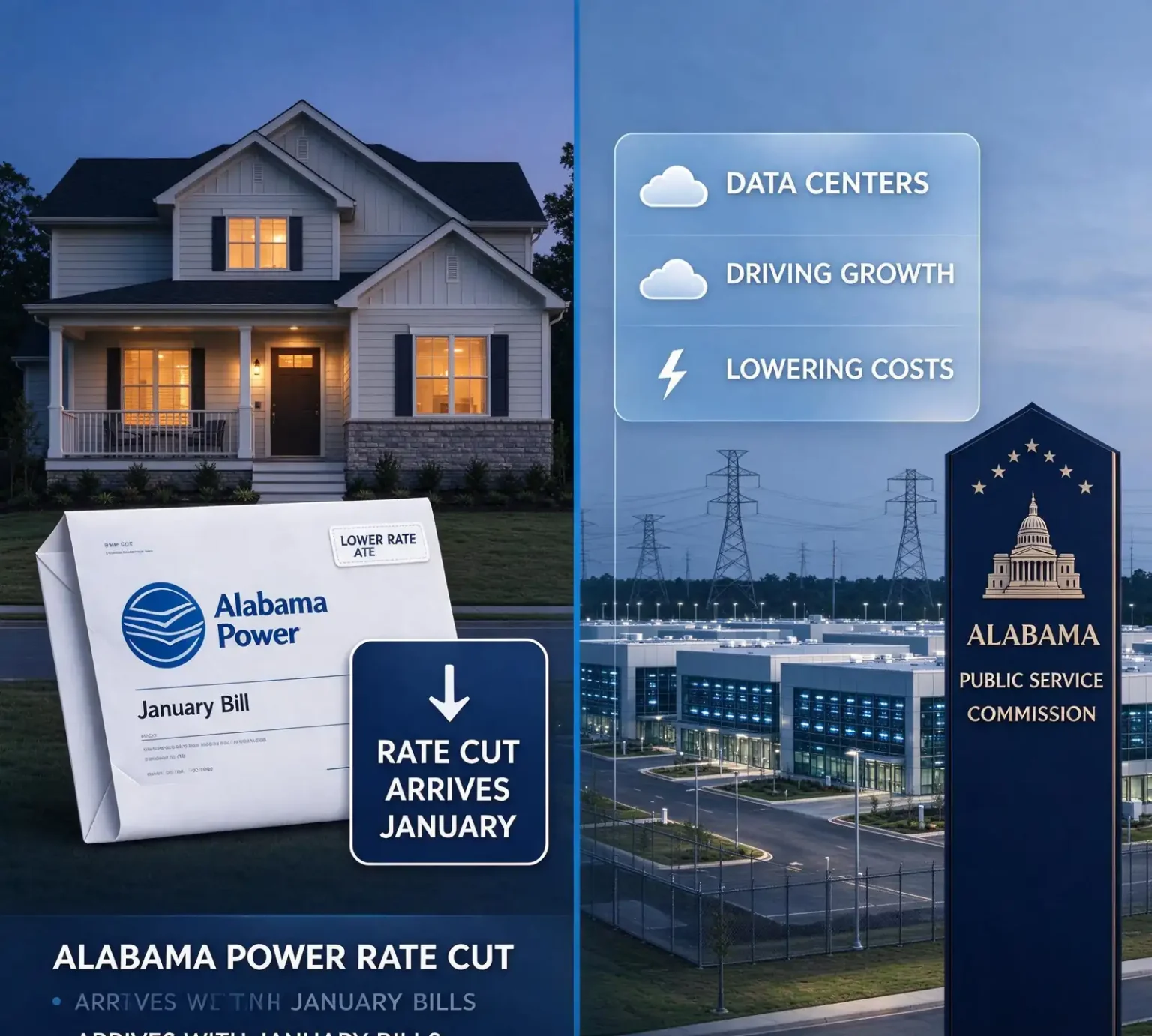
MONTGOMERY, Ala. — Households served by Alabama Power should see somewhat smaller electric bills starting in January, and state leaders say a second round of savings could follow if lawmakers agree to scrap the state tax on home utility bills. The Alabama Power rate cut, filed Friday, Nov. 20, with the Alabama Public Service Commission, would lower what customers pay by a combined $160 million over the course of 2027.
The utility said the reduction is made possible mainly by money it expects to collect next year from very large data centers connecting to its system. At the same time, the incoming state administration and two Republican legislators from Mobile County are preparing a bill for the 2027 legislative session that would remove the tax Alabama charges households on their power, water and natural gas service.
What Customers Can Expect
The amount any one household saves will depend on how much electricity it uses. Alabama Power offered several examples comparing the new rates with current ones:
- 750 kilowatt-hours a month: about $40 saved per year
- 1,000 kilowatt-hours a month: a little more than $50 saved per year
- 2,000 kilowatt-hours a month: roughly $106 saved per year
A kilowatt-hour is the standard unit on a power bill, equal to running a 1,000-watt appliance for one hour. Estimates from Duke University researchers put the typical Alabama home at about 1,143 kilowatt-hours a month, which is higher than the national average. Long, humid summers that keep air conditioners running and widespread use of electric heat pumps help explain why Southern households tend to use more power than homes in milder climates.
Based on the company’s examples, a household near the state average could expect annual savings somewhere between the $50 and $106 figures, closer to the lower end. The new rates are scheduled to show up beginning with January bills.
Why Rates Are Going Down
The utility tied the cut to growth across the state, particularly to large-load customers such as data centers that require enormous, around-the-clock supplies of electricity. Company leadership said customers will see their rates drop in January as a direct result of that growth.
Alabama Power also explained that the company’s contracts with large data centers require those customers to cover the full cost of serving their electricity needs. Because the data centers carry those costs themselves, the company said, the added revenue can be used to ease the burden on everyone else.
The filing goes to the Alabama Public Service Commission, the elected three-member body that regulates investor-owned utilities in the state, including the rates Alabama Power may charge. Alabama Power, a subsidiary of Atlanta-based Southern Company, serves much of the state, including Mobile and other parts of south Alabama.
The Proposed Tax Repeal
A separate effort could reduce bills further. Alabama currently adds a 4 percent tax to household bills for electricity, water and natural gas. The legislation under development would eliminate that charge for residential customers.
Here is what full repeal would mean for a typical bill, assuming the measure removes the tax entirely:
- A household with a $200 monthly electric charge before taxes would save $8 a month
- Over a year, that adds up to $96
- Savings would apply to residential natural gas and water bills as well, since the same tax covers those services
The incoming administration has said its team has already drafted the bill and asked two Mobile County Republicans, one in the state Senate and one in the House, to sponsor it when lawmakers meet in 2027. The two legislators said they have held numerous meetings with transition staff to have the measure ready to file.
One of the sponsoring lawmakers said the tax ultimately falls on customers rather than on the power companies, so removing it would pass the savings straight to ratepayers without requiring anything of the utilities. He added that Alabama has ranked among the Southeastern states with the highest electric rates for several years and that customers have earned some relief. He also said the idea has been discussed for some time.
The second sponsor said Alabamians are paying too much simply to keep their lights on, and that no family should have to choose between paying the power bill and buying groceries. He said eliminating the tax would make a real difference for working people across the state.
The company’s rate reduction stands on its own. It is not contingent on lawmakers repealing the residential utility tax, so customers will see the January decrease whether or not the bill passes.
Data Centers Take Center Stage
The announcement lands in the middle of a broader debate in Alabama over the rapid arrival of data centers, the large computing facilities that power cloud services and artificial intelligence. Critics in many states have worried that such projects could drive up costs for ordinary customers by straining the electric grid and water supplies.
The incoming administration has argued the opposite, saying Alabama Power’s move shows that data center growth can bring power prices down while generating new money for schools, hospitals and police agencies in local communities. In a statement Friday, the incoming administration characterized the $160 million reduction as consistent with what the transition team had predicted and described it as only a first step toward lower utility costs.
The incoming administration also said it had suggested the reduction to Alabama Power months ago and that the change should have come sooner. Even so, it praised the company’s leadership for agreeing to a move that gives up some potential revenue and that it said will help Alabama families. Transition officials said they are also in talks with other electricity providers around the state, hoping to persuade them to take similar steps.
The plan is not only about relief for households. The incoming administration has pledged to:
- End certain tax breaks currently available to data centers
- Raise property taxes on data center developments
- Make data center developers cover every dollar of the transmission lines, substations and water infrastructure required by their projects
The Mobile County lawmakers said they support that approach. One of them said the goal is to lower electricity costs for homes while making sure data centers pay their fair share for the infrastructure built to serve them. He said new development should cover its own costs and suggested that as utilities supply more power overall, rates should come down for all customers. He also said he appreciated the incoming administration’s willingness to have new development help pay for upgrades to the state’s electric grid.
Lower power bills were one of the priorities laid out in the governing agenda the incoming administration released in October.
What Happens Next
Several steps lie ahead before Alabama households feel the full effect of both proposals:
- Rate filing: Alabama Power’s request is before the Public Service Commission, with the reduction set to take effect on January bills.
- New administration: The state’s next governor is scheduled to be sworn in Jan. 18, 2027.
- Legislative session: Lawmakers return to Montgomery in early February for the 2027 regular session, when the utility tax bill is expected to be filed.
- Debate and votes: Like any tax change, the repeal would need to pass both the House and Senate and be signed into law before customers would see the savings on their bills.
If both the rate decrease and the tax repeal go into effect, a household with a $200 monthly electric bill could see the combined benefit of lower base rates plus the $96 a year that eliminating the 4 percent tax would deliver. For now, the January rate reduction is the piece that is already on its way to customers.
Understanding the Utility Tax
Because the tax is figured as a percentage of each bill, the dollar amount a household pays rises and falls with its usage. A family whose electric charge climbs during a hot summer month pays more tax that month, and a lighter bill in spring or fall means a smaller tax. Repealing it would therefore help most in the months when bills are highest. Under the proposal, the change would apply to residential customers, which is where the sponsors have focused their efforts.